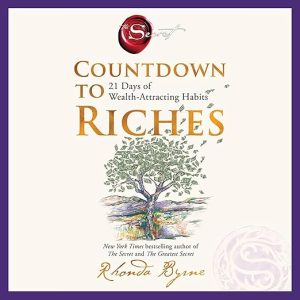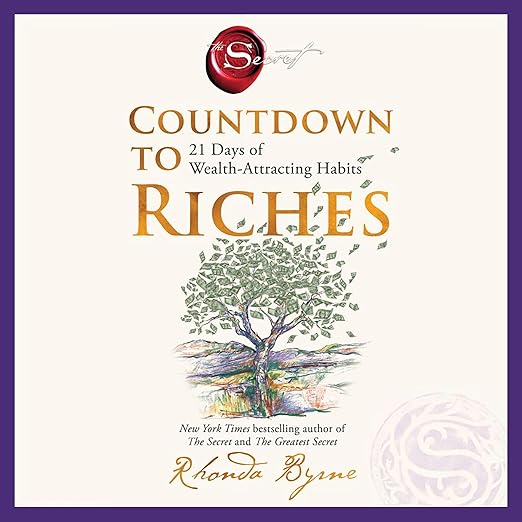
Twenty-one days is the structure Rhonda Byrne builds this entire audiobook around, and my verdict going in is straightforward: anyone who found real value in The Secret already knows whether Countdown to Riches is for them, because Byrne is not trying to convert skeptics with this newest addition to her catalog. Nearly two decades after The Secret turned law-of-attraction thinking into a publishing phenomenon, Byrne returns to the same core framework specifically for money, arguing across those twenty-one structured days that financial struggle is 'caused by one thing, our thoughts,' and that a 'scarcity mindset' is the real obstacle standing between most people and the life they want. That defined daily structure, rather than one long undifferentiated argument, is the book's most practical improvement over her earlier titles.
Our Take on Countdown to Riches
Byrne narrates her own material, as she has across her prior audiobooks, and self-narration remains the right call for this kind of first-person conviction-based content. A hired narrator reading Byrne's specific claims about mind and money would risk sounding like a script; Byrne reading her own words sounds, at minimum, like someone who believes every sentence she wrote, which is the entire product being sold here. Her pacing across eleven-plus hours stays warm and unhurried, closer to a guided practice than a lecture, which suits the twenty-one-day structure's built-in repetition.
The synopsis lays out its promise as four discrete bullet points, find twenty-one days of practices, unlock the power of the mind, adopt new wealth-sustaining habits, and learn profound wisdom about how the world really works, and that structure itself signals the book's ambition: this is pitched as equal parts practical program and worldview shift, not simply a habit tracker with affirmations attached. Byrne clearly wants listeners to come away with both a changed daily routine and a changed underlying belief system, which is a heavier lift than most twenty-one-day programs attempt.
Each of the twenty-one days centers one clear idea rather than layering multiple concepts at once, a structural discipline that reviewers specifically credit for making the material feel 'simple to stay consistent' rather than overwhelming. That daily-dose structure also means Countdown to Riches works better as an actual practice than as a single continuous listen; the content is built for returning to one day at a time over three weeks, not consuming start to finish in a single sitting the way a narrative audiobook would be.
Byrne's earlier titles, The Power and The Greatest Secret in particular, each took the original Secret framework in a slightly different direction, relationships and gratitude for the former, a more overtly spiritual reading for the latter. Countdown to Riches continues that pattern of taking one consistent core idea and refracting it through a new specific lens, here money and daily practice, rather than introducing a genuinely new philosophy with each release.
The Strengths
Byrne's own narration history is worth noting for anyone deciding whether to listen versus read: she has narrated her own audiobooks consistently since The Secret first arrived in audio form, and that continuity means longtime listeners already know exactly what register to expect, warm, deliberate, unhurried, treating each sentence as worth sitting with rather than rushing toward the next point.
The attached reviews are enthusiastic almost uniformly. One longtime reader calls it 'one of her most powerful books yet' after following Byrne's work 'for over a decade,' explicitly ranking it alongside The Secret, The Power, and The Greatest Secret as 'the perfect evolution' of her core thesis. Another describes the daily habits as 'short, easy to follow, and don't feel overwhelming at all,' crediting the structure with helping them 'stay more intentional about my money and mindset.' A third calls the book simply inspiring and helpful, noting they bought a copy for themselves and gifted several more.
Context matters here: The Secret is not a minor prior credit, it became one of the best-selling self-help phenomena of the past two decades, spawning a documentary film and a publishing category's worth of imitators. Countdown to Riches arrives as Byrne's attempt to apply that same foundational framework with more structure and specificity than her earlier, more diffuse titles offered, narrowing the famously broad ask-believe-receive formula down to one domain, money, and one defined timeframe, twenty-one days, rather than leaving application entirely up to the reader.
A supplemental enhancement PDF accompanies the audiobook, and for a program built around daily practices rather than pure narrative, that companion document is worth downloading rather than treating as optional extra. Listeners who want to actually track twenty-one days of practice, not just absorb the philosophy passively, will get more out of pairing the audio with the printed structure than listening alone.
Weak Spots in Countdown to Riches
Because the twenty-one-day structure assumes sequential daily engagement, listeners who prefer consuming self-help audiobooks in one or two long sittings should adjust expectations; Countdown to Riches is built to be paced out, and rushing through all eleven-plus hours at once works against the spaced-repetition logic Byrne's own framework depends on for the mindset shift to actually take hold.
This is shelved under religion-spirituality for good reason, and listeners expecting conventional personal-finance content, budgeting frameworks, investment strategy, debt payoff plans, will not find any of that here. Byrne's argument operates entirely at the level of mindset and belief, not mechanics, which is either exactly what a listener wants or a fundamental mismatch depending on what problem they are trying to solve with this audiobook.
Longtime Byrne readers should also know this is not a radical departure from her established framework; the core law-of-attraction logic from The Secret carries through largely intact, applied here specifically to wealth rather than restated as new philosophy. Listeners hoping for a genuinely new argument, rather than a focused twenty-one-day application of a familiar one, may find less novelty here than the marketing around a new release implies.
The book's insistence that a scarcity mindset is learned rather than realistic runs directly counter to how most financial advice treats caution around money, as prudent rather than as an obstacle to overcome. That inversion is either liberating or uncomfortable depending on a listener's relationship with financial anxiety, and Byrne does not spend much time acknowledging the argument's tension with genuinely precarious financial circumstances.
Who Should Listen to Countdown to Riches
Recommended for existing Byrne readers looking for a more structured, actionable follow-up to The Secret, and for anyone drawn to mindset-based approaches to money who wants a defined twenty-one-day practice rather than an open-ended philosophy to interpret on their own. Listeners already keeping a gratitude or manifestation journal will find the twenty-one-day structure slots naturally into that existing practice.
Skip it if you are looking for evidence-based personal finance guidance or have never connected with Byrne's law-of-attraction framework in her earlier books; nothing about this newest audiobook is likely to change a skeptic's mind.