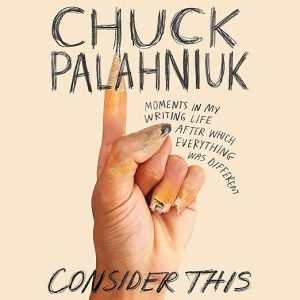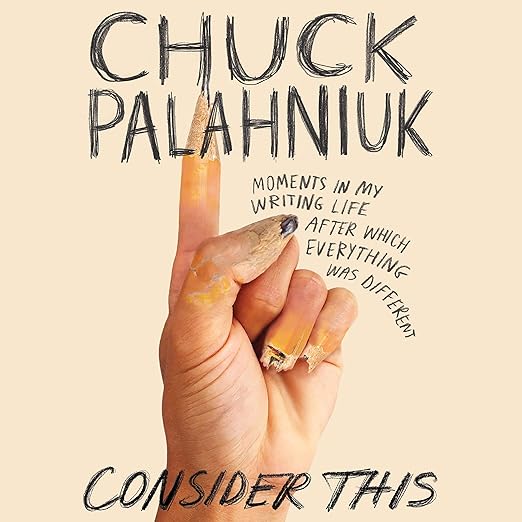
Chuck Palahniuk's workshop at Powell's Books in Portland was standing-room-only before he was famous. Consider This, narrated by Palahniuk himself, is the distillation of what that workshop taught and what the decades of craft essays on LitReactor worked toward: a coherent theory of what he calls Dangerous Writing, which holds that fiction should function as a tool to engage readers in discussions, to touch buried emotional material, to create an experience that outlasts the reading. This audiobook runs five hours and fifty-two minutes and is structured as a hybrid, part memoir of a writing life, part practical handbook, part love letter to the community of writers and booksellers that kept Palahniuk engaged with the form long after commercial success could have made that engagement optional.
One reviewer noted that this is not a work of fiction, a clarification that matters because Palahniuk's prose style is so recognizable that even his nonfiction can feel like the opening of a novel. Consider This is energetic and warm in the same way his LitReactor essays were, but the organizing principle is generosity rather than provocation. He is here to give something away, to share techniques, anecdotes, principles, and the kind of street-level MFA advice that is harder to find than it should be in a world full of expensive graduate programs that teach craft at considerable remove from the actual difficulty of writing something that matters to a reader.
The Best Parts of Consider This
Self-narration is the correct choice for this material, and Palahniuk is a better narrator than many writers who attempt it. He reads with a directness that strips any sense of performance from the delivery. When he describes scenes from workshops he attended with Tom Spanbauer, the founder of Dangerous Writing, he reads those recollections as if he is telling them to you specifically, not performing them for an audience. That intimacy is what the book's structure demands, and it is what Palahniuk consistently provides across the nearly six-hour runtime. The voice that comes through is recognizable, frank, and oddly reassuring in its insistence that writing well is a learnable practice rather than an innate gift that arrives or does not.
The practical content here is worth dwelling on. The book draws on what Palahniuk calls a kitchen-table MFA, a collection of principles about subtext, status dynamics, the use of physical sensation as a vehicle for emotional revelation, and the mechanics of pacing that Palahniuk accumulated from Spanbauer and from the evolving circle of writers he has worked with over decades. These are not abstract principles. They are illustrated with specific examples from classic literature and from Palahniuk's own novels, which means listeners who have read Fight Club, Choke, Lullaby, or any of the subsequent books will find their understanding of those works significantly enriched by hearing the craft decisions behind the effects they remember.
One reviewer described this as practical advice and concrete examples from beloved classics and Palahniuk's own books, combined with anecdotes and postcards from the road. That structure, theory grounded in specific examples, is what distinguishes a genuinely useful craft book from the many that offer principles without proof. Palahniuk proves his principles constantly, which is itself a form of modeling: he does in the writing what he is telling you to do, and the convergence of form and content is one of the book's quieter pleasures across the full runtime.
Before You Commit to Consider This
Listeners expecting a conventional craft guide organized by chapter-headed topics will need to adjust their expectations. Consider This is organized more associatively than systematically. Palahniuk moves between memoir, workshop anecdote, craft principle, and literary example in a way that mirrors how a skilled writer actually thinks about fiction, laterally and by accumulation rather than in linear sequence. That structure rewards re-listening in a way that more conventionally organized craft books do not. The first pass gives you the framework; the second gives you the details you missed because you were still orienting to Palahniuk's distinctive approach.
The Dangerous Writing philosophy has a specific ideological dimension worth naming. Palahniuk believes fiction should be used to generate productive discomfort, to push readers toward awareness of buried emotional material, to create an experience that cannot be consumed passively and forgotten. Writers who are comfortable in more decorative or entertainment-focused traditions of fiction may find this prescription too narrow. For writers who feel that fiction should be doing more work than it typically does, the framework is energizing rather than prescriptive.
Should You Listen to Consider This?
Writers at any stage of their development who want to understand how Palahniuk's approach to fiction actually works will find this audiobook essential. The content is particularly valuable for short story writers, since many of the specific craft principles are rooted in short fiction mechanics before being extended to novel structure. Fans of Palahniuk's novels who want to understand the method behind the effect will also find it illuminating as a companion to his fiction, changing how they read the techniques operating in the work they have already encountered.
Readers with no interest in the craft of writing and no particular connection to Palahniuk's work will find less to hold onto here. Consider This is a writer's book, addressed to writers, shaped by decades of workshop experience. It is not a general-interest memoir, though the anecdotes are strong enough that readers with broader literary interests will still find value in it even without an active writing practice of their own.
Before You Press Play
- Narrator: Chuck Palahniuk reading his own work is the only version of this audiobook that makes complete sense. His direct, undecorated voice matches the philosophy that dangerous writing should be felt rather than performed.
- Subjects: Craft of dangerous writing, the workshop as creative ecosystem, storytelling as deep reader-engagement.
- Tone: Intimate and generative, like sitting in Palahniuk's kitchen while he talks through everything he learned.
- Bottom line: Essential listening for writers who want to understand how fiction creates lasting impact, delivered by the author with the authority of someone who has practiced and taught these principles for decades.