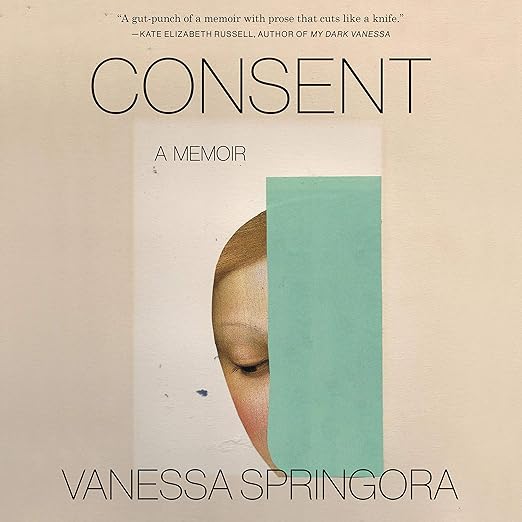
Vanessa Springora was thirteen when her relationship with one of France's most celebrated writers began, and this audiobook spends four hours and thirty-two minutes asking the question the French literary establishment spent thirty years avoiding: whose story was this ever actually about? Consent, translated from the French by Natasha Lehrer and read by Anne-Marie Piazza, is Springora's own reclamation of that story, published at the end of 2019 as the reckoning around powerful men gave a generation of women, including a woman in her forties now directing one of France's leading publishing houses, reason to finally speak.
A Molotov Cocktail Flung at the Establishment
The New York Times called Consent 'a Molotov cocktail, flung at the face of the French establishment,' and that description holds up because Springora isn't just recounting what happened to her, she is indicting the entire cultural machinery, publishers, critics, a permissive literary scene, that allowed a fifty-year-old, well-connected author to pursue a thirteen-year-old girl in plain sight for years. The synopsis notes she draws parallels between children's fairy tales, French history, and her own life, a structural choice that turns personal memoir into cultural argument without losing the intimacy of first-person testimony.
What separates this from a straightforward survivor's account is the control of the prose itself. The New Yorker praised how 'her sentences gleam like metal,' each chapter snapping 'shut with the clean brutality of a latch,' and The Times of London called the book 'rapier-sharp, written with restraint, elegance and brevity.' That combination of restraint and fury is the book's defining quality: Springora doesn't need to raise her voice to make the indictment land.
The fairy tale framing the synopsis mentions isn't incidental decoration. Fairy tales are full of predatory older figures and vulnerable young girls dressed up as morality or magic, and Springora uses that familiar structure deliberately, forcing a reader to notice how culture has always had ready-made stories for exactly this dynamic without ever quite naming it as abuse. Drawing that parallel alongside French history specifically sharpens the book's larger argument: this wasn't an aberration hiding in plain sight, it was a pattern the culture already had language for and chose not to use.
Piazza's Restraint for Sentences That Gleam Like Metal
Material this difficult needs steadiness without sensationalism, letting the horror of the content register without either flattening it into clinical detachment or tipping into exploitative performance, and Anne-Marie Piazza's narration is asked to hold that line for the full runtime. No specific listener feedback on her performance is attached to this listing, but that is the exact register this text requires, restraint that respects both the author's own controlled prose style and the weight of what she's describing.
Reviewer Bonnie Brody calls the memoir 'gut wrenching' and says it 'made my blood boil,' a visceral reaction that matches the intensity press reviews describe. Reviewer Barbara raises a genuinely sharp comparison worth sitting with: she invokes Lolita, noting that Nabokov's novel 'was written by the aggressor,' while Springora's memoir instead 'tells us what it feels like to be abused,' inverting the perspective that has long shaped how this kind of relationship gets told in literature.
Kirkus called it a story of 'sophisticated Parisians who looked the other way,' and Publishers Weekly's review specifically notes it will 'linger with readers long after the last page is turned,' language two separate trade publications reached independently, speaking to how widely the book's impact registered beyond a single market or language. Booklist adds a useful framing of its own, calling the account 'a commanding discussion of sexual abuse and victimization, and a powerful act of reclamation.'
The LA Review of Books calls the account 'lucid and nuanced...will speak to trauma survivors everywhere,' a claim about the book's reach beyond its specific French literary-world setting into a broader, more universal register that the other trade-press quotes reinforce from their own angles.
Wrote This While Running a Publishing House
At just four hours and thirty-two minutes, this is a short audiobook for how much emotional and cultural weight it carries, and listeners should expect density rather than a leisurely pace; Springora compresses a great deal of argument and testimony into a compact runtime. The subject matter itself, a sustained, detailed account of the sexual abuse of a minor, demands real preparation; this is not a book to start casually or in the background.
Reviewer 'A reader' raises the book's own central question directly in their review title, 'What are the meanings of consent?', noting the unsettling ambiguity in how a girl can be simultaneously described as precocious and eager while also being, factually, a child unable to meaningfully consent to what happened. That tension is the book's whole argument, not a flaw to smooth over, but listeners should know it is examined rather than resolved.
A pointed irony sits in a detail the synopsis states but doesn't dwell on: Springora wrote this account while running a major French publishing house herself, meaning she now holds real power inside the exact literary establishment that once protected the man who targeted her as a teenager. That vantage point sharpens the book's institutional critique considerably beyond a purely personal memoir.
Reviewer Barbara poses a genuinely difficult question in passing, 'how old is old enough,' that the book itself refuses to answer with a tidy number, instead building its entire case around why the question is the wrong one to focus on at all when an adult with power and reputation is pursuing a child. That refusal to let the conversation get bogged down in age-of-consent technicalities, staying instead on power, complicity, and cultural permission, is part of what makes the book's argument land as cultural indictment rather than a narrower legal or personal grievance.
Reclaiming Narrative Control as the Clear Audience
Readers of memoir centered on power, complicity, and reclaiming narrative control, in the tradition of the broader reckoning literature the synopsis situates this within, are the clear audience, along with anyone drawn to the specific literary-culture angle Springora brings as an actual publishing insider examining her own industry's failures.
Readers of literary nonfiction examining institutional complicity more broadly, not just memoir specifically, will find Springora's insider vantage on the publishing world itself adds a dimension beyond the personal account, implicating a whole professional culture rather than one man alone.
Readers already familiar with France's broader reckoning around powerful men, or with parallel literary-world reckonings in other countries, will find useful context here for how one country's specific cultural and legal permissiveness let a case like this go unaddressed for decades before consequences finally arrived.
Listeners who are not currently prepared for detailed, unflinching first-person accounts of child sexual abuse should treat the short runtime as no indicator of easy listening, since Springora compresses enormous weight into just over four hours rather than diluting it across a longer, gentler arc.
Before You Press Play
- Narrator: Anne-Marie Piazza narrates a translated French memoir that demands restraint without flattening the material's real weight; no specific listener feedback on her performance is on record.
- Subjects: Power and complicity in literary culture, reclaiming a stolen adolescence, the meaning of consent itself
- Tone: Controlled fury beneath restrained, elegant prose
- Bottom line: Essential, difficult listening for readers of memoir about power and abuse, best approached with full awareness of its subject matter.
Before You Listen
Is the Consent audiobook translated, and does that affect the listening experience?
Yes, Natasha Lehrer's English translation is what this audiobook uses, and reviewer 'A reader' specifically notes the translation while still calling the prose 'well written and insightful.'
Does this audiobook name the writer involved in Vanessa Springora's story?
The synopsis itself withholds his name, describing him only as one of France's most celebrated writers, and this review follows that same restraint.