In Brief
- Voice: Robert Petkoff's clean, authoritative delivery suits O'Reilly and Dugard's chapter-by-chapter survey format and its reference-style structure.
- Big ideas: Presidential leadership and legacy, first ladies' historical roles, private lives behind public records
- Atmosphere: Brisk, opinionated, built for reference
- Worth it?: A strong pick for listeners who want 45 digestible presidential portraits rather than one continuous narrative, with a soft spot in the final two chapters.
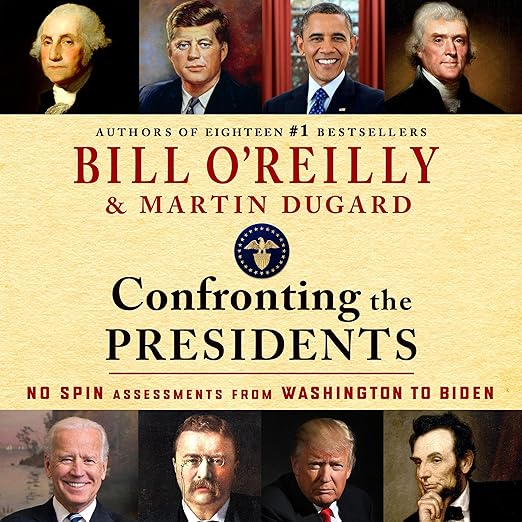
Forty-five presidential portraits share one throughline in this audiobook: Bill O'Reilly and Martin Dugard's promise of no-spin commentary applied consistently from George Washington's "troubled relationship with his mother" through Joe Biden's time in office. Confronting the Presidents marks a genuine departure for the authors of the bestselling Killing series, trading a single narrative arc for a chapter-by-chapter survey structure, one leader at a time, each one judged on achievements, failures, and the private habits history books usually skip.
The synopsis poses its central framing directly, asking "who best served America, and who undermined the founding ideals", and Confronting the Presidents structures all 45 portraits as attempts to answer some version of that question for each individual president, whether a household name or one of the more forgettable one-term presidents most listeners couldn't place chronologically without help.
A Presidential Historian Calls It Historically Sound
The book's real appeal is structural: rather than one continuous historical argument, O'Reilly and Dugard build 45 self-contained portraits, which means a reader curious specifically about Lincoln or specifically about Reagan can get a satisfying answer without wading through unrelated chapters first. The authors' research turned up genuinely new material, including previously unseen correspondence, and the synopsis singles out Washington's strained relationship with his mother as one example of the private-life detail woven into otherwise familiar historical territory.
Reviewer Jason describes returning to the book repeatedly as a reference since buying it in 2024, which is exactly the use case the chapter-by-chapter structure is built for. Constantinos E. Scaros, who identifies himself as a presidential historian, pushes back against academic skepticism of the book's rigor and calls it historically sound rather than lightweight popular history, a notable endorsement from someone positioned to be a tougher grader than the average listener.
Jason's review describes using the book as an ongoing reference tool, most recently while reading a separate book about the First Ladies and wanting more context on their presidential husbands, which is exactly the cross-referencing use case Petkoff's chapter-by-chapter narration style supports well. A book designed to be revisited for one specific figure years after the initial listen needs a narrator who makes each chapter self-sufficient, and that's what the reviews describe happening in practice.
The synopsis promises answers to some genuinely unexpected questions alongside the obvious ones, including what presidents "like to eat, drink, and do when they aren't working, or even sometimes when they are", a detail that signals the book isn't just another dry chronological march through inaugurations and policy fights. That willingness to include the trivial alongside the consequential is part of what makes a 45-portrait survey readable in the first place; nobody wants sixteen straight hours of pure foreign-policy analysis, and the human-interest texture keeps each chapter feeling distinct from the one before it.
Petkoff Reads the No-Spin Commentary Straight
Robert Petkoff's narration is doing exactly the job this format needs: clean, authoritative delivery that makes individual chapters work as standalone listens rather than requiring the full sixteen hours in sequence. That matters more here than in most narrative nonfiction, since the book is explicitly designed for non-linear, reference-style use, something to return to for a specific president rather than a single continuous story arc, and Petkoff's steady register supports jumping in anywhere without losing footing.
The book also handles O'Reilly's famously opinionated public persona without letting the narration editorialize on top of an already opinionated text; Petkoff reads the "no-spin" commentary straight, letting the authors' judgments land as written rather than amplifying them further. For a book explicitly timed around the 2024 election season and built around a running judgment call on every administration's lasting legacy, that restraint keeps the audiobook from feeling like a one-sided lecture rather than a fair hearing.
Doing the math on the format is revealing: sixteen hours across 45 presidents works out to roughly twenty minutes per portrait on average, enough time for real texture on any single figure without demanding the multi-hour commitment a dedicated single-subject biography would require. That pacing is precisely why the book works as something to dip into during a commute or a workout rather than requiring a dedicated multi-week listening project, closer in practice to a stack of long-form magazine profiles than to a single unbroken narrative.
The Final Two Chapters Are the Weak Point
Not every chapter gets equal treatment, and the final two chapters are the clearest weak point according to one reader, who found the coverage of the most recent presidents thinner than earlier chapters, describing it as two separate opinions offered in place of the deeper research applied elsewhere in the book. That's a real structural inconsistency worth knowing about going in, especially for anyone specifically curious about the most contemporary chapters rather than the historical ones.
At over sixteen hours covering 45 distinct subjects, the book necessarily trades depth for breadth on any single president; listeners hoping for Killing-series-style immersive detail on one particular administration should look toward O'Reilly and Dugard's dedicated single-subject books instead, since this one is built explicitly as a survey rather than a deep dive.
The book's own framing promises "45 wonderfully entertaining and insightful portraits", and for the large majority of the book that claim holds up according to reader feedback; the final-chapters weakness one reviewer flags reads as a genuine exception to an otherwise consistent standard rather than a sign the whole project is uneven.
O'Reilly and Dugard are best known for the Killing series, described in the synopsis as "the #1 bestselling narrative history series in the world", and that track record sets a high bar; listeners coming from those books expecting the same propulsive single-subject momentum should recalibrate for a genuinely different reading experience here, since the survey format trades that immersive quality deliberately for breadth, and the two aren't really comparable on the same terms. Anyone who picks this up on Killing-series reputation alone should know that reputation buys goodwill but not a matching structure.
First Ladies Add a Genuine Second Angle
History buffs who like dipping in and out rather than committing to one continuous read will find the format built specifically for their habits, and the first-ladies material adds a genuine second angle beyond the presidents themselves, useful for anyone curious about the less-covered figures who shaped the same history. Listeners heading into election season looking for context on how past presidents handled comparable pressures get real material here, not just historical trivia.
The final two chapters thin out precisely where curiosity about the present peaks, so anyone buying this specifically for sharp analysis of the two most recent administrations should temper expectations; the earlier 43 chapters carry the deeper research the book is otherwise known for.
Common Questions
Does the Confronting the Presidents audiobook cover all 45 U.S. presidents in equal depth?
Not quite. One reviewer specifically flags the final two chapters as thinner than the rest, offering more opinion than the researched detail found in earlier portraits.
Does the audiobook cover Biden's presidency in the same depth as earlier chapters?
According to reader feedback, the coverage of the most recent presidents is comparatively thin, so listeners specifically interested in current-era analysis should temper expectations.