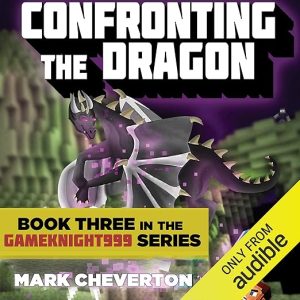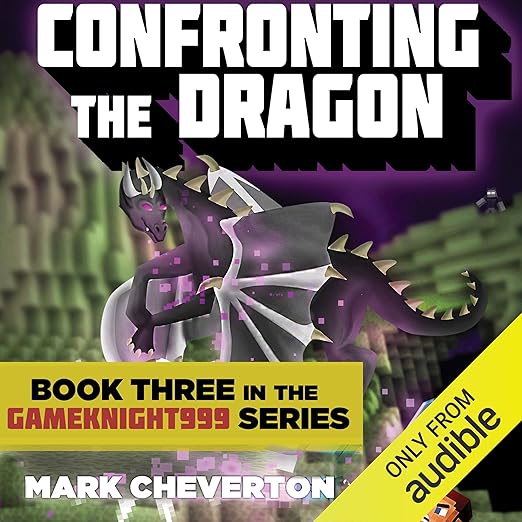
Mark Cheverton's Confronting the Dragon audiobook delivers exactly what the Gameknight999 series promises its young listeners: high-stakes Minecraft-universe adventure that moves fast, escalates constantly, and puts its protagonist through enough genuine difficulty that the victories actually mean something. Narrated by Chris Sorensen, this third installment in the series takes Gameknight999 and his NPC army into the End dimension for the confrontation with Malacoda and Erebus that the first two books have been building toward, and the payoff is substantial for readers who have followed the story from the beginning. Sorensen's performance holds the energy across nearly 11 hours without flagging.
Keeping Notch's Presence Ambiguous Until the Reveal
Cheverton's method across the series has been to use the Minecraft universe not as a backdrop for a conventional fantasy story but as a genuinely rule-bound world with its own logic. The threat in Confronting the Dragon is specific and Minecraft-coherent: the ghast king Malacoda and the enderman Erebus are leading their monster army to the server housing the Source, a viral code that, if it escapes into the real world, would destroy not just Minecraft but the digital lives it contains. Gameknight999, still a user-that-is-not-a-user, has to solve the mystery of how the monster horde is growing so rapidly before he can mount any effective resistance, and that investigative element gives the audiobook a first-act structure that is more sophisticated than typical middle-grade adventure pacing.
The twist that Gameknight's friend Mason turns out to be Notch, the creator figure of the Minecraft universe, clearly landed hard for young readers and listeners; multiple reviews call it the best moment in the series so far. In audio, that reveal depends on Sorensen having kept Notch's presence appropriately ambiguous throughout the preceding scenes, and he does. The performance does not telegraph what is coming, which makes the moment land as cleanly in audio as it does on the page. Young reviewers reference this plot development with genuine excitement, a reliable indicator that the narrative construction holds up across both reading and listening formats.
The series has attracted readers from fourth through seventh grade, according to parent reviewers, and Sorensen's performance is calibrated for that range. The vocabulary and situations extend young readers without overwhelming them, and the audiobook format reinforces the serial quality of the storytelling in ways that support sustained engagement rather than passive consumption. Children who have listened to this series report returning to installments they have already heard, which is high praise for Sorensen's consistency in bringing the characters to life with enough specificity that repeat visits still feel rewarding.
The Ender Dimension Sequences Are the Audiobook's Peak
Chris Sorensen is well-matched to this material. He has the vocal energy to keep younger listeners engaged across the nearly 11-hour runtime, and his differentiation between the various NPC characters is consistent enough that listeners can track who is speaking without confusion. The monster characters, particularly Erebus, get vocal treatment that conveys menace without tipping into the kind of horror register that would be inappropriate for the age group. Parent reviewers note that their children consume these books almost without stopping, and in audio that pacing energy has to be sustained by the narrator. Sorensen sustains it throughout.
The Ender dimension sequences are the audiobook's peak in terms of pure atmospheric achievement. The description of the floating island in the void and the Ender Dragon itself is vivid in the text; Sorensen's delivery of these sections has the right weight and tempo to let the imagery land. Cheverton has clearly spent significant time in the actual game world, and that specificity gives the audio production material that is easier to render in sound than generically described fantasy landscapes would be.
A Young Reviewer Already Plotting the Next Book
Pay attention to how Cheverton handles Gameknight's leadership arc in this third book. The series has been building from an uncertain, isolated user toward someone capable of inspiring and sustaining an NPC army, and Confronting the Dragon is where that arc reaches its most demanding test. The audiobook is more interested in how Gameknight earns the trust and loyalty of his allies than in the combat mechanics themselves, which gives the final sequences a character dimension that distinguishes the series from purely action-driven gaming fiction.
The subplot involving the unknown presence with glowing white eyes is seeded carefully throughout the audiobook. Listeners who have followed the series will recognize this as Cheverton playing a long game, and the payoff, with Erebus confirming he will return, sets up the next installment with genuine anticipation rather than rote sequel-baiting. The acknowledgment from a young reviewer who had specific ideas for the next book's direction testifies to how fully Cheverton has drawn his audience into the world's logic and made them feel like active participants in its future.
Built as a Parent-Child Listen for Minecraft Fans
Young listeners who have played Minecraft, particularly in survival multiplayer mode, will get the most from this audiobook, as a parent reviewer notes explicitly. The Gameknight999 series as a whole is best consumed in order, and Confronting the Dragon is a series-dependent installment rather than a standalone. It is appropriate for ages roughly nine through thirteen and works well as a parent-child listen for households with Minecraft players. Adults without prior engagement in the series or the game will find it a functional but thin experience; this audiobook is built for its specific young audience, not for crossover readership.
Questions Listeners Ask
Is this audiobook appropriate for children who have not played Minecraft?
Cheverton writes the world clearly enough that non-players can follow the story, but the emotional texture of the Minecraft references, and the specific appeal of seeing game logic used for narrative purposes, will mean less to children unfamiliar with the game. The adventure story itself is accessible; the full resonance requires at least some Minecraft familiarity.
How does Chris Sorensen's narration hold up across the nearly 11-hour audiobook runtime?
Sorensen maintains consistent energy throughout, which is the essential requirement for middle-grade adventure audio. Character voices are differentiated and held consistently from scene to scene. Parent reviewers report that children who have listened to this audiobook on long drives or at bedtime engage with it as attentively at hour ten as at hour one.
Is the Mason-as-Notch twist spoiled anywhere in the audiobook's description or early chapters?
No. Cheverton keeps the reveal properly earned across the book's runtime, and Sorensen's performance does not telegraph it in advance. The reveal is consistently cited by young readers and listeners as the series' best moment, which suggests it lands as intended in audio as well as in print.