
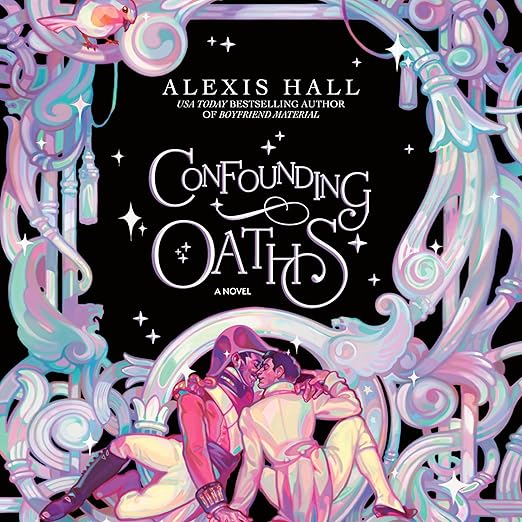
John Caesar wants his sister married well, and this audiobook makes that ordinary Regency ambition considerably harder than usual. The year is 1815. Mary Caesar needs to navigate the marriage mart, which is difficult at the best of times and worse when your family's background is nontraditional, when the whims of the ton are pernicious, and when the world you are moving through is full of scheming fairies and capricious gods who take an interest in what people say out loud.
Is Confounding Oaths Worth Your Time?
Mary's problem is that she makes a wish, and she makes it too literally. What she actually wants is for gentlemen to pay her as much attention as they pay her younger sister, and voicing that puts her squarely in the sights of a malicious fairy godmother. John's motives for rescuing her are not purely noble either, which Alexis Hall is careful to establish: the sooner Mary is settled, the sooner he can return to the aristocratic life of leisure he would rather be leading.
That rescue throws him at Captain Orestes James, an up-from-the-ranks hero of Wellington's armies with a ragtag band of misfits attached, and the two of them go into a world of fey bargains and sacrificial magic to get Mary back. Twelve hours and seventeen minutes hold that plot, a courtship, an entire family, and a magical economy in which wishes function as binding contracts with adversarial counterparties. It is a lot of book.
A five-star response from December 2025 reports preferring this installment to the first, and the reasons given are entirely about people rather than plot: Mr Caesar and Captain James themselves, the whole Caesar family as a unit, and a continuing delight in Miss Bickle. That is a useful signal about where the sequel puts its energy. The family is the ensemble this book actually invests in, and readers who arrived for the couple may notice the redistribution.
The Best Parts of Confounding Oaths
Hall writes dialogue that demands to be performed, and one response gives the best possible evidence of it. Five stars in February 2025, describing the compulsion to read out the 'scathing cuts and witty dialogue tidbits' to a partner who had no investment in the story, right up until that partner became invested by the final big scene. A book that survives being quoted aloud to someone with no context is a book whose lines work independently of their setup.
Hall builds the romance on a genuinely well-chosen gap. John is a nobleman for whom casual dalliances with soldiers are familiar territory and lasting attachments are not, and Orestes came up through the ranks rather than buying a commission. Every obstacle between them is structural: rank, expectation, and John's settled conviction that wanting more is pointless. Hall's framing of that last piece, a man who has learned firsthand that getting what you wish for can be dangerous, ties the courtship directly to the magic plot.
Critical reception quoted in the description is worth taking at face value. Publishers Weekly gave it a starred review and singled out the sequel for bringing 'back all the magic, both literal and figurative, that readers expect,' which is a precise compliment for a second installment specifically. Continuity of tone across a series is a real technical achievement, and this one holds the register of the first while moving the focus onto a different set of people.
Before You Commit to Confounding Oaths
The most detailed dissent on the listing is a three-star response from February 2026 from a reader who loved the first book and came in excited. The objection is structural: the romance between the two leads felt rushed and then stopped being the main point, while the central plot problem 'felt divorced from the romance,' leaving the whole story disconnected. If you want a sequel where the couple stays at the center throughout, that is the risk, and it is the most substantive criticism this book has attracted.
The same response says something that will confuse anyone shopping for audio. It refers to liking how the book is told 'to us with the narrator,' and reports that in this installment the device works less well. That narrator is a character inside the fiction, the unreliable voice relating events, not the person reading the recording. It is the conceit the series is built on, carried over from the first book, and every mention of it on this page means the storyteller rather than the performer.
Which leaves a genuine gap. Across 156 ratings and five written responses spanning January 2025 to February 2026, not one comments on Nneka Okoye's reading, and the only appearances of the word narrator refer to the book's framing device. Sample before you buy, because twelve hours of arch first-person storytelling depends heavily on delivery and nothing on this page tells you how this one lands. Note too that the listing files the book under an identity category with no genre tag at all, which tells you who is in it and nothing about what it is.
Should You Listen to Confounding Oaths?
Listeners who want their Regency destabilized will have the best time. An August 2025 five-star response captures the book's exact frequency by quoting it: 'debating the various careers open to unwed women in the year of some people's lord 1815.' That reader describes the setting as an 'absolutely bonkers mythical magical absurd poignant world,' which is four adjectives that ought to cancel each other out and instead describe the thing accurately.
Readers of queer historical romance tired of the subgenre's usual restraint will do well here, and readers who came to Alexis Hall through contemporary work and are curious how that comic voice handles fairies and Wellington's officers. The Caesar family material rewards anyone who enjoys an ensemble more than a two-hander, and Miss Bickle in particular has clearly acquired a following.
Start with Mortal Follies rather than here. This is book two, it assumes familiarity with the world's rules and its narrating conceit, and the reviews that praise it most are explicitly comparing it against the first. Skip it if you need the central pairing to carry every chapter, since the strongest criticism on the page is precisely that it does not. Anyone else gets a very funny, very strange book that treats a wish as a legal instrument.







