At a Glance
- Performance: Kristina Ellis narrates her own strategy guide with the direct, encouraging tone of someone who actually lived the advice.
- What it covers: Financial aid strategy, resilience, first-generation college access.
- Feel: Practical, motivating, no-nonsense.
- Our call: A tight, efficient listen for any family staring down college costs without a plan.
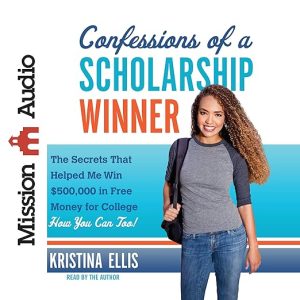
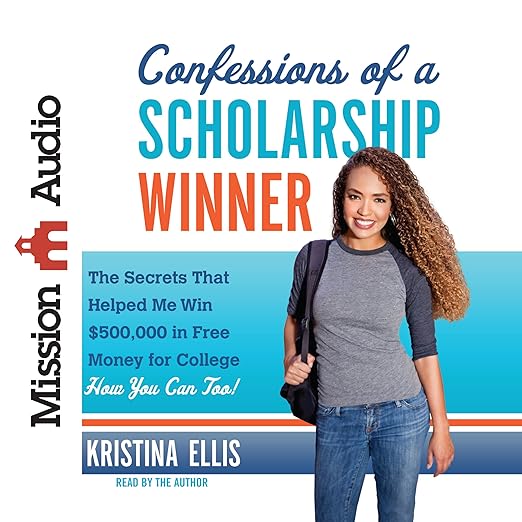
Kristina Ellis was an average student with unremarkable test scores when her widowed mother told her, on the first day of high school, that college was entirely her own financial problem to solve. How does a teenager with mediocre grades turn that ultimatum into five hundred thousand dollars in scholarships, enough to fund a full education through a doctoral degree at a top-twenty university? This audiobook is Ellis's own answer, delivered in under five hours and narrated in her own voice, part personal account and part practical strategy guide for any family facing the same problem she once did.
More Like a Workbook Delivered Aloud
The book walks through a specific, repeatable process rather than vague encouragement: finding the scholarships that actually fit a given student, understanding the mechanics of paying for college beyond the sticker price, performing well in a scholarship interview, and building a personal narrative that highlights real strengths regardless of financial background or athletic and academic star power. Ellis is explicit that a student does not need to be a star athlete or a top student to use her method, which is the book's central promise and the reason it resonates with families who assume scholarships are reserved for exceptional kids.
Because Ellis is narrating her own strategy, the book reads less like a distant expert's advice and more like a specific playbook from someone who ran it herself under real financial pressure, a single-parent household after her father's death from cancer, and came out the other side with her doctoral education fully funded. That lived specificity is doing real work throughout the book's roughly four and a half hours.
The material is organized around actionable steps rather than abstract motivation, closer to a workbook delivered aloud than a memoir with tips sprinkled in. Listeners get a genuine method: identify the right scholarships, understand what committees are actually looking for, prepare a real interview strategy, and turn personal obstacles into part of the pitch rather than something to hide.
One specific promise in the synopsis stands out from typical scholarship guides: coaching for the interview itself, not just the written application. Many scholarship resources stop at essay tips and deadline trackers, treating the interview as an afterthought, but Ellis frames interview performance as a distinct, learnable skill deserving its own dedicated attention, which tracks with the reviewer who mentioned being impressed by her own television interview presentation before ever opening the book.
The Price of a Coffee and a Sandwich
The synopsis promises help to overcome the personal obstacles that stand in a student's way, a deliberately open phrase that lets the book serve students whose obstacles look nothing like Ellis's own. Her specific story, losing a parent, growing up in a single-income household, is the concrete example, but the strategy underneath is framed broadly enough to apply to any student's version of a similar gap between ambition and resources.
Self-narration works to this book's advantage. Ellis is not a professional voice actor, but she is the actual person who executed this strategy, and hearing the plan explained by the student who lived it adds a credibility a hired narrator could not replicate. One reviewer specifically noted being impressed by Ellis's presentation in a televised interview with Katie Couric before ever picking up the book, a real-world data point about her polish and preparation that carries over directly into the audiobook's tone.
Impressed by Ellis on Television With Couric
Reviews attached to this title lean on a consistent argument: relative to the scale of the problem, thousands of dollars in potential tuition, the audiobook's price and four-and-a-half-hour time investment amount to a rounding error against the payoff, a framing that holds up given Ellis's own five-hundred-thousand-dollar result and shows up independently in more than one reviewer's own words.
A parent of two teenage daughters wrote that the book arrived in their lives at exactly the right moment and would save the family, in her words, thousands of dollars in education costs for roughly the price of a coffee and a breakfast sandwich. That kind of direct financial framing is common in the reviews attached to this title, and it reflects the book's core pitch accurately: a small investment in strategy against a genuinely enormous future expense.
Another reviewer admitted going in skeptical, having read some negative reviews suggesting the book would not help a financially stable family, and came away pleasantly surprised, calling it 'a perfect blend of knowledge and inspiration' that applies broadly rather than only to students from Ellis's own impoverished background. That range, useful whether or not a family is struggling financially, is a real strength worth knowing about upfront.
A Strategic Workbook Instead of a Directory
One reviewer went in expecting a literal list of specific scholarship websites and programs to apply to, based on Ellis's television appearances, and was surprised to find that is not what the book delivers. It functions more as an ongoing strategic workbook for students and parents than as a directory, teaching the underlying method rather than handing over a ready-made list of links, which is worth knowing before pressing play if a curated resource list is specifically what a listener is after.
At four hours and thirty-three minutes, this is a genuinely short, efficient listen rather than an exhaustive treatment of the American financial aid system. It covers Ellis's specific strategy well but does not attempt to be a comprehensive guide to every scholarship type, financial aid form, or institutional quirk a family might encounter, so pairing it with more specific research for a given student's situation is a reasonable expectation.
Because the book is built around one person's specific, successful method, some of the advice is naturally shaped by Ellis's own circumstances and personality, an outgoing, interview-comfortable, doctoral-track student. Listeners whose kids have a very different temperament may need to adapt some of the interview and self-presentation advice rather than follow it verbatim.
Neither a Star Athlete Nor a Valedictorian
This audiobook suits parents and high schoolers actively facing the scholarship search, especially families without deep financial cushions who need a genuine strategy rather than reassurance. Its short runtime makes it an efficient starting point before diving into more detailed research on specific programs.
It also works well for students who do not see themselves as traditionally exceptional, not a star athlete, not a valedictorian, since Ellis's entire pitch is built around proving that scholarship success does not require either. Listeners drawn to practical, personal-experience business and career guidance will find the tone familiar and useful.
Anyone hoping for a curated directory of specific scholarship names and links, rather than a strategic framework and mindset, should pair this audiobook with a dedicated scholarship-search website or database, since that is not the book's actual function despite what its media appearances might suggest.
A Few Questions About Confessions of a Scholarship Winner
Does Kristina Ellis narrate this audiobook herself?
Yes, Ellis reads her own book, which gives the strategy advice a lived-in credibility since she is the person who actually executed the plan she describes.
Does this audiobook include a list of specific scholarships to apply for?
No. Despite some listeners expecting a directory, the audiobook teaches a repeatable strategy and mindset rather than providing a curated list of scholarship names or links.
How long is the Confessions of a Scholarship Winner audiobook?
It runs four hours and thirty-three minutes, a short, efficient listen focused on strategy rather than an exhaustive survey of every financial aid option available.