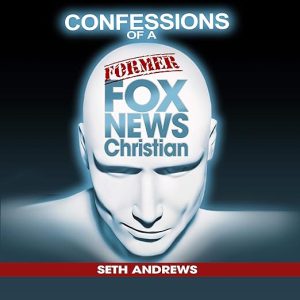
Seth Andrews narrates his own audiobook Confessions of a Former Fox News Christian, and that choice is the whole point. Andrews is the creator of The Thinking Atheist podcast, and his voice carries the particular authority of someone who has actually occupied both sides of the worldview he is examining. He spent years as an evangelical Christian whose media diet consisted of Rush Limbaugh, Glenn Beck, Ann Coulter, and Fox News. The book is the account of what happened when the closed system those voices built around him began to fracture. At seven hours and thirty-seven minutes, this is a sustained argument as much as a personal memoir, and Andrews delivers it with the control of someone who has spent years crafting spoken content for an audience that demands precision.
Inside Fox News' Closed Belief System
Andrews does not write a simple conversion narrative. The structure of the book is more diagnostic than personal, moving through the Fox News ecosystem's influence on specific policy attitudes, religion, race, foreign policy, war, LGBT rights, protest movements, the Constitution, before returning to the individual psychology of how outrage-based media creates what he calls "closed systems." A closed system, in his framing, is one that pre-immunizes its members against any information that might challenge it; the system feeds on and amplifies fear, ignorance, and tribal identity rather than evidence. Andrews knows this system from the inside, which gives his analysis a specificity that academic media criticism rarely achieves. He can tell you not just what the rhetoric sounds like but what it felt like to believe it.
One reviewer called this "a fascinating, probing, personal journey detailing his gradual evolution from a right-wing, Christian fundamentalist to a non-believing, happy, proud, liberal Secular Humanist." That captures the arc but misses the texture. Andrews is a sharp prose stylist, and the thirteen chapters build an argument that feels cumulative rather than repetitive. He is also genuinely funny in places, which keeps the material from becoming a relentless attack. He reserves his sharpest critique not for the viewers but for the system that monetizes their anxieties, and that distinction matters for how the book reads: this is not an angry polemic but a considered autopsy.
Thirteen Chapters Build Real Momentum
The self-narration is not incidental. Andrews is a broadcaster by profession and it shows in how he handles tonal shifts, moving between personal recollection, cultural analysis, and outright sardonic commentary without the seams showing. He knows when to slow down for rhetorical effect and when to accelerate through a passage that is building toward a punchline or a harder point. The audiobook format advantages this material in a way print does not: you can hear Andrews' relationship to his own past self in the way his voice modulates when he recounts something he once believed without question. There is no way to capture that particular cost in ink on a page.
The book was published in 2020, which means some of the specific programming references are several years old, but the structural argument about how conservative media ecosystems function has only become more relevant since. Andrews is not describing one channel in isolation; he is describing a media logic that has migrated across platforms and formats. That durability makes it more than a time-capsule document. The thirteen-chapter architecture also gives the audiobook real momentum; each chapter functions as a discrete unit but the accumulation creates pressure that is hard to resist.
Race and Foreign Policy Chapters Reward Active Listening
Listeners who currently hold the worldview Andrews left will likely find this audiobook hostile, not because Andrews is unfair but because his argument is thorough. He is not writing to persuade committed Fox News viewers; he is writing about the experience of having been one and what the exit looked like. That framing means the book lands differently depending on where you stand. Listeners somewhere in the middle, curious about how media shapes belief but not deeply invested in either position, may find it the most useful. Confirmed atheists and secular humanists who already share Andrews' conclusions may find parts of it familiar, though the personal specificity keeps it from feeling like preaching to a crowd that already agrees.
The chapters on race and foreign policy are the most forensic and require the most active listening. Andrews is tracing specific rhetorical patterns through specific programming choices rather than making broad generalizations. That level of detail rewards close attention but may feel dense if you are listening in short fragmented stretches. Budget time for the final chapters in particular, where the personal and the analytical threads converge most explicitly.
Personal Story Over Data-Heavy Journalism
This audiobook suits listeners who want to understand the psychology and architecture of partisan media rather than simply confirm their existing opinions of it. Former religious conservatives navigating questions about faith and media influence will find it particularly resonant. It works well for anyone who wants a personal account rather than a sociological study, a voice from inside the experience rather than a scholar observing it from a distance. Those looking for a purely spiritual memoir rather than a cultural critique will find this pulls steadily in a different direction. Listeners who prefer data-heavy journalism over personal essay should look elsewhere, though Andrews cites enough concrete examples to ground the argument in observable reality rather than impression.