
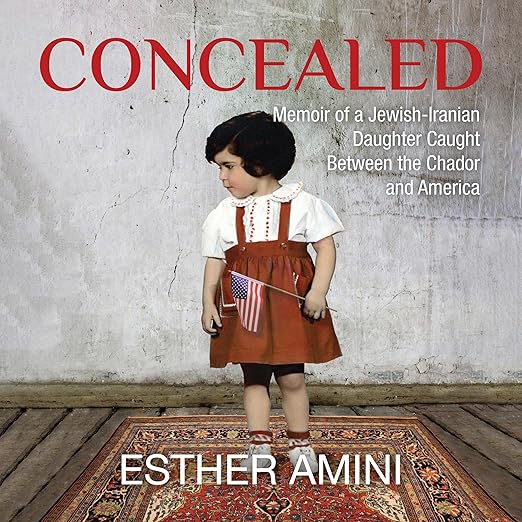
Esther Amini's father answers most questions with silence or a sudden explosion of temper, and this audiobook spends its early chapters tracing that silence back to Mashhad, Iran, the holy Muslim city he fled as a young man. Amini grew up in Queens, New York, during the free spirited 1960s, the American-born daughter of Persian-Jewish parents who carried Mashhad's specific history, including its long-hidden underground Jewish community, with them into a household governed by rules her father enforced against talk, books, higher education, and any resistance to an early arranged Persian marriage.
Written by Esther Amini and narrated by Cassandra Campbell, this 11-hour-and-19-minute audiobook holds a 4.6 rating from 665 ratings.
A Tradition-Bound Household Threatened by Freedom Itself
The central tension Amini builds the memoir around is specific and sustained: a dutiful daughter caught between tradition-bound parents and a hunger for the self-determination her 1960s American surroundings openly offered every other girl her age. Her father's prohibitions, no unsupervised reading, no pursuit of higher education, active pressure toward an early marriage within the Persian community, sit at the center of the conflict, and Amini traces her own eventual resistance without ever fully disowning the parents who imposed those limits.
Behind that immediate family conflict sits a fuller historical account of Mashhad's underground Jewish community and the specific persecution that eventually drove Amini's parents to leave. The book follows their arduous journey to the United States and then, pointedly, the new threat they encountered once they arrived: not persecution this time, but freedom itself, which challenged the tradition-bound structure they had built their entire identity around preserving.
What to Keep and What to Discard From Inheritance
Amini's sense of indebtedness to her two Iranian-born brothers runs through the memoir as a quieter counterweight to the conflict with her parents, and the synopsis's own language, family members who build, buoy, wound, and save one another across generations, applies as much to those sibling relationships as to the more dramatic standoffs with her father. The sibling material gives the book real warmth alongside its harder chapters.
The memoir's real destination is less about escaping her parents than about the harder, more ambiguous work the synopsis names directly: deciding what to keep and what to discard from everything she inherited. Amini does not resolve that question with a clean break from her family's traditions, and that refusal to oversimplify is part of what keeps Concealed from settling into a familiar rebellion-and-freedom arc.
Campbell Delivers Poignant, Funny, and Uplifting at Once
Reviewer NYC doc, a member of the same insular Persian-Jewish community Amini describes, praised the sheer amount of detail in the book, noting it surfaced history even she had not previously known about her own background. That level of specificity, drawn from extensive research according to the same reviewer, gives the memoir real documentary value beyond its personal story.
Cassandra Campbell's narration handles the memoir's tonal range with the same restraint that has made her a reliable choice for literary nonfiction generally, moving between the household's tense, silence-heavy scenes and the more openly funny, entertaining passages the synopsis itself promises without letting either register overwhelm the other. The synopsis specifically calls the book poignant, funny, entertaining, and uplifting all at once, and Campbell's steady delivery makes room for all four qualities to actually land.
A Holy Pilgrimage City Hiding a Jewish Community
Food and celebration function as their own throughline here, the specific rituals and gatherings that held the family together even during its most strained periods, and that detail keeps Concealed from reading as a straightforward story of oppression and escape. Amini is clearly working to hold complexity rather than deliver a simple verdict on the household she grew up in.
Reviewer Liane Wakabayashi's review adds a specific, useful piece of context: Mashhad is described as one of the holiest Shia pilgrimage sites in Iran, a detail that sharpens the danger and precariousness of a hidden Jewish community existing there, and Campbell's narration carries that added historical weight without needing to over-explain it for listeners encountering the specifics for the first time.
The synopsis describes Amini's approach as combining a 'keen eye, quick wit, and warm heart,' and that specific triad holds up as an accurate description of the finished audiobook rather than jacket-copy flattery. Campbell's narration moves between all three registers, observant detail, genuine humor, and real tenderness toward difficult people, without letting any single one dominate the others for too long.
A Book Called Concealed That Finally Speaks
This is culturally dense material, specific to Persian-Jewish Mashhadi history that may be genuinely unfamiliar to general audiences going in. Reviewer Loves to Read notes how strictly Amini's parents held onto old-world views even decades after immigrating, refusing to adapt their worldview to their new American reality, and listeners without any prior cultural context may need to sit with that rigidity rather than expect it explained away.
The themes here include real parental control, sustained pressure toward an unwanted marriage, and prolonged family estrangement, and reviewer Liane Wakabayashi does not soften the description, calling Amini's parents far more complicated and difficult than most Mashhadi Jewish immigrant families of that era. Listeners sensitive to depictions of authoritarian parenting or restriction placed specifically on a daughter should know this going in, even though the memoir ultimately reads as a story of eventual self-determination.
Reviewer NYC doc specifically praised the photographs included with the book as even more informative than the text itself, and audio listeners should know upfront that this visual material, family photographs tied directly to the events described, is simply unavailable in the audiobook format, a real if unavoidable gap for anyone drawn to that detail.
A real irony sits inside the title itself: a memoir called Concealed, built around a father who enforced literal silence in his own household, is itself an act of finally speaking after decades of not being permitted to. That tension between the title's subject and the book's own existence gives the material an extra layer worth listening for.
A Familiar Shape With a Distinctly Mashhadi Texture
Memoir readers generally, anyone interested specifically in Persian-Jewish or Mizrahi Jewish history, readers drawn to immigrant family dynamics and generational conflict, and fans of Cassandra Campbell's literary nonfiction work will all find real substance in Concealed's eleven and a half hours.
Readers of other memoirs built around a first-generation daughter caught between an immigrant household's rules and her American surroundings will recognize the shape of Amini's conflict immediately, even as the specifically Persian-Jewish, Mashhadi details give this entry a distinct texture within that broader, familiar genre.
At eleven hours and nineteen minutes, this sits closer to a substantial literary memoir than a quick read, and Campbell's steady, unhurried pacing makes that length feel earned rather than padded, letting both the tense household scenes and the historical Mashhad material breathe without ever feeling rushed toward a resolution.
Readers looking for a lighter, more purely uplifting immigrant success story should recalibrate expectations, since the family conflict here stays genuinely unresolved and uncomfortable for long stretches before any reconciliation surfaces, and that honesty is a large part of what gives the book its lasting weight rather than something to work around.
Questions Listeners Ask
Is the Concealed audiobook a hard listen given its themes of parental control?
At times. It covers real pressure toward an early arranged marriage and prolonged family estrangement, though it ultimately reads as a story of self-determination.
Does this audiobook require prior knowledge of Persian-Jewish history?
No, but listeners without background on the Mashhadi Jewish community may want to sit with some unfamiliar cultural context rather than expect it fully explained.
How does Cassandra Campbell's narration handle the Concealed audiobook's tonal shifts?
Smoothly. She moves between tense, silence-heavy household scenes and the book's real humor and warmth without over-emphasizing either register.
Does the Concealed audiobook include the photographs from the print edition?
No. One reviewer specifically praises the print edition's photographs, which are not accessible in the audio format.







