Quick Take
- Narrator: Annette Romano handles both Rose's interiority and the ensemble cast of the Man o' War with real skill, giving each character a distinct register without over-performing.
- Subjects: Sapphic romance in hostile environments, found family versus institutional loyalty, navigating moral ambiguity at sea
- Tone: Tense, adventurous, and romantically charged, set against a flooded dystopian world
- Bottom line: A genuinely compelling debut that works both as queer romance and as speculative world-building, with a protagonist whose central gift is a satisfying metaphor for the entire story.
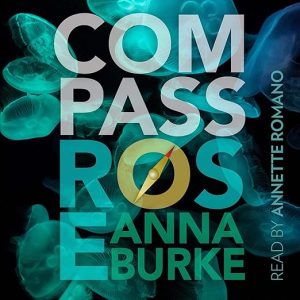
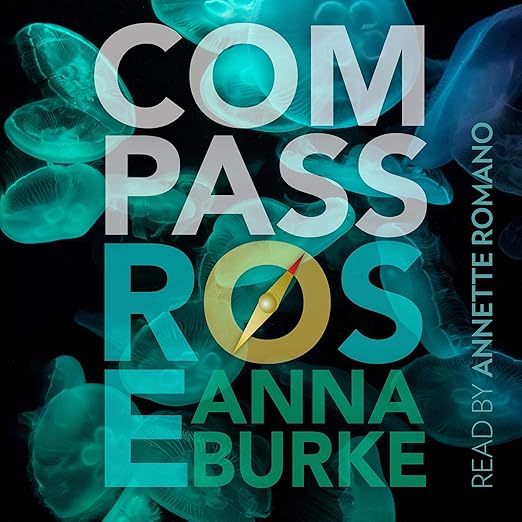
I started Compass Rose on a long train journey and missed my stop. I do not say that to signal that it is page-turning in the shallow sense. I say it because Anna Burke builds her flooded, anarchic world of 2513 with enough specificity that I lost the familiar geography of my actual location. The year 2513. The seas have risen so dramatically that civilization mostly exists underwater or in archipelago settlements. Navigation is survival. And Rose, the protagonist, was born with an internal compass that is both her greatest asset and the thing that makes her a target.
This is the first book in the Compass Rose series, published by Bywater Books in 2019 and narrated by Annette Romano. The LGBTQ designation in the metadata is accurate but undersells what the book is. It is a fully realized piece of speculative fiction that happens to center a sapphic romance, and the world-building and the romantic tension earn equal weight throughout. That combination is rarer than it should be in either genre, and Burke handles it with more confidence than most debuts achieve.
A Closer Look at Compass Rose
Burke's smartest structural decision is making Rose's navigational ability literal rather than metaphorical, and then letting the metaphorical dimension emerge naturally from the story's events. Rose perceives cardinal directions instinctively, which the Archipelago Fleet prizes enough to send her on a secret mission into pirate territory. She is handed over to the mercenary ship Man o' War and its captain Miranda with minimal briefing and considerable risk. The mission requires her to spy on the pirate queen Ching Shih, which means embedding herself in a crew that has every reason to distrust her presence.
What unfolds is a story about the limits of Rose's most reliable instrument. Her internal compass tells her true north in every physical sense but is useless for the human terrain she has to navigate aboard the Man o' War. She cannot calibrate Miranda. She cannot read the crew's shifting alliances. She cannot determine the actual moral coordinates of the mission she has been given. The gap between her extraordinary perceptual gift and her ordinary human uncertainty is where the novel's real interest lives, and Burke does not resolve that gap cheaply.
What Makes Compass Rose Worth Hearing
One reviewer noted that Miranda lacks moments showing why her crew is so devoted to her beyond reputation. That observation is fair, and it reflects the book's slight imbalance: Rose is drawn with considerable interior depth while Miranda remains more opaque throughout. But the opacity is partly intentional. We see Miranda through Rose's perception, which means we share Rose's inability to fully read her. The frustration of not knowing whether Miranda is trustworthy is the reader's as much as Rose's, and Burke uses that shared uncertainty to keep the romantic tension alive without cheap dramatic shortcuts.
Annette Romano manages this dynamic well. Her narration of Rose's resistance to Miranda's pull has the quality of someone genuinely fighting a current, not of someone performing reluctance for narrative convention. The romance develops at a pace that several reviewers praised as properly earned rather than accelerated for convenience. Romano gives the two women distinct voices that make their scenes together immediately recognizable without sounding artificially differentiated, which is the harder technical challenge in a 12-plus-hour listen.
Things to Know Before Starting Compass Rose
The flooded world of 2513 is described by one reviewer as scarily plausible, and the details Burke includes, swarms of deadly jellyfish, pocket realms of breathable space, the complex politics between the Archipelago Fleet and pirate factions, suggest a fully realized universe rather than a scenic backdrop. One reviewer praised the world-building as excellent, with pacing that gains momentum as the story unfolds and becomes impossible to put down in the final act. That trajectory is accurate to my own experience. The book earns its ending rather than arriving at it through plot convenience, which is what separates a good debut from a promising one.
Who Anna Burke Is Writing For
Listeners who want sapphic romance with genuine stakes and a world that matters beyond the relationship will find this deeply satisfying. Those who come primarily for the adventure and can take or leave the romantic dimension will find the action sequences and world-building sufficient on their own terms. At just over twelve hours, Romano maintains momentum across the full runtime. Those who specifically want fast-moving romance with minimal speculative complexity might find the world-building investment front-heavy, but the payoff in the final act is worth the patience required to reach it.
Burke's achievement with Compass Rose is that she wrote a debut that does not feel like one. The world she built in 2019 has held up through multiple reads for the people who discovered it early, and Romano's narration makes the audiobook version a complete experience rather than a secondary format. At a 4.7 rating across 715 reviewers, the book has found a substantial audience, and the praise is consistent enough across different reader types that it is not genre-loyalty speaking. The flooded world, the complicated morality of nearly every character, and the romance that earns rather than assumes its resolution make this a title I return to in conversation regularly when someone asks what sapphic speculative fiction actually looks like when it is done with full commitment to both the speculative and the romantic dimensions.
Common Questions
How does Annette Romano differentiate the ensemble cast aboard the Man o' War?
Romano gives each crew member a distinct vocal register without resorting to caricature. The differentiation is subtle enough that the characters feel like individuals rather than types, which is essential for a 12-hour listen with multiple crew members in play.
Is the post-apocalyptic flooded world well-explained, or does it assume prior familiarity with the setting?
Burke establishes the world's rules efficiently through Rose's perspective as someone entering a new environment. Listeners do not need prior knowledge of the series. The world-building is woven into the narrative rather than delivered as front-loaded exposition.