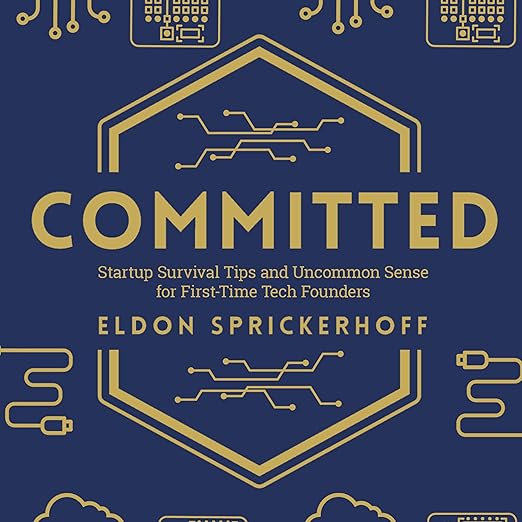
A billion-dollar valuation is the headline, but the real subject of this audiobook is everything that happened before eSentire got there. Eldon Sprickerhoff cofounded the cybersecurity firm as a technical founder with no formal business training, and Committed is his attempt to hand later engineers-turned-CEOs the map nobody gave him. The premise is specific: most startup strategy books are written for MBAs or serial operators, not for the person who can build the product but has never negotiated a term sheet or fired a cofounder.
Sprickerhoff Narrates His Own Hard Knocks
Sprickerhoff narrates his own book, and that choice matters more here than it does for most business titles. He is not performing expertise; he is reporting from inside decisions he actually made, including the ones that went badly. The synopsis calls this his MBA from the 'School of Hard Knocks,' and the audiobook leans into that framing rather than smoothing it into consultant-speak. Listeners get raising early capital, competing against better-funded rivals, and the slower work of building organizational resilience, delivered by someone who was still learning it in real time.
The central reframe, that a founder's actual job title is Chief Survival Officer, gives the book a spine that a lot of founder memoirs lack. It is not a loose collection of war stories; it is organized around the idea that survival, not vision, is the skill nobody teaches technical founders. That focus keeps the six-hour runtime tight and specific rather than sprawling into general leadership advice that could apply to any industry.
Failure and Success Are Two Separate Skills
The synopsis draws a distinction worth sitting with: pushing through failure and dealing with success are named as two separate skills, not one continuous challenge. That framing pushes back against the common startup narrative that treats survival as only about avoiding collapse. Sprickerhoff's account suggests that scaling past initial survival brings its own disorientation, decisions about growth, delegation, and what kind of company to become, that a founder fixated purely on not failing may not be prepared for.
Founder literature has a well-known success-theater problem: books written after an exit tend to retroactively smooth out decisions that looked far less certain in the moment. Sprickerhoff's narration works against that tendency by keeping his own uncertainty audible in the delivery itself, less a victory lap recorded after the fact and more a debrief that still remembers what not knowing the outcome actually felt like.
Closer to a Survival Guide Than a Highlight Reel
The synopsis maps out exactly what the book covers, and the list reads like a checklist of first-time-founder blind spots: finding product-market fit, raising early-stage capital, competing against bigger and better-funded rivals, and building the resilience to keep going after a bad quarter. What makes it worth six hours rather than skimming a blog post on the same topics is the specificity. Sprickerhoff is not offering universal principles; he is narrating decisions from eSentire's own history, which gives listeners something concrete to compare their own situation against.
Adam Pfefer's review frames the book as essential reading built directly from Sprickerhoff's first-hand experience of the startup journey, and that framing captures the real appeal here. This is not a book assembled from interviews with other founders or academic case studies, it is one operator's account of building a company to a billion-dollar outcome, with the mistakes left in rather than edited out for a cleaner story.
Listeners who found real value in Ben Horowitz's The Hard Thing About Hard Things will recognize the register here: unglamorous, occasionally uncomfortable honesty about how close a company came to failing before it succeeded. Sprickerhoff does not sand down the parts of the eSentire story that make him look uncertain or wrong in the moment, which is exactly what distinguishes a survival guide from a highlight reel.
An Asset for Authenticity, a Limit on Polish
This is a narrow book by design, and it is worth knowing that going in. Committed is written for the first-time technical founder specifically, someone who can ship code but has never had to read a cap table. Founders further along in their journey, or those who came from a sales or finance background rather than engineering, may find the candor less revelatory, since some of this ground may already be familiar territory from other reading.
Sprickerhoff is a business founder, not a professional narrator, and the recording has the pacing of someone reading his own hard-won conclusions rather than performing a script. That is an asset for authenticity and a mild limitation for polish. Listeners who want a heavily produced audio experience, with music cues or chapter framing, will not find that here. What they get instead is a consistent, direct voice that never overstates its own certainty about what worked.
The cybersecurity industry adds a specific texture most generic startup books miss. Building trust with enterprise clients who are, by definition, anxious about being breached is a different sales problem than a typical B2B pitch, and Sprickerhoff's account of navigating that skepticism while still small and unproven gives the book real specificity beyond generic go-to-market advice.
Survival thinking also changes daily decisions in ways growth-first thinking does not: saying no to deals that would strain cash flow, treating runway as the primary metric over vanity growth numbers, and building redundancy into a young company before it feels necessary. That mindset shift, more than any single tactic, is the actual argument Committed makes underneath its individual chapters.
Not Taught in Any Business School Class
Reviewer Vanessa Dimauro put it plainly, calling the depth of the guidance something that 'can not be taught in any business school class,' and that is a fair description of the book's actual value proposition. Adam Pfefer's review frames it as a guidebook for founders, and that word fits better than memoir. A reviewer identified only as Amazon Customer described tangible lessons and said the book was hard to put down, strong praise for a genre that often rewards skimming over sustained listening.
Technical founders approaching a first serious fundraise, or who already sense they are underprepared for the business side of the job, are the clearest audience here. Aspiring founders still at the idea stage will get real value too, mostly as a preview of decisions they have not had to make yet. Listeners hunting for a general leadership book, or one that spends real time on marketing rather than survival and resilience, should look elsewhere.
Amazon Customer's review calling the book hard to put down is notable for a genre more often described as useful or informative than genuinely engaging. Part of that readability likely comes from Sprickerhoff choosing specific war stories over abstract principle, a choice that keeps six hours moving briskly rather than settling into a lecture register.
Does Eldon Sprickerhoff's self-narration work for this audiobook?
Yes, though he is a founder narrating his own experience, not a trained voice actor. The delivery is direct and unpolished in a way that suits a book built around candid survival strategies rather than a rehearsed pitch.
How long is the Committed audiobook and is that enough time to cover the material?
It runs 6 hours and 8 minutes, which is tight for the ground it covers: fundraising, competition, resilience, and failure. The brevity works because the book stays focused on survival strategy rather than trying to be a comprehensive business school curriculum.