Quick Take
- Read by: Steven V. Roberts self-narrates his tribute to his late wife with restraint that makes the emotional moments land harder.
- At its heart: Journalism history, grief and marriage, women breaking institutional barriers
- Vibe: Warm, reflective, unabashedly loving
- Short version: A moving, efficiently told husband's tribute, best appreciated as a celebration rather than a neutral biography.
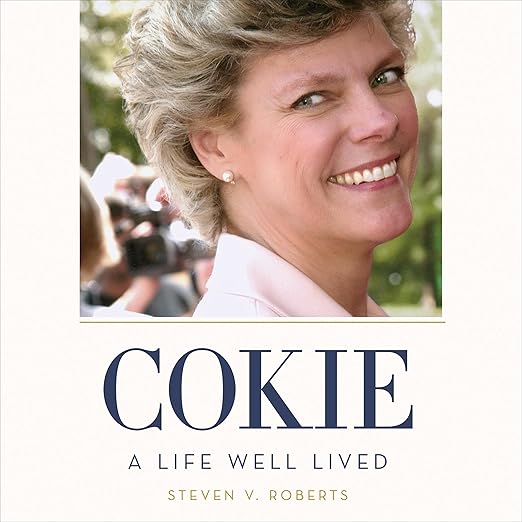
Fifty-three years of marriage sit behind every page of Cokie, the tribute Steven V. Roberts wrote and narrates himself in memory of his wife, the journalist Cokie Roberts. This is not a conventional biography assembled by an outside writer working from archives and interviews; it's a husband's account, decades of watching Cokie build a career at NPR and ABC that eventually made her, as the book's own framing puts it, someone people still ask 'What Would Cokie Do?' about, years after her death. The audiobook runs a tight seven hours, and Roberts uses that space efficiently, moving between her public triumphs and the private life he alone was positioned to describe.
Cokie Roberts' public profile gets its due here: more than forty years on national television and radio, five bestselling books about women in American history, a Saturday Night Live impression, a name check on The West Wing, and a joke in Spy Magazine asking whether she was a 'moderately well-known broadcast journalist or center of the universe.' Even the animals named after her get a mention, Roberts notes that several dogs and at least one dairy cow carried her name. None of this is included as trivia for its own sake; Roberts uses the scale of her public recognition to set up the book's real subject, which is who she was underneath all of it.
The book divides Cokie's identity into the roles Roberts lists outright: daughter, wife, mother, journalist, advocate, historian. That structure could easily read as a greatest-hits checklist, but Roberts uses it instead to organize genuinely specific memories rather than general praise, her tenacity breaking through the glass ceilings at NPR and ABC, her instinct to put other people first even while running a demanding national career, her role raising two daughters while her own profile kept climbing. The craft decision to let his own voice narrate all of this, rather than hand it to a professional reader, turns out to be the single most important choice in the whole project.
Roberts states his goal plainly at one point: to tell stories that will make listeners cheer, laugh, or cry, and hopefully inspire them to be more like Cokie, to be a good person, to lead a good life. That's a big, sentimental claim for a book to make about itself, and the audiobook mostly earns it by staying specific. Rather than arguing in the abstract that Cokie Roberts was admirable, Roberts keeps returning to particular scenes, a specific instance of discrimination she faced in a career dominated by powerful men, a specific late-night conversation, a specific decision that reveals character better than a summary ever could.
The Pacing of a Well-Edited Eulogy
Self-narration is the whole case for this audiobook, not just a nice bonus. A professional narrator, however skilled, would be performing grief and admiration from the outside; Roberts is simply reporting what fifty-three years of marriage actually sounded like, and that difference is audible in small hesitations and warm asides that a script alone wouldn't capture. Listener Marc Lackritz calls the result 'vivid and fluid prose, combined with his undying great love of Cokie,' and that combination, craft plus genuine feeling, is exactly what comes through in the narration itself.
The book also benefits from real editorial honesty, which keeps it from tipping into hagiography. Reviewer Lalia Wilson gave it four stars rather than five specifically because, in her words, Cokie 'was too good to be true' as the book presents her, a fair critique of any tribute written by someone who loved the subject completely. Roberts doesn't fully escape that trap, but he gets closer than most memorial books manage, largely because he's willing to include the discrimination Cokie faced and the ordinary friction of a demanding marriage alongside the highlight reel.
At seven hours, this is also simply an efficient listen. Roberts doesn't pad the book with exhaustive career chronology; he moves through decades quickly when the material calls for it and slows down for the moments that matter most, which keeps the pacing closer to a well-edited eulogy than an exhaustive biography. Reviewer Amazon Customer describes the book as full of 'true stories both great and not so great,' a fair summary of how efficiently Roberts balances celebration against honesty.
A genuinely useful historical dimension also surfaces for anyone who wants context on the specific institutional barriers Cokie faced. Her rise at NPR came during the network's earliest years, and her later move into television at ABC happened while national newsrooms were still overwhelmingly male at every level above entry positions. Roberts doesn't turn this into a dry institutional history, but the specifics land with more weight for a listener who understands how genuinely unusual her trajectory was for the era she was working in.
Narrating His Own Grief in Real Time
Listeners should go in understanding exactly what kind of book this is: a husband's tribute, not an independent journalistic biography. Roberts was Cokie's coauthor on earlier bestselling projects and her partner for over five decades, and that closeness is the book's greatest asset and its one real limitation at once. Anyone wanting a more clinical, outside assessment of her career and its institutional impact at NPR and ABC should treat this as a loving companion piece rather than the definitive account.
The subject matter is also, unavoidably, about loss. Roberts is narrating his own grief in real time even while celebrating a full life, and listeners who found the idea of a woman still guiding people's daily choices years after her death moving should expect that same emotional register to run through the whole seven hours, not just the closing chapter.
Cokie's Career Maps Onto a Larger Story
Longtime NPR and ABC News listeners who remember Cokie Roberts from decades of live broadcasting are the most obvious audience, and they'll get the added value of hearing her husband's voice fill in everything the broadcasts never showed. Fans of her own five books on women's history will also find useful context here about the person writing them.
Readers of political-journalism memoirs generally, the kind of book that sits between biography and love letter, will recognize the genre and appreciate how well Roberts executes it. It's also a strong pick for anyone interested in the well-documented history of women breaking into national broadcast journalism in the 1970s and 1980s, since Cokie's career maps directly onto that larger story.
Worth knowing going in: this is fundamentally a celebration written by someone who cannot, and does not pretend to, offer a neutral account. Listeners specifically looking for critical distance on Cokie Roberts' career and public choices, rather than a loving record of her private character, will find this book answers a different question than the one they're asking.
Before You Listen
Is the Cokie audiobook narrated by a professional voice actor?
No. Steven V. Roberts, Cokie's husband and a journalist himself, narrates the entire audiobook, which adds a genuine intimacy a professional reading could not replicate.
How long is the Cokie audiobook?
Seven hours, a tightly edited runtime that moves efficiently between Cokie Roberts' public career and Steven V. Roberts' private memories of their marriage.