- Voice: Scott Payne narrates his own memoir with a grounded Southern cadence that makes the undercover world feel immediate; his delivery of the ritual scenes is measured rather than sensationalized, which is the right call for material this disturbing.
- Big ideas: domestic extremism, undercover identity, faith and family under pressure
- Atmosphere: Tense and grounded
- Worth it?: Payne's account of infiltrating The Base, a neo-Nazi group, is one of the more significant FBI memoirs of the past decade, and his self-narration adds an authenticity the material demands.
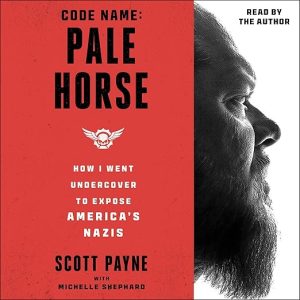
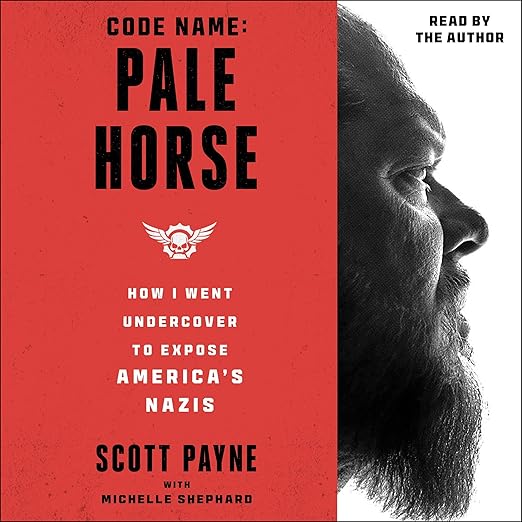
Scott Payne, the FBI undercover agent who spent years inside some of the most dangerous domestic extremist organizations in the United States, narrates his own memoir, Code Name: Pale Horse, with the kind of quiet authority that only the person who actually lived through it can bring. The audiobook runs six hours and fifty-five minutes and covers operations that read, as the publisher's copy notes, like fiction: infiltrating the Outlaw Motorcycle Club in Massachusetts, working the opioid epidemic in Tennessee, joining the Ku Klux Klan in Alabama, and culminating on Halloween night 2019, when Payne, operating as Pale Horse, stood in the backwoods of Georgia with a neo-Nazi cell as they slaughtered a goat and drank its blood in a ritual sacrifice. That scene is not hyperbole. It is the factual event at the center of this New York Times bestseller and 2026 Audie Award Finalist for Autobiography/Memoir.
Payne's Register Turns Quieter for Family Scenes
Payne's code name came to him through his infiltration of The Base, which the book describes as the nation's most dangerous and fastest-growing white supremacy group at the time of his operation. The designation of Hillbilly Donnie Brasco, assigned by those in the Bureau who recognized what Payne was doing in back-country terrain, is both accurate and slightly inadequate. Joe Pistone's Brasco operation was extraordinary, but it targeted the Mafia. Payne was working domestic terrorism in a politically charged environment where the stakes of undercover failure were not just personal but institutional. Two endorsements from former FBI agents, Joseph Pistone and Joaquin Garcia, who described Payne as one of the top undercover agents in the Bureau, are worth weighing. These are not publicist quotes from writers or academics; they are professional evaluations from people who understand what the work actually demands.
The audiobook's emotional core is the tension between Payne's professional identity, built on sustained deception, and his personal life: a marriage that held, two daughters raised, Sundays at church. That tension is not resolved in the book so much as honestly examined. Payne does not claim that sustaining a covert persona across years of violent, ideologically extreme environments left him unchanged. He claims that faith and family gave him something stable to return to, and his narration in the sections covering those returns carries a different register, quieter and more deliberate, than the operational chapters. That shift is audible, and it is one of the reasons self-narration is the correct choice for this material.
A Voice Actor Cannot Replicate What He Survived
Self-narration is the right call for this audiobook. A professional voice actor could approximate the Southern working-class cadence Payne deploys as cover, but they cannot replicate the specific quality of a man recounting events he survived. When Payne describes the Halloween night ritual in the Georgia backwoods, the details are already disturbing; his measured delivery, neither performed for effect nor audibly minimized, is what makes the scene hit its full register. A reviewer who described finishing the book in around three days was responding to a pace the audiobook format handles somewhat differently: the six hours and fifty-five minutes allow for a more considered listen without losing narrative momentum.
The book also functions as primary-source documentation of domestic extremism at a specific historical moment. The Base, the Outlaw Motorcycle Club operations, the KKK infiltration: Payne was present at a series of nexus points in the recent history of American extremism, and his accounts offer operational detail that is both specific and responsible. For listeners who want to understand how these organizations actually function internally, how recruitment works, how ideological commitment is reinforced day to day, and how undercover penetration disrupts or fails to disrupt that process, there is no better single-volume account currently available in audiobook form.
Three Operations Illuminate One Psychology
The structural decision to interweave the three major operations rather than presenting them purely chronologically is worth noticing. Payne uses each operation to illuminate aspects of undercover psychology that the others complicate: what changes across operations, what does not, what becomes easier and what becomes harder as you accumulate years of sustained deception. The motorcycle club chapters and the KKK chapters both clarify, retrospectively, why The Base operation required a particular kind of psychological endurance that the earlier work prepared him for. Listeners who follow that through-line will find the operational memoir is also, quietly, a psychological one about identity maintenance under extreme conditions.
Payne is also honest about the limitations of undercover work and the cases that did not produce the outcomes the Bureau anticipated. He does not present his career as uniformly triumphant, and that honesty adds considerable credibility to the whole account. The book does not editorialize about the political context of domestic extremism, which is another deliberate choice: Payne stays anchored in operational reality rather than ideological commentary, and the restraint pays dividends in credibility throughout.
No Procedural Distance From Extremism Here
This audiobook is for listeners interested in domestic terrorism, FBI procedure, or memoir from the operational edges of law enforcement. It is not for those who want procedural distance from extremism: Payne puts you inside these organizations through his own presence in them, and some of the material is genuinely disturbing in ways that cannot be softened by framing. Listeners who want to understand the recent history of American domestic extremism from someone who lived inside it, narrated by the person himself, have no better starting point than this one.
Does this audiobook cover The Base specifically, or is it primarily about earlier operations?
The Base infiltration is the climactic operation and gives the audiobook its title, but Payne covers his earlier work with the Outlaw Motorcycle Club, the opioid epidemic in Tennessee, and the KKK in comparable operational detail. The book builds to The Base rather than focusing exclusively on it.
Is the self-narration by Scott Payne a significant reason to choose the audiobook over the print edition?
Yes. Payne's own voice and delivery of the operational scenes, particularly the Halloween 2019 ritual in Georgia, adds a specific authenticity that a professional actor would struggle to replicate. His measured tone under disturbing material is itself notable and praised by reviewers.
How does this audiobook handle the political context of domestic extremism without becoming polemical?
Payne keeps the focus on the operational reality of infiltration rather than ideological commentary. He describes what these organizations believe and how they function, but the analysis remains anchored in firsthand experience rather than political argument, which gives it unusual credibility.