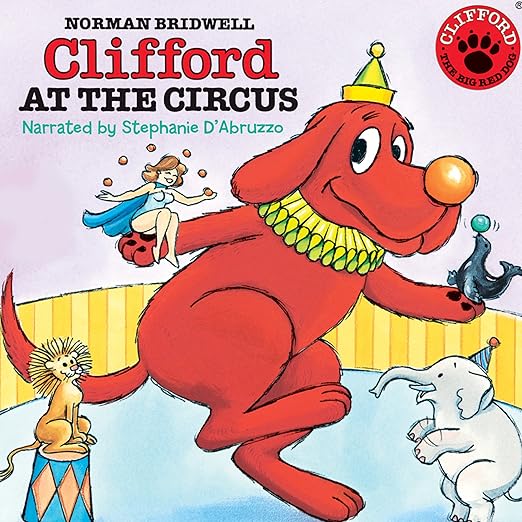
In Brief
- Performance: Stephanie D'Abruzzo is the credited reader of this four-minute picture book; no listener review addresses the recording at all, so sample it yourself for pace.
- What it covers: Circus rescue, unlikely helpfulness, friendship, bedtime routine
- Feel: Bright, brisk and affectionate, over before a small listener can fidget
- Our call: A faithful four-minute reading that earns its place in a bedtime rotation and struggles to justify itself as a standalone purchase.
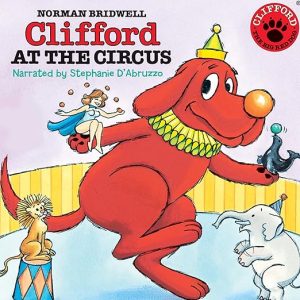
Four minutes is the entire runtime. Not four hours: this audiobook finishes in less time than it takes to make a cup of tea, and the useful question is not whether it is any good but what a recording that short is actually for. Norman Bridwell's Clifford joins a circus in trouble on Emily Elizabeth's word, tames the lions, walks the tightrope, stands in for an elephant, and then has to rescue Emily Elizabeth. That is the whole plot, moving at exactly the speed the format demands.
The first thing to weigh is what a picture book becomes once you remove the pictures. What survives is a plot with a voice on it, and whether that is enough depends on how old the listener is and whether a printed copy is also in the house. Bridwell is the credited author, and a reviewer praises the "great pictures" without hesitation, which is a fair description of what four minutes of audio cannot hand back to a child.
The runtime, though, is quietly reassuring. Another reviewer notes that Clifford books "only take about 3-5 minutes to complete", and four minutes sits precisely inside that window. The runtime therefore matches an unhurried read-aloud rather than a padded adaptation, though nobody here has described the recording itself, so treat that as arithmetic rather than as testimony. For a story of this length that is the right decision, since anything more elaborate would smother it.
The plot has a genuine turn in it, which is more than the format strictly requires. Clifford solves the circus's problem by doing several jobs he is spectacularly unsuited to, and then the problem changes shape entirely and becomes Emily Elizabeth. A reversal inside so short a span is efficient storytelling by any standard, and it gives a small listener a reason to stay attentive all the way to the end rather than drifting once the gag is established.
Four Minutes Built for the Bedtime Routine
Bedtime is what a length like this is actually for. The most useful review attached to the title comes from a household that describes Clifford books as "an absolute naptime and bedtime staple" in their house, and who identifies the reason precisely: the length means "it is easy to include these books as part of a routine". Four minutes slots into a bedtime sequence without negotiation, without a cliffhanger, and without a child asking for one more chapter.
Stephanie D'Abruzzo is the credited reader, and the demand a picture book this brief places on a narrator is narrow and worth stating plainly: clarity at an unhurried pace, warmth that never tips into condescension, and enough character in the voice to hold a two-year-old for the length of the recording. None of the three written reviews here comments on the audio at all, so I can tell you what the job requires and not how it was met.
The audience evidence is nonetheless encouraging, provided you read it for what it is. One reviewer read the book aloud at a carnival themed party and reports that all of the children enjoyed it, calling it classic Clifford. Separately, a different reviewer found it "perfect for party favors". Both are describing the book earning its keep at children's parties, which is genuinely relevant even though neither of them was listening to a recording.
Audio does hand a small child one thing the printed book cannot, which is independence. The track is short enough that a pre-reader can start it, finish it and start it over without asking anybody for help, and that is a different kind of ownership from being read to. Any parent who has lived through the endless-repetition phase will understand immediately why that matters, and why a runtime this short reads as an asset rather than a shortfall.
Losing the Pictures Costs the Physical Comedy
Losing the illustrations is the real cost here, and it should be said plainly. This is a book whose comedy is physical, and physical comedy is drawn. A child hearing that Clifford stood in for an elephant will imagine something; a child looking at the picture of it sees the joke fully formed. The audio version keeps the story and the affection intact while surrendering the visual punchlines that made the series famous in the first place.
Value is the second question, and it is a fair one. Four minutes as a standalone purchase is thin, however charming those minutes happen to be. If you are assembling an audio bedtime rotation, a single short track will not carry an evening on its own, and it is worth looking at whether a collected volume serves you better before buying individual stories at this length. That is a purchasing decision rather than a criticism of the recording.
The familiarity of the character is worth factoring in too. Clifford runs as a series, on the account of the household quoted above, and a good part of what a parent buys here is continuity rather than novelty: the same characters and the same gentle scale of jeopardy that the adult in the room may well have met at the same age. Audio changes the delivery without touching any of that, and for a bedtime purchase continuity is arguably the entire point.
The rating deserves a note too. A 4.8 average across 394 ratings is a substantial pool for something this short, and it reflects a great deal of affection for the character. All three written reviews, though, are describing the book rather than the recording: pictures, party favors, reading aloud to a room. The commentary you can actually read concerns the story rather than the reading, so let the score reassure you about Bridwell and sample the audio for yourself.
Toddlers Already in the Clifford Habit
Households with a child somewhere between toddler and early school age are the natural home for this, especially one already inside the Clifford habit, and above all at bedtime or naptime where a short, complete, low-stakes story is exactly what the moment needs. It also works well for short car journeys with a small passenger who wants something with a clear beginning and an ending before the destination arrives.
Buying it as a standalone listen for an older child, or for anyone hoping for a substantial story, will disappoint, and a child who loves the drawings will notice immediately that they are missing. As a faithful four-minute reading of a picture book that at least one household uses to close an evening, this does exactly what it was made to do. The harder question is whether that runtime justifies its own line on a receipt, and honestly the arithmetic is thin.
Questions Listeners Ask
Is four minutes really the full length of this audiobook?
Yes. The listing runs to four minutes, which matches the three to five minutes one reviewer says a Clifford book takes to complete. The arithmetic points to an unhurried read-aloud rather than an expanded adaptation, so expect the story at roughly the speed you would read it.
Is a four-minute audiobook worth buying on its own?
That depends on how you use it. As part of an existing bedtime rotation it slots in perfectly and asks almost nothing of the evening. As a standalone purchase it is very slight, and anyone building a library of listening for a small child should compare it against collected volumes before committing.