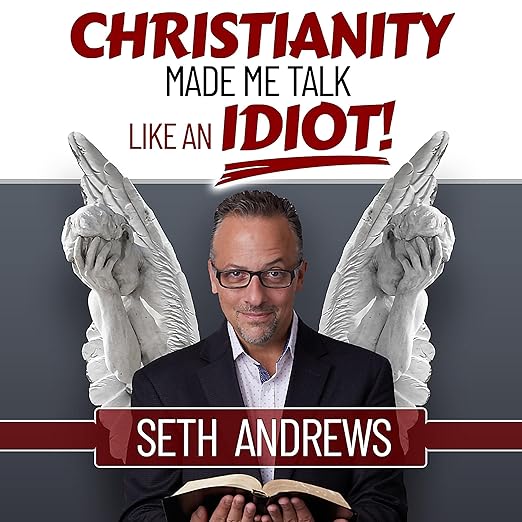
Seth Andrews was not, by his own accounting, an idiot during his thirty years as an evangelical Christian. His IQ did not shift when he left religion. So why, he asks in the audiobook of Christianity Made Me Talk Like an Idiot, narrated by Andrews himself, did he so often sound like one? Andrews spent years as a radio host and broadcaster before becoming known as The Thinking Atheist, and his voice carries the particular confidence of someone who knows exactly how to use a microphone to make a point. At six hours and fifty-seven minutes, he moves through an inventory of Christian beliefs and practices that, when examined outside the community that normalizes them, reveal their strangeness with comic and occasionally unsettling clarity.
Andrews Targets Practices, Not Believers Themselves
The book's central argument is not that Christians are stupid. Andrews is careful about this distinction throughout, and reviewer Ray captures the tone accurately: this is readable for the religious and non-religious alike precisely because Andrews is reconstructing his own experience rather than indicting everyone who believes. The targets of his critique are specific: reenacted Easter crucifixions, monthly communion as a consumption of symbolic flesh, hymns about being washed in blood, scriptural material about golden hemorrhoids, apocalypse dragons, and human sacrifice. These are real phenomena within Christian practice, and Andrews treats them as someone who once participated in them without irony, then came to see them from the outside, then tried to understand how that transition happened.
The broadcaster's discipline is visible in the audiobook's pacing. Andrews does not linger where lingering would dilute the point, and he does not rush where the subject requires sitting with the discomfort of recognition. Reviewer Thomas Edward, who came to the book having already listened to Andrews's podcast for years, found substantially new material here, which speaks to the audiobook as a genuine creative synthesis rather than a repurposing of existing content. The book shares its title with a talk Andrews gave, which serves as one of several origins for this material; the audiobook expands that foundation considerably rather than simply extending it.
Self-Narration Makes the Insider Comedy Land
The self-narration makes this the right format for this book. Andrews is performing a kind of comedy of recognition, inviting listeners who were inside evangelical culture to identify the moments when religious language required them to set aside questions they would have asked in any other context. That recognition comedy only works if the voice performing it carries the authority of someone who was genuinely inside the experience rather than observing it from the outside. Andrews has that authority. He is not lampooning Christianity as a cultural outsider; he is examining it as someone who loved it, lived it for thirty years, and then spent additional years trying to understand what he had been doing and why.
At just under seven hours, the audiobook is long enough to be substantive without exhausting its material. Andrews structures the critique thematically rather than autobiographically, which means each section functions somewhat independently as a focused examination of a particular practice or belief. That structure makes the audiobook accessible to listeners who come in with varying levels of familiarity with evangelical Christianity; the practices Andrews examines range from universally familiar to specific to certain traditions, and his explanatory framing accommodates both kinds of listener without condescending to either. Reviewer Book Shark's observation that Andrews makes arguments that belief in any gods is unnecessary captures the philosophical undercurrent of the material, which goes beyond comedy into genuine claims about religious epistemology.
Humor That Comes From Proximity, Not Distance
Listeners who come to this audiobook hoping for a gentle or purely descriptive treatment of evangelical culture will find Andrews's perspective more pointed than they might prefer. He is not a neutral observer. He is a former evangelical who left the faith and has spent years thinking carefully about why, and his conclusions are not tentative. That directness is the audiobook's strength for listeners who share his orientation and will be the source of friction for listeners who do not. The audiobook is not designed to convert skeptical believers; it is designed to give voice to the experience of people who left evangelical Christianity and found the language of their former faith newly audible as performance.
The humor is real throughout, but it is not always comfortable. The comedy comes from proximity to the material rather than from a safe critical distance, which means some passages will land differently for listeners with strong emotional ties to the practices Andrews is examining. The book does not end with a prescription for what believers should do with its argument; it ends, as Andrews frames it, with the invitation to listen and decide for yourself. That open-endedness is either generous or evasive depending on what you were hoping to take away. Andrews is also a satirist as much as a memoirist in these pages, and listeners who respond well to satirical nonfiction will find the register familiar; those expecting straightforward memoir may be surprised by how pointed the comedy gets.
Precise Language for a Familiar Deconversion Experience
Listeners who grew up in evangelical Christianity and have experienced any part of the doubt or deconversion process will find this audiobook gives precise language to experiences they may have described only vaguely to themselves. Former believers who are already familiar with Andrews's podcast will find this a more concentrated and personal treatment of his critique than his episodic content typically allows. Religiously unaffiliated listeners curious about what evangelical Christianity actually sounds like from the inside, and why that language seems impenetrable from the outside, will find it illuminating. Current evangelical believers who are genuinely curious about how a committed insider came to find the language strange are also potential listeners; Andrews is clear that he does not consider the people who believe idiots, only the linguistic and ritual forms he was required to inhabit without examining them.
Quick Take
- Read by: Seth Andrews narrating his own material is inseparable from the book's argument; he is a former broadcaster, and his vocal control, comedic timing, and ability to shift between earnest recreation and dry critique make this audiobook a fundamentally different experience from the text alone.
- At its heart: religious language as social performance, the gap between belief and intellectual self-image, deconversion as identity reconstruction
- Vibe: Sharp and funny with a current of genuine retrospective honesty about what faith required him to suspend
- Short version: Andrews at his most focused and self-revealing, with a runtime and structure that makes this audiobook more accessible than a longer treatment of the same material would be.
Does this audiobook cover the same material as Seth Andrews's podcast or YouTube content?
It covers related territory but is not a direct transcript. Reviewer Thomas Edward, a longtime podcast listener, found substantially new material in the audiobook. The book develops its argument with more sustained focus than episodic content allows and draws on Andrews's personal experience more specifically than his broadcast work typically does.
Is Seth Andrews's self-narration a significant asset for this particular audiobook?
It is arguably the defining production choice. Andrews is a former broadcaster whose vocal control and comedic timing are professional-grade, and he is performing an argument about how religious language sounds when examined from outside. His authority as someone who lived that language for thirty years makes the critique land in ways a hired narrator could not match.