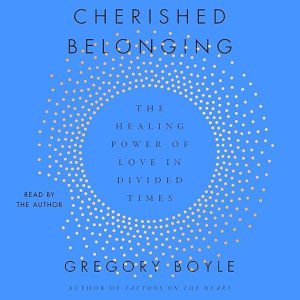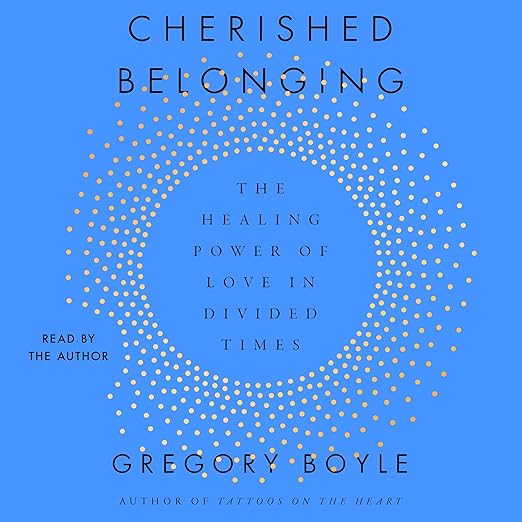
Thirty years spent building what has grown into the world's biggest gang-intervention operation gives Gregory Boyle a specific kind of authority, and Cherished Belonging spends this audiobook putting that authority in service of two deceptively simple claims: everyone is inherently good, no exceptions, and everyone belongs to everyone else, no exceptions. Boyle narrates his own material, and the stories he tells from inside Homeboy Industries, the program he founded, carry the specific texture of decades spent actually testing those two principles against real, difficult human lives rather than proposing them as abstract theology.
Boyle narrating his own book is, as with most memoir and personal testimony, simply the right call, and it matters more here than usual because so much of the material is direct reported speech, lines from the men and women he calls his homies, that a hired narrator would have to reconstruct secondhand. When Boyle quotes Pooka, a former gang member, saying that 'here, love is our lens. It is how we see things,' the line carries the specific cadence of someone who has actually heard it said many times over, not a polished paraphrase.
A. Buyer, who identifies as Buddhist, wrote that they have 'read all of Fr. Boyle's books' and called him 'one of my heroes,' which signals plainly this is not Boyle's first outing and that his appeal reaches well past his own Catholic and Jesuit readership into other spiritual traditions entirely. The same reviewer cited a specific line from within the book itself, Boyle's own formulation that 'everyone is unshakably good,' a slightly different phrasing from the book's own 'inherently good' framing but capturing the identical underlying claim.
Boyle's speaking voice is already well known to many listeners from decades of public talks, and that familiarity works in the audiobook's favor. Unlike a first-time author narrating unfamiliar material, Boyle has spent years refining how he delivers these specific stories aloud to live audiences, which means the audiobook captures a genuinely practiced cadence rather than a writer awkwardly reading his own prose out loud for the very first time.
If Love Was a Place, It Would Be Homeboy
The book's two organizing principles, that people are inherently good and that people genuinely belong to each other, sound almost too simple stated abstractly, but Boyle spends the book demonstrating what happens when an institution actually organizes itself around them for three decades straight. Marcus, one of the men who came through the program, is quoted telling a classroom of inner city teenagers, 'if love was a place, it would be Homeboy,' a line that compresses the entire argument of the book into a single sentence.
The book's own framing places it alongside Anne Lamott, Mary Oliver, and Richard Rohr, three writers who each share Boyle's interest in grounded, unsentimental spirituality over abstract doctrine, and that comparison holds up well across the book's stories. Boyle also reaches back further than his own three decades of work, arguing that early Christianity itself began as a spiritual movement built on equality and peace, a way of life rather than a fixed set of beliefs, before institutions reshaped it into something more rigid.
Richard, another listener, distilled his reaction into a short but genuine exclamation: 'a message of hope for us all,' describing the book as offering 'a proven way to effective inhabit this planet together.' That last phrase reads slightly rough on the page, but the sentiment underneath it, that Boyle's framework is not just inspiring but actually workable, tested by an organization that has operated it for thirty years, is exactly the kind of practical claim the book keeps returning to.
Boyle Rarely Resolves a Story Into a Moral
This is explicitly a book of Catholic and Jesuit spirituality, even though A. Buyer's own Buddhist perspective suggests its appeal extends past any single faith tradition. Boyle writes and speaks as a priest, and his theological claims, that compassion is the answer to every genuine question, that early Christianity was fundamentally about emancipation, are offered from inside that specific religious framework rather than a secular or interfaith one. Listeners who want the practical, story-driven wisdom without the explicitly Christian theological scaffolding underneath it may find themselves doing some translation work as they listen, converting his religious vocabulary into their own preferred framework.
The material Boyle draws from is not uniformly gentle at all. Homeboy Industries exists because gang violence, incarceration, and premature death are real and ongoing facts in the communities it serves, and some of the book's stories carry that weight directly. Margot Howard, one reviewer, noted that 'being present pushes fear out and makes space for humor, healthier connection and positive expansion,' and that balance, real loss sitting alongside real humor, is accurate to the book's actual tone, but listeners expecting only comfort and inspiration without any grief-adjacent material should adjust expectations slightly.
At eight hours and six minutes, the book moves through a genuinely large number of individual stories rather than one sustained narrative arc, which means the pacing depends heavily on how much a given listener connects with Boyle's essayistic, story-by-story structure throughout. Listeners who prefer a single throughline memoir over a collection of connected reflections and anecdotes should know this leans closer to the latter.
Margot Howard's review also points to a real interpretive demand the book makes: understanding 'the complexity of the world' well enough to 'see more clearly the essence of goodness around us,' in her own words, requires a listener genuinely willing to sit with ambiguity rather than receive tidy takeaways. Boyle rarely resolves a story into a simple moral; he lets the specific human details of a homie's life carry whatever meaning the listener draws from it.
Compassion Is Universal, the Language Is Not
Social workers, chaplains, teachers, and anyone working directly with at-risk or justice-involved youth will find that Boyle's three decades of frontline experience translates into more than inspirational language; it offers a genuinely tested framework for practice. Listeners already familiar with Boyle's public speaking or Homeboy Industries' own reputation will find this a natural continuation, while newcomers to his voice will still find it a complete, self-contained entry point that requires no prior exposure to his earlier work.
Anyone allergic to explicitly religious framing, even of the gentle, non-doctrinaire kind Boyle practices, may find the steady presence of prayer, scripture, and priesthood throughout the book more than they bargained for going in. The compassion at the center of the book is universal; the language surrounding it, specifically, is not.
- Narrator: Gregory Boyle narrates his own reflections with a practiced, speech-honed cadence, giving quoted lines from Homeboy Industries members genuine, lived-in weight.
- Subjects: Radical compassion, community and belonging, early Christian roots of kindness
- Tone: Warm and reflective, grounded rather than saccharine despite heavy subject matter
- Bottom line: A genuinely moving, self-narrated collection of reflections from decades of frontline work, best for listeners open to its explicitly Christian spiritual framing.
Common Questions
Does Gregory Boyle narrating his own audiobook make a real difference compared to a professional narrator?
Yes. Boyle has spent years delivering these specific stories aloud in public talks, so the audiobook captures an already practiced cadence rather than an author reading unfamiliar material for the first time.
How emotionally difficult is this audiobook given its subject matter around gang violence?
It does not shy away from real loss and hardship, but multiple listeners describe the overall tone as balancing grief with genuine humor and warmth rather than sitting in despair.