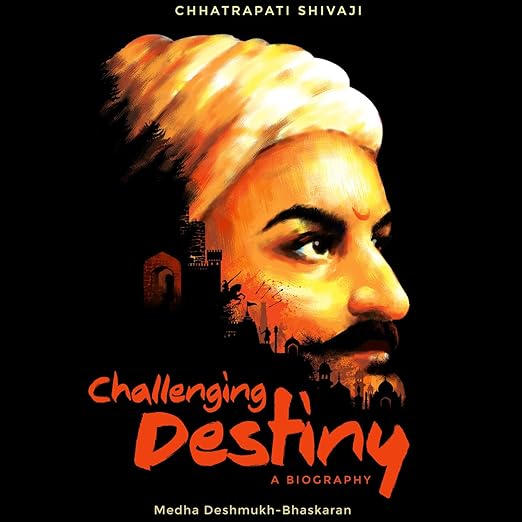
Seventeenth-century India under Mughal expansion is the backdrop Medha Deshmukh Bhaskaran sets before introducing her actual subject, the warrior-king Shivaji, and this audiobook spends real time on that context before the more familiar biographical beats begin.
A Navy Built to Contest European Maritime Power
Bhaskaran frames Shivaji as a warrior and thinker operating well ahead of his historical moment, someone who envisioned dignity, respect, and economic empowerment for ordinary people at a time when the subcontinent was dominated by imperial power on one side and colonial naval ambition on the other. The book traces how a single regional leader built enough military and ideological force to challenge the full weight of the Mughal Empire, a genuinely improbable historical arc that the book treats with appropriate weight rather than flattening into simple triumph.
The synopsis frames the conflict as a clash between 'conflicting ideologies, contrasting belief systems, and sharply different visions of India,' and the book bears that framing out: this is not presented as a simple military campaign but as a contest over what direction the subcontinent's future was actually going to take.
Part of what makes Shivaji's specific historical arc so remarkable, and part of why the book spends real time on it, is the range of different kinds of power he had to build essentially from nothing: a land army capable of challenging Mughal forces many times its size, a network of hill forts across difficult terrain, and eventually a navy meant to contest European maritime dominance along the western coast. Bhaskaran treats each of those as its own achievement rather than folding them into one generic rise-to-power narrative. That naval effort in particular is easy to overlook in popular accounts of Shivaji that focus mainly on land battles and fort-building, and the book's attention to it fills in a genuinely underappreciated part of the larger historical picture.
Singh's Fluency With Marathi and Mughal Terms
Avinash Kumar Singh narrates with the kind of cultural fluency this material needs, moving between Marathi and Mughal-era terminology, regional geography, and period titles without stumbling over the pronunciation the way a narrator less familiar with the region's history might. That fluency matters more than usual here, since the book leans on specific place names and historical terms that carry real weight for listeners who already know this history and real orientation value for listeners who do not. That fluency also extends to correctly pronouncing the Sanskrit-derived honorifics and titles the text uses when describing Shivaji's court and administration, a detail easy to get wrong but consistently handled well here.
Reviewer JBJS specifically credits the 'painstaking amount of research' behind the book, adding that 'history is well understood when it is looked at with context of what's happening around during that time.' Another listener, abhishek gupta, writes that Shivaji's 'honor, valor and dharma fuels countless hearts and minds till today,' devotional language that runs through this listing's reviews consistently and signals plainly what kind of book this is before a single chapter begins.
The book moves between battlefield strategy and more reflective passages about governance philosophy and religious tolerance, and Singh handles that tonal range without either flattening the military sequences into dry procedure or overplaying the more contemplative material into sermonizing. That balance matters for a figure as mythologized as Shivaji has become; a narrator who leaned too hard into either register would tip the book further toward hagiography than it already leans. Singh's steadiness across that range makes the whole book read as one coherent portrait rather than two different books awkwardly stitched together.
Reviews That Read Closer to Worship Than Analysis
Worth naming honestly: the reception around this book, both in the synopsis's own language and in listener reviews, runs closer to reverence than detached historical assessment. Reviewer rAdhAkRSNa titles their review entirely in capital letters to explain 'why he was GREAT,' and another opens by noting 'no wonder he is worshipped.' Listeners expecting a critical, warts-and-all academic biography should recalibrate; this is history written from inside genuine cultural admiration for its subject, not against a skeptical baseline.
Listeners with no prior background in Maratha or Mughal history should expect a learning curve in the early chapters, since the book assumes at least passing familiarity with the broader political landscape of seventeenth-century India even as it works to build context. A quick outside primer on the Mughal Empire's reach at the time would make the opening stretch land with more clarity.
Listeners without a glossary or reference handy may want to keep a search engine within reach for the region's courtly titles and geography, which the book uses fluently but does not always stop to define for an outside audience. That is a reasonable choice for a book clearly written with real familiarity with its subject in mind, but it does mean a listener new to the region's history will occasionally need to pause and look something up rather than absorb everything by ear alone. None of this is a serious barrier to enjoying the book, but it is worth setting expectations accurately: this functions best as an engaged, occasionally interactive listen rather than pure passive background audio, and keeping a phone or tablet within reach turns those pause-and-look-up moments into a minor, even enjoyable, part of the listening experience rather than a real obstacle.
A Regional Maharashtra Story Skipped by General Surveys
Listeners interested in South Asian history, anti-colonial and anti-imperial resistance movements, or leadership under seemingly impossible odds will find eleven hours and eighteen minutes well used here, especially anyone already familiar with Shivaji's cultural stature looking for a fuller, more detailed account of exactly how that stature was earned and sustained across the centuries since.
Members of the Indian diaspora looking for a deeper connection to a specific regional history, Maharashtra's role in resisting Mughal expansion, rather than a generalized account of Indian history overall, are an especially strong fit, since the book's regional specificity is exactly what a broader survey history would necessarily compress or omit. That specificity is the book's real value proposition, a detailed regional story most general histories of India only mention in passing. Educators looking for material to supplement a broader world history or South Asian history curriculum will also find the book's regional depth genuinely useful as a targeted case study, and the book's clear narration makes it easy to assign specific chapters as standalone listening.
Readers seeking a strictly neutral, revisionist academic treatment rather than a work written in open admiration of its subject should approach with that framing in mind before pressing play.
Before You Press Play
- Voice: Avinash Kumar Singh narrates with real cultural and historical fluency across Marathi and Mughal-era terminology.
- Big ideas: anti-imperial resistance, seventeenth-century Indian history, leadership against impossible odds
- Atmosphere: Reverent, sweeping, historically dense
- Worth it?: A historically rich, openly admiring account of Shivaji's rise, best suited to listeners already invested in South Asian history.
Common Questions
How much prior knowledge of Mughal or Maratha history does the Challenging Destiny audiobook assume?
Some. The book builds real context, but listeners with zero background should expect a learning curve in the early chapters covering the broader seventeenth-century political landscape.
Is the Challenging Destiny audiobook a neutral historical account or does it celebrate Shivaji?
It is openly admiring rather than neutral. Both the synopsis and the listener reviews reflect genuine reverence for Shivaji as a cultural and historical figure.
How long is the Challenging Destiny audiobook?
It runs 11 hours and 18 minutes, enough time to build substantial historical context around Shivaji's rise against the Mughal Empire.
Does Avinash Kumar Singh's narration handle Marathi and Mughal-era terminology well?
Yes. His narration moves through regional place names, period titles, and historical terminology with real fluency rather than stumbling over unfamiliar pronunciation.