Before You Press Play
- Read by: Ambi Kavanagh reading her own work brings an unhurried, meditative quality that suits the guided exercises well, though the pace can feel slow outside of the practice sections.
- At its heart: Chakra energy alignment, seasonal and lunar self-care rituals, holistic wellness through ancient systems
- Vibe: Calm and grounding, with a ritualistic warmth
- Short version: A thorough entry point for anyone curious about chakra-based self-care practices, most valuable when listened to actively with the supplemental PDF in hand.
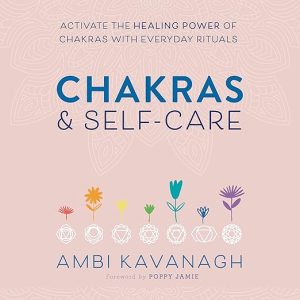
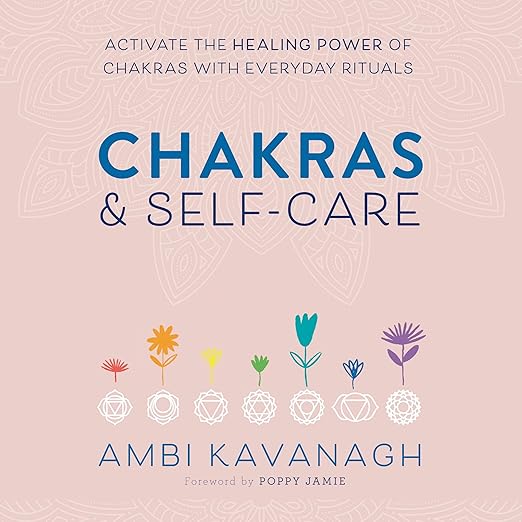
I came to Chakras and Self-Care on a Sunday evening after a week that had felt scattered in the way weeks sometimes do, when the hours pass but nothing quite coheres. There is a particular appeal to wellness audiobooks in that state of mind, and Ambi Kavanagh's approach, grounded in the chakra system but extended outward into seasonal rituals and elemental correspondences, offers more than the usual affirmation-and-breathe format. Whether that appeals or exhausts you will depend almost entirely on how much you want to engage with its framework on its own terms.
Kavanagh is a Reiki master and wellness expert, and she narrates her own book with the unhurried authority of someone who has taught this material in person many times. The audiobook arrives with a supplemental PDF of charts, essential oil recipes, and an appendix from the print edition, and that PDF is not optional reading. Without it, several of the activation exercises lose their visual reference points, and some of the elemental and astrological correspondence charts become difficult to follow by ear alone. Listeners who plan to engage with this as a practice resource rather than passive listening should download the PDF before starting.
What Ambi Kavanagh Delivers
The organizing structure is the seven chakras, and Kavanagh works through each one methodically, pairing each energy center with affirmation exercises, visualization practices, and physical activation techniques. This is not unusual for chakra literature, but what distinguishes this particular approach is the layering of additional systems: astrological correspondences, goddess archetypes, essential oil blends, and sacred stones are all mapped onto each chakra, creating a dense associative network that goes well beyond the basics. Reviewers who came in as beginners noted that the depth surprised them. One reviewer described the chakra information as original and not the usual introduction, which gets at something real: Kavanagh is not content to simply describe the root, sacral, solar plexus sequence and call it a day.
The affirmation, visualization, and activation exercises are the most immediately practical sections of the book. Kavanagh reads them with the measured pacing of a guided meditation, which works well in audio. The essential oil blend recipes are included in enough detail to be usable, and while you will want the PDF for the specific proportions, Kavanagh does explain the reasoning behind each blend aloud, which adds context to the purely instructional content. This dual-layer approach, explaining the why alongside the how, is one of the book's consistent strengths across all seven chakra sections.
What Makes Chakras & Self-Care Worth Hearing
The section I found most distinctive, and most genuinely useful as listening material, is the seasonal energy rituals. Kavanagh structures self-care not just around the individual chakras but around nature's rhythms and lunar cycles, arguing that true preventive health involves reconnecting with external cycles as much as tending to internal ones. This is a broader claim than most wellness books make, and Kavanagh makes it with enough specificity to be actionable rather than vague. The daily rituals are designed to be short and repeatable, and several reviewers mentioned returning to specific sections when they needed a particular kind of reset.
For listeners who already have some familiarity with chakra work, this seasonal and lunar dimension is likely where the book offers something new. For complete beginners, the sheer volume of systems introduced simultaneously, chakras plus astrology plus elements plus goddess archetypes plus essential oils, can feel overwhelming in the early chapters. One reviewer characterized it as excellent for beginners while also noting the breadth, and both assessments can be true. The book is beginner-accessible in that it explains each system from scratch, but it is not a minimalist introduction by any measure.
Things to Know Before Starting Chakras & Self-Care
Author-narrated wellness books live or die on the quality of the reader's voice and pace, and Kavanagh's narration is one of the genuine strengths here. Her tone is warm without being saccharine, and the pace is slow enough to follow during active practice. The affirmations and visualizations benefit enormously from her delivery, which carries the same quality as a teacher guiding a class rather than someone reading text aloud. The risk with this kind of pace in a non-practice section is that it can feel slow when you simply want information, and that is occasionally the case in the more expository chapters. But for an audiobook designed to accompany practice rather than just inform, that trade-off is the correct one.
The audio-only limitation is most pronounced with the correspondence charts and the appendix. If you are listening in a car or on a commute, the sections referencing the PDF will be frustrating. This is genuinely a book that works best when you are stationary and have the PDF available alongside the audio, which narrows its portability compared to most audiobooks. This limitation should be weighed before purchase, particularly for listeners whose primary audiobook context is commuting or exercise.
Who Should Pick Up Chakras & Self-Care
Chakras and Self-Care is best suited to listeners who are curious about chakra work and want a thorough introduction that connects it to practical daily and seasonal rituals rather than purely theoretical descriptions. At just under five hours, it is short enough to revisit regularly, and the structure supports returning to individual chakra sections as needed. Readers who already have deep familiarity with the chakra system may find the foundational explanations more than they need, though the seasonal framework is likely to offer something new regardless of prior knowledge.
Those looking for a strictly secular wellness approach, or who find the goddess archetypes and astrological correspondences outside their interest, will find the framework limiting. This is a book written entirely within its own spiritual vocabulary, and it does not translate or justify that vocabulary for skeptical readers. That is not a flaw exactly, but it is a meaningful self-selection criterion. If the chakra system as a model for human health and energy is not something you are prepared to take seriously on its own terms, the practical exercises will likely feel arbitrary.