- Performance: Richard Dawkins brings unmistakable intellectual authority to the narration, though his well-known atheist position occasionally shades the delivery of ostensibly neutral interview material in ways attentive listeners will notice.
- What it covers: Loss of faith among clergy, institutional religion and dissent, the isolation of private unbelief
- Feel: Sober and quietly devastating, with moments of surprising tenderness
- Our call: A rigorous and compassionate study of clergy who have privately lost their faith, genuinely important work that earns its place in the literature on religion and doubt.
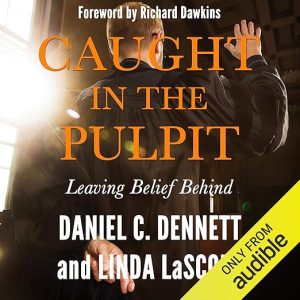
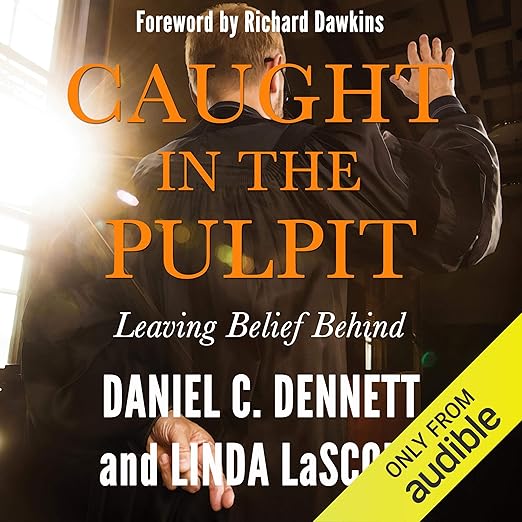
I came to Caught in the Pulpit through a reference in a book about religious sociology, which is not a typical recommendation pipeline but turned out to be exactly the right context. This is not a polemical work dressed in the language of scholarship, it is a genuine qualitative study of a specific, underexplored population, and its scholarly DNA shows. Dennett and LaScola conducted confidential interviews with clergy across the ministerial spectrum, from Catholic to Mormon to Pentecostal to Episcopalian, who had privately abandoned belief while continuing to serve in their religious roles. The expanded edition updates that research and deepens the case study base.
The narration by Richard Dawkins is the fact most likely to provoke immediate reaction from listeners, and it deserves honest engagement. Dawkins is one of the most prominent public atheists alive, and his narration of a book that is largely sympathetic to the struggles of non-believing clergy might seem either poetically appropriate or editorially compromised depending on your prior relationship to his work. I found it mostly the former, with occasional moments where his delivery suggests someone who has long since resolved the questions these clergy are still working through.
Priests, Ministers and Rabbis Losing Private Belief
The central insight of the book is deceptively simple: there exists a population of people whose professional identity, social relationships, family stability, and financial security are all bundled together with a set of beliefs they no longer hold. The conditions that make leaving nearly impossible are not weakness or hypocrisy, they are structural, and Dennett and LaScola are careful to map those structures rather than judge the individuals caught within them. One reviewer described the book as well documented, fascinating, very credible and deeply disturbing, which captures the tone precisely.
The case studies move across denominations in a way that illuminates both the common pattern and the significant variations. A Catholic priest's situation differs substantially from that of a Baptist minister or a Reform rabbi, and the authors honor those distinctions while also identifying the shared experience: the moment when seminary education or deep private study leads to conclusions that cannot be reconciled with what is preached from the pulpit, and the long subsequent negotiation with what to do about that.
This Speaks to More Than Just Clergy
One reviewer who had personally left a literalist church, without ever preaching, described finding refreshing honesty and clarity in the book that resonated with their own experience. This points to one of the audiobook's more unexpected audiences: people who have navigated faith transitions of any kind, not just clergy. The specific institutional pressures are unique to professional religious service, but the interior experience of holding private belief at variance with one's social and professional context is far more widely shared than the book's narrow subject might suggest.
The scholarship is genuine without being inaccessible. This is an expanded and updated edition, which means the research has been deepened since the original publication, and the additional interview material adds texture to the initial findings. Listeners interested in the sociology of religion, the psychology of belief, or the institutional dynamics of religious organizations will find this rigorously useful rather than merely provocative.
Case Studies Over a Dramatic Central Thesis
The case-study format, flagged by one reviewer as unexpected, is worth noting. This is not a narrative work that builds toward a conclusion through story, it is an accumulation of testimony and analysis. Listeners who prefer their nonfiction to have a more linear argumentative structure may find the format feels less driven than they expect. The payoff is in the texture of the interviews and the care with which the authors contextualize individual experience within broader patterns, not in a dramatic central thesis.
The don't-ask-don't-tell dynamic within religious institutions, the institutional preference for not surfacing doubt, is identified as a significant structural element, and the book's implications for the future of religious institutions are raised without being fully developed. This is a study, not a manifesto, and readers who want Dennett and LaScola to draw sharper conclusions from their data will find the restraint appropriate to scholarship but occasionally frustrating as a reading experience.
Not a Polemic, Despite Dawkins' Narration
This is for listeners interested in the sociology and psychology of religious belief, particularly as it intersects with professional identity and institutional pressure. It will resonate with people who have experienced faith transitions of their own, with anyone interested in how religious institutions handle internal dissent, and with readers who engage seriously with the current literature on secularization and belief.
It is probably not the right listen if you want a direct atheist argument, this is not a polemic, and its compassion for the struggling clergy it profiles extends to taking their institutional contexts seriously rather than simply applauding their doubts. And listeners who find Dawkins's public position too loaded to listen past should know that the narration, while competent, is not neutral in register.
Does Richard Dawkins's atheism compromise the objectivity of his narration?
It is an honest question. Dawkins narrates with care, but his delivery occasionally suggests someone for whom the central intellectual questions have been long settled. Listeners who are actively religious may find his framing difficult to separate from the material; those who are not will likely find it a credible, if not neutral, performance. The book itself is more measured than its narrator's public reputation suggests.
Is this book sympathetic to the clergy it profiles, or does it treat their continued service as dishonest?
Notably sympathetic. Dennett and LaScola are careful to map the structural conditions that make leaving nearly impossible, the bundling of professional identity, financial security, family stability, and social relationships with religious belief, and treat the clergy's situations with genuine compassion rather than judgment.
What denominations are represented in the interviews?
The book covers a wide range: Catholic, Baptist, Episcopalian, Methodist, Mormon, Pentecostal, and others. The comparative structure is one of the book's strengths, the authors honor the significant differences between a Catholic priest's institutional situation and that of a Protestant minister while identifying the common interior experience.
Is this a good listen for someone who has personally experienced a faith transition, even if they were not clergy?
Several reviewers specifically note this resonance. One listener who had left a literalist church found the book refreshing and personally resonant. The institutional pressures are unique to clergy, but the interior experience of private unbelief within a believing community is more widely shared.