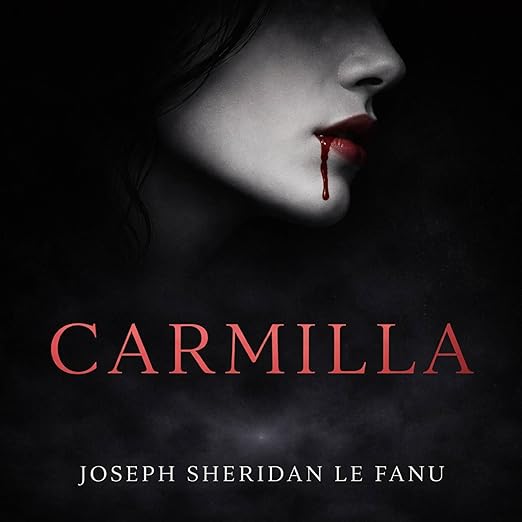
- Performance: Alex Freeman delivers a measured, atmospheric performance that honors the Gothic pacing without overplaying the dread, letting Le Fanu's prose do its own work.
- What it covers: Forbidden desire, female supernatural power, psychological horror
- Feel: Slow-burning and unsettling
- Our call: Two hours and forty-five minutes of Gothic literature that holds up with surprising force, and a foundational vampire text that rewards careful listening.
The room was quiet and the light was low, which is exactly how you should approach the Carmilla audiobook. Joseph Sheridan Le Fanu's 1872 novella predates Dracula by a quarter century and has never quite received its due in the popular imagination, despite the fact that Bram Stoker drew heavily on it. Hearing narrator Alex Freeman render Laura's isolated, seductively disorienting encounters with the mysterious Carmilla in audio format brings forward exactly what the text achieves on its own terms, before the Dracula comparison even becomes relevant. The audio context removes the distance of academic reading and places the listener directly inside Laura's unsettled consciousness, which is where the horror actually lives.
Le Fanu's prose is dense with Victorian atmosphere but not with Victorian clutter. The sentences move. Laura's first-person account of Carmilla's arrival at her father's secluded estate carries a quality of compelled fascination that sits at the intersection of desire and dread, and Freeman's narration preserves that ambiguity without collapsing it into one register or the other. This is a Gothic text that depends on what it withholds rather than what it announces, and the audiobook format at two hours and forty-five minutes gives it room to breathe without overstaying its welcome. The runtime is precisely calibrated to the novella's structure, which builds its atmosphere in slow layers rather than quick shocks.
Freeman's Voice Makes Laura's World Feel Claustrophobic
What distinguishes Carmilla from the broader vampire canon is the centrality of female experience on both sides of the predator-victim dynamic. Laura is not a passive figure waiting for rescue. Her fascination with Carmilla is active and willful, even as the circumstances around her deteriorate into genuine danger. That dynamic gives the text a psychological complexity that most horror writing of its era does not attempt, and that complexity is part of why the novella has remained in continuous critical discussion since its publication and continues to attract new audiences more than a century and a half later.
The themes of forbidden desire and isolation read differently in audio than they do on the page. Freeman's vocal choices emphasize the claustrophobia of Laura's domestic world, the estate as a kind of gilded enclosure that makes Carmilla's arrival feel not just threatening but revelatory. One reviewer praised the book's descriptive writing as something for readers who appreciate classic prose, and that appreciation translates cleanly to listening. Le Fanu rewards an audience that is willing to sit with ambiguity and let the atmosphere accumulate before demanding resolution. Freeman understands this and does not rush the pauses.
Carmilla's Fingerprints Are All Over Dracula
The audiobook version of Carmilla is particularly well-suited to listeners who come to it as foundational vampire literature rather than as casual horror entertainment. This is a text with a documented influence on Stoker, and hearing it in audio reveals just how many of Dracula's most effective elements, the psychological manipulation, the seductive approach before the attack, the slow erosion of the protagonist's certainty, were already fully formed in Le Fanu's work decades earlier. The historical interest compounds the literary interest in a way that gives the listening experience multiple layers of engagement.
At the same time, the novella functions as a compelling LGBTQ text in ways that feel remarkably forward rather than merely antiquated. The queer reading of Carmilla is not a retrospective imposition; the text is explicit in its depiction of intense same-sex desire, presented through the conventions of Gothic horror but never actually concealed by them. For listeners interested in the history of queer representation in literature, this audiobook is genuinely significant rather than merely curious. It belongs in the same conversation as later works that more openly claim that territory.
Audio Removes the Print Edition's Spoiler Footnotes
The pacing is Gothic, which means patient. Listeners conditioned by contemporary horror, with its rapid escalation and explicit reveals, may find Le Fanu's accumulative approach demanding in the early sections. The dread in Carmilla is atmospheric and oblique. Things are felt before they are seen, and seen before they are explained. That is precisely the technique's strength, but it requires a different kind of engagement than modern horror conventions invite, and some listeners will need to consciously adjust their expectations before the text rewards them.
One reviewer flagged that some editions of the printed text include footnotes that interrupt the story with editorial opinions, in some cases even spoiling plot developments before they occur. That is worth noting as a contrast because the audiobook format eliminates that particular problem entirely. Freeman reads the text without editorial intrusions, which allows the narrative to unfold exactly as Le Fanu intended. In this specific case, the audiobook is arguably a cleaner experience than certain annotated print editions that editors have felt the need to annotate toward a particular interpretation.
Gothic and Victorian Fans Are the Natural Audience
This audiobook is best suited to listeners with an existing interest in Gothic fiction, Victorian literature, or the history of vampire mythology. Fans of Le Fanu's other work, particularly In a Glass Darkly, in which Carmilla appears as one of five connected tales, will find the audio format an excellent way to revisit the novella. Readers who want to understand what Stoker absorbed and transformed will find the comparison illuminating and will likely return to both texts with new eyes after hearing this one.
General horror fans who are new to Victorian prose should be forewarned about the period-specific pacing, but for listeners willing to meet the text on its own terms, Carmilla delivers genuine chills alongside genuine literary depth. Alex Freeman's narration is a capable guide into Le Fanu's particular darkness, and at under three hours, the investment is modest relative to the return. This is one of those cases where the audiobook format genuinely serves the source material rather than merely adapting it.