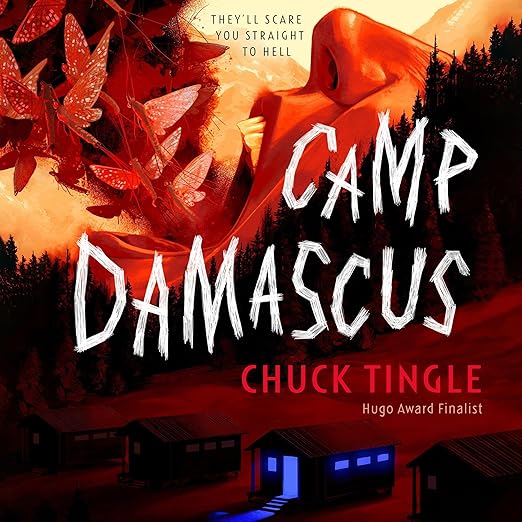
Can a horror novel simultaneously chill you to the bone and feel like an act of love? I listened to this audiobook over two evenings, and by the time I reached the final chapters, I was genuinely unsettled in a way that stayed with me long after I pulled out my earbuds. Chuck Tingle built his reputation writing stories that celebrate love in its most unexpected forms, and Camp Damascus proves that sincerity can coexist with genuine terror.
The setup is precise and pointed: Rose is a deeply religious young woman in Neverton, Montana, whose faith is real and whose community appears loving. She is also autistic, which Tingle weaves into her characterization not as a quirk but as a lens. The way Rose processes information, notices patterns, and resists the social pressure to perform neurotypical normalcy turns out to be exactly the kind of mind that can see through what Camp Damascus actually is.
First, the Big Picture
This audiobook works because it takes its horror seriously. Reviewer Stephanie Hulsey observed that everything Tingle writes is suffused with sincerity, and that sincerity is precisely what makes the horror land. The demons are not metaphorical. The conversion camp is not merely a symbol. The book insists on literalizing both in ways that are viscerally disturbing, and then it asks you to sit with the fact that the real horror in Neverton is ideological, not supernatural. The two layers reinforce each other rather than canceling out.
Rose's autism is handled with a care that earns its place in the narrative. She scripts her social interactions, she finds comfort in routine, and she reads the people around her through behavioral pattern-matching rather than intuition. This makes her simultaneously more vulnerable to certain kinds of manipulation and uniquely equipped to identify inconsistencies that everyone else smooths over. Tingle does not use autism as a plot device; he uses it as a characterization framework that happens to be plot-relevant.
Mara Wilson's narration is one of the strongest elements of this production. The AudioFile review noted that she conveys all of Rose's intelligence, inquisitiveness, and fear as she is hunted by otherworldly beings, and that assessment is accurate. Wilson understands that Rose is not a passive victim, and she modulates the performance accordingly. The moments of terror feel earned because Wilson has built a character who has agency throughout, which makes it hurt more when that agency is threatened. Her pacing in the quieter scenes, where Rose is processing what she has seen and building her understanding, is particularly effective.
The production is a Macmillan Audio release from Tor Nightfire, and it has the polish you would expect from that combination. At just under ten hours, it is a controlled runtime that never outstays its welcome.
Weak Spots in Camp Damascus
The book's structure deserves attention. Reviewer Chels noted that the story elements have coherent patterns, and that is deliberate. Tingle is working in a tradition of horror that uses its formal shape to reinforce its thematic content. The escalation is systematic, not random. Each revelation layers onto the previous one, and the third act pays off setup that was established much earlier. This is more disciplined than many horror debuts manage.
The religious community of Neverton is portrayed with a complexity that some horror novels avoid. The faith of its members is presented as genuine, not merely as a mask for malice, which means the horror of the camp is not reducible to simple hypocrisy. Something truly terrible is happening there, and the people enabling it are not all cynical operatives. That ambiguity is uncomfortable in the right way.
T. Kingfisher, whose endorsement appears on the cover, described it as a joyful, furious romp through dark places, which is a useful preparation for what you are getting. Joyful might seem like an odd word for horror about conversion camps, but by the time the ending arrives, you understand what she means. The book is angry, but the anger comes from a place of genuine love for the people it is defending.
Rose's community in Neverton is not a collection of villains. This is one of the novel's more sophisticated moves. The people who perpetuate Camp Damascus are not primarily cynical operators; many of them genuinely believe in what the camp represents, which makes the horror harder to locate and harder to escape. Tingle's background in writing about love in all its forms gives him a specific angle on the damage that systems built around the rejection of love can do, not through cruelty alone but through sincere, organized belief. The book Long-listed for Library Journal Best Books of the Year in 2023, and the recognition is warranted. This is a debut that knows exactly what it is doing.
Is This One for You?
Horror readers who want their genre fiction to have something to say will find this deeply satisfying. Listeners interested in queer representation who also have a tolerance for genuine scares will find it unusually well-constructed. If you are autistic or have an autistic family member, the characterization of Rose is worth seeking out independently of the horror context.
Listeners who want their horror purely atmospheric and divorced from social commentary may find the political dimensions intrusive. Camp Damascus wears its convictions openly, and the horror is inseparable from those convictions. If you want the supernatural elements without the ideological argument underlying them, this is not the book for you. It is also worth noting that the content involves religious trauma and conversion therapy, which may be genuinely distressing for listeners with direct experience in those contexts.
Common Questions
How frightening is this audiobook? Is it more psychological or visceral?
Camp Damascus operates on both levels. The horror has visceral elements involving demons and genuine physical danger, but the deeper dread is ideological. The conversion camp at the center of the story is disturbing because of what it represents, and Tingle makes sure both layers are working simultaneously.
Is this audiobook appropriate for listeners with personal experience of religious trauma or conversion therapy?
The book engages directly with conversion camp practices and religious community pressure, so listeners with close personal history in those contexts should approach with awareness. The narrative is ultimately on the side of the people who survived such environments, but it does not soften the depiction of what they survived.