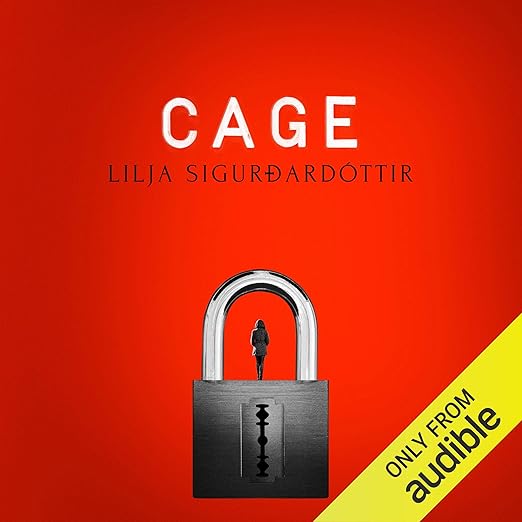
Crime trilogies are hardest to build at the end, and the reason is structural: two books of accumulating threat have to resolve inside a third, usually in less room than either of them took. Cage runs eight hours and thirteen minutes of audiobook, opens with Agla walking out of prison to find that the person she expects is not waiting, and spends what remains settling accounts. Debts, betrayals, an international fraud, a drug empire with a fault line running through its own house. The response column keeps circling that structural problem without ever quite naming it.
One Voice for Four Names That Won't Agree
Lilja Sigurdardottir is how the byline reads on this record. TapTheLine, writing in September 2019, spells it Lilja Sigurðardóttir, and the difference is not decorative if you are trying to follow a series across editions and formats: search one spelling and the other may not surface. The record files the series as the Reykjavik Noir Trilogy while the description on the same page calls it the Reykjavík Noir trilogy, accented. Small things, and they are exactly how series listings fracture into pieces that never find each other again.
Agla's release starts the clock. Foreign businessmen pull her toward a fraud the description says stretches from Iceland around the world, her former nemesis María somehow ends up on the same side of it, and Ingimar, called a ruthless drug baron, sits on a powder keg in his own home without knowing it. Sonja comes back from London with a threat to her family behind her. Four moving parts, eight hours, and one credited voice to keep them separate by sound alone.
Sonja is also Sonya. The description introduces her as Agla's lover with a j, then a few lines later warns of a deadly threat to Sonya with a y, as though a second character had walked in. Both spellings sit in the same block of text. That same block repeats its own opening sentence as its closing paragraph, word for word, drugs and smuggling and big money and political intrigue arriving twice inside a description you could read in one breath. Whoever assembled this page was not reading it.
Suzannah Hampton Alone Against Four Icelandic Names
Iceland gives the trilogy its particular flavor of crime: a financial world small enough that fraud is personal, and a cast who all seem to have met before. Linda Sparks sums the appeal in three words, excellent, fast-paced, exciting, and the early hours do deliver that. Yvo, the most detailed responder here, praises the eclectic mix of elements and points of view that carried the first two books, and notes this one picks up six years after the second leaves off. That gap is doing real work. Six years is long enough for a criminal ecosystem to reorganize itself, and the book opens with the reader as far behind the characters as Agla is behind the world outside her cell, which is either an elegant piece of construction or an obstacle, depending on how much of the earlier plot you still carry.
Mixed is the honest word for what the column says next. TapTheLine, at three stars, calls Cage a weaker novel than its two predecessors and describes the final impressions as somehow mixed, while insisting that does not blemish the trilogy overall. The response signed jody b. read all three, ranks this one below the others, and calls the ending very disappointing. Yvo still cannot decide whether it is weaker, but confirms the road the third book takes was unexpected. Three readers, three versions of one reservation.
Suzannah Hampton is credited alone, and the one response that touches anything a reader can affect gets there sideways. GypsyWeaver, arriving at this author for the first time, reports attention held throughout but repeated confusion keeping the main characters straight. In print that is a structural complaint about a multi-strand plot. In audio it is also a casting question, because a single voice separating Agla, Sonja, María and Ingimar across shifting viewpoints either fixes that confusion or doubles it, and the page keeps its own counsel. The Icelandic names alone make that credit worth a sample before purchase, since a listener meets Agla, Ingimar and María by ear long before seeing them spelled.
Every Review Describes a Novel, Not a Performance
Nobody in the column reviewed the recording. TapTheLine quotes a passage by ebook percentage, jody b. talks about reading all three, and the rest describe a novel rather than a performance. That is the ordinary condition of a review column inherited from print, and the practical effect is that the eight hours you would be buying carry no listener verdict at all. The star line offers nothing either: 4.1 sits above a counter reading 1, with five written responses stacked underneath it.
Latecomers should know what they are walking into. This is the third of three, it opens on a release from prison that means nothing unless you know what put her there, and Yvo describes the book as quite different from its predecessors in ways that read as deliberate rather than accidental. The description compounds the problem by giving away the fraud, the drug empire and the threat to Sonja's family, which is most of the machinery, while telling you nothing about how the previous two books ended. A description that spoils the present and withholds the past is a strange artifact, and it is what you get on this page.
Wrong Entry Point for Anyone New to Sigurdardottir
Completists with Snare and Trap already behind them are the obvious audience, and they should temper expectations rather than avoid the book. Every detailed responder here says some version of the same thing: this one is different, this one is weaker, this one still belongs. If two novels of Agla and Sonja are already behind you, eight hours to see where the pair land is an easy call, and the compressed running time means the ending arrives without a long approach. The fraud plot is the part that rewards patience; the domestic wreckage inside Ingimar's house is the part that pays fastest.
Nordic crime listeners meeting Sigurdardottir for the first time have picked the wrong entry point, and GypsyWeaver's experience proves it: held attention, constant confusion over who was who. The financial-fraud strand assumes a familiarity with the earlier plots that no summary on this page provides. Anyone who needs a narrator to build characters from scratch, rather than reactivate ones already known, should also weigh the single-voice credit against a cast of four viewpoints. Come to Cage third, or come to it much later.
A Few Questions About Cage
Does the Cage audiobook work if you have not heard the first two Reykjavik Noir books?
Poorly. It opens on a prison release whose meaning depends on the earlier novels, and Yvo notes the story resumes six years after the second book closes. GypsyWeaver, starting here, held attention but kept losing track of who was who. Begin with Snare if you want the ending to land.
How many narrators does the audiobook credit for a story with several viewpoints?
One. Suzannah Hampton is the only voice listed for eight hours and thirteen minutes covering Agla, Sonja, María and Ingimar. No posted response comments on how well those four stay distinct by ear, so the single-voice question goes untested on this page.
Why does the description spell the same character both Sonja and Sonya?
No good reason. The opening paragraph names Agla's lover Sonja, and a later paragraph warns of a threat to Sonya, treating one character as two. The same description also repeats its first sentence verbatim as its final paragraph, which suggests the copy was pasted rather than written.