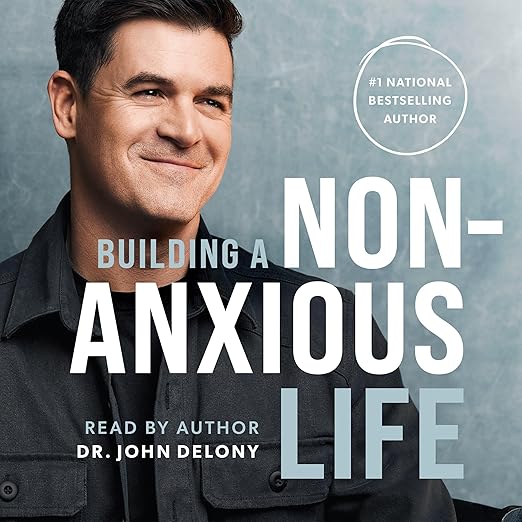
Dr. John Delony's approach to anxiety in Building a Non-Anxious Life begins with a reframe that is worth naming directly: he treats anxiety not as a character flaw or a chemical imbalance to be managed away but as an alarm system that has been miscalibrated by the conditions of modern life. That reframe shapes everything that follows in this audiobook, which arrives with Delony's own narration and the full authority of someone who has spent twenty years researching mental health, living through his own period of crisis, and working with people who are drowning in the ordinary pressures of contemporary existence. At six hours and nine minutes, this is substantive without being exhausting.
What We Made of It
Delony's six-choice framework is the book's structural backbone: choosing reality, choosing connection, choosing freedom, choosing health and healing, choosing mindfulness, and choosing belief. The framework is simple enough to hold in working memory - which matters for a book aimed at people who are already overwhelmed - and each choice is specific enough to generate real questions about how it applies to a particular listener's situation. Delony resists the urge to flatten these choices into affirmations or daily habits in the thin motivational sense. "Choosing reality" is not about positive thinking; it is about accurately perceiving what is actually happening in your life and relationships rather than operating from catastrophizing or denial. That precision distinguishes the book from the wider self-help genre's tendency toward vague reassurance.
The personal dimension is calibrated carefully. Delony refers to his own experience with crisis and breakdown without making the book a memoir. He positions himself as someone who has been where many readers are and who has done the work to get somewhere different - not recovered in the sense of being finished, but functional in the sense of being able to choose rather than simply react. That positioning is honest and earns trust with an audience that can detect performed wellness from some distance. The "no-nonsense, straightforward approach to mental health" described in the synopsis is accurate: Delony does not soften the difficulty of the six choices or suggest that making them once is sufficient.
Why Building a Non-Anxious Life Works as an Audiobook
Delony is one of the more significant voices in the accessible mental health space, known to a large audience through his radio work and podcast presence. His self-narration brings that conversational register to the audiobook format, and the six hours here feel organized around listening rather than reading - there is a rhythm to his delivery that keeps the framework grounded in specificity. The sections on choosing connection are particularly well-suited to audio, because Delony speaks about the actual mechanics of human relationship with the kind of warmth that is easier to transmit in voice than in text. His directness about what anxiety is costing people - the blame, the anger, the impatience he names in the synopsis's opening questions - lands with more immediacy in his own voice than it would in a stranger's reading.
Reviewers have consistently described the book as both quick and substantive, which is an unusual combination. One described it as a "breath of fresh air" with practical applicability to everyday life - a descriptor that points toward what Delony actually accomplishes here. He is not writing theory; he is writing instructions for people who need something to do with their anxiety today rather than a comprehensive understanding of its neurological underpinnings. The clinical grounding is present but worn lightly.
Delony's framework sits in interesting relationship to the therapeutic culture it emerges from. He has clearly absorbed both clinical psychology and more recent neuroscience of stress, but he presents the material without the academic distance those fields sometimes impose. The alarm system metaphor for anxiety is not novel - it appears in various forms in cognitive-behavioral and acceptance-commitment frameworks - but Delony's account of what keeps the alarm misfiring in contemporary life is more specific and culturally grounded than most clinical presentations of the same idea. He names the structural conditions: social media, chronic overcommitment, disconnection from community, the erosion of belief systems that gave suffering meaning. That list functions as a diagnosis, and it makes the six choices feel like responses to identified causes rather than generic wellness recommendations floating free of any context.
What Might Not Land
The sixth choice - choosing belief - carries an implicit framework about meaning-making that listeners should engage with actively rather than skim past. Delony's background gives his treatment of belief a particular shape, and while the chapter is not doctrinaire, listeners who are allergic to meaning-based frameworks will find it asks more of them than the preceding five choices. That is worth knowing in advance rather than arriving at it surprised at hour five.
The book is also clear-eyed about its own limits. Delony explicitly acknowledges that anxiety will not disappear and that the six choices are daily commitments rather than one-time decisions. Listeners looking for immediate relief rather than a sustainable practice may find the honesty about difficulty frustrating rather than reassuring. The structure of the framework rewards listeners who engage with each choice as a long-term behavioral shift rather than a technique to deploy in an acute anxious moment - though several of the mindfulness and connection strategies can also serve immediate purposes.
Should You Listen to Building a Non-Anxious Life?
People experiencing chronic background anxiety rather than acute clinical crisis will find this most immediately useful. The six-choice framework is practical enough to begin applying within days of finishing the audiobook, which matters for an audience that needs traction quickly. Those already working with a therapist will find the framework complements clinical treatment rather than replacing it. Listeners who have consumed a lot of anxiety-adjacent self-help and found it either too abstract or too cheerfully optimistic will find Delony's directness a welcome change of register. Those whose anxiety requires clinical intervention - severe panic disorder, OCD, trauma-based conditions - will find the six choices useful but insufficient as a standalone approach, and Delony is honest about that limitation rather than overselling the framework's reach.
Key Details
- Read by: Dr. John Delony narrates his own audiobook, and the self-narration is a genuine asset - he reads with the warmth and directness of his radio and podcast work, which makes the clinical content feel like a conversation rather than a lecture.
- At its heart: Anxiety as alarm system versus lifestyle, daily choices as the foundation of mental health, the relationship between connection and wellbeing
- Vibe: Honest and grounded, with the no-nonsense quality of someone who has sat with real people through real crisis
- Short version: A practical, clearly structured six-choice framework for addressing anxiety that works precisely because Delony does not promise to make anxiety disappear - he promises something more achievable and more durable instead.
A Few Questions About Building a Non-Anxious Life
Does Dr. John Delony's self-narration make this audiobook more or less accessible than a professional narrator would?
More accessible, in this case. Delony narrates with the directness and warmth of his radio and podcast work, and the conversational register makes six hours of mental health content feel like an extended dialogue rather than a lecture. The personal anecdotes land with more weight in his own voice than they would in a hired narrator's reading.
How does Building a Non-Anxious Life compare to other popular anxiety audiobooks?
Delony's distinctive contribution is the six-choice framework and his refusal to promise that anxiety will disappear. Where many anxiety books focus on reducing symptoms, this audiobook focuses on building conditions in which anxiety is less likely to dominate - connection, health, belief, mindfulness - which is a more structural approach than symptom management.