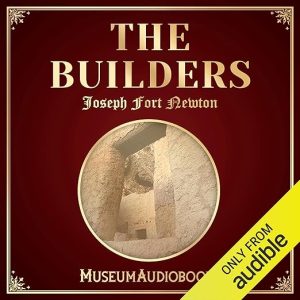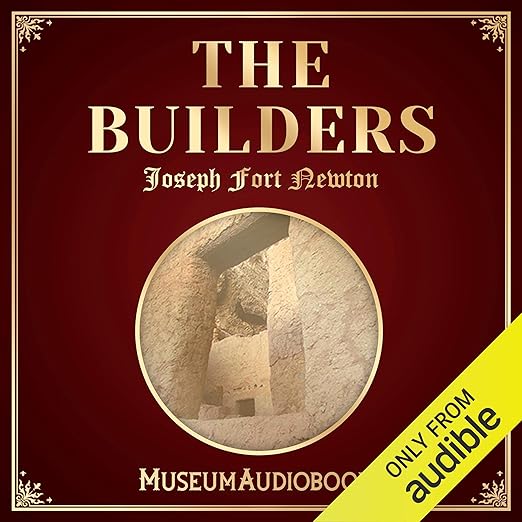
I came to Builders sideways, through a research rabbit hole that started with the symbolism in Romantic-era poetry and ended, somehow, with the Roman Collegia and the origins of operative masonry. Joseph Fort Newton's name kept appearing in footnotes, and by the time I finally loaded the audiobook I had built up an expectation of something dry and earnest. What I found was more considered than I had anticipated, and occasionally quite beautiful.
The Builders was originally published in 1914, which places it firmly in the Edwardian intellectual tradition: discursive, rhetorically ambitious, and written in a prose style that assumes its reader has time and patience. Newton was an Iowa minister and a Freemason, and this book represents his attempt to trace the philosophical and historical roots of the organization with both scholarly rigor and genuine spiritual investment. The result is an unusual hybrid: part history, part philosophy, part argument for Freemasonry's relevance to the moral life of modern men.
Newton's central historical argument is that Freemasonry derives not from the medieval cathedral builders as popular mythology suggests, but from the Roman Collegia, a society of master architects and builders with its own initiatory practices and internal hierarchy. He develops this thesis methodically across the book's early sections, drawing on ancient sources and tracing the symbolic inheritance of the building trade from antiquity forward. One reviewer noted that even those who do not accept all of Newton's conclusions will find his research impressive, and that assessment is fair. The historical sections are the book's strongest material, combining genuine scholarship with the kind of argumentative clarity that makes dense subject matter accessible.
The philosophical second half shifts register significantly. Newton moves from historical argument to rhetorical exhortation, writing about the ideals of Freemasonry in the elevated language of early twentieth-century spiritual discourse. This is where the book becomes, as one reviewer put it, pleasant but occasionally wearing. Newton believes deeply in what he is describing, and his sincerity is evident throughout. Whether the rhetorical flourishes feel inspiring or overwrought depends on your tolerance for that particular period style. As a trained literary reader, I found myself more engaged with the argumentative sections and willing to accept the exhortatory passages as artifacts of their historical moment.
The Best Parts of Builders
Anne Makoto's narration is a genuine contribution to this audiobook's accessibility. Newton's prose requires patience, and Makoto reads with a measured deliberateness that never becomes monotonous. She handles the architectural metaphors and the philosophical abstractions with equal steadiness, keeping the listener oriented through the more complex passages. For a text that might feel impenetrable in print, her audio reading functions almost as a guided meditation through Newton's argument.
The 1914 publication date means the historical research reflects early twentieth-century scholarship rather than contemporary Masonic historiography. More recent academic work has complicated some of Newton's conclusions, and listeners coming to the topic fresh should understand that this is a founding document of a discourse rather than its final word. But as a founding document, it has the qualities that made it foundational: clarity of purpose, genuine intellectual ambition, and a willingness to take Freemasonry seriously as a philosophical tradition rather than simply a social institution.
Before You Commit to Builders
One reviewer who came to the text knowing almost nothing about Freemasonry described finding a lovely and practical philosophy rather than the dry institutional history they had expected. That trajectory is worth noting: the book's philosophical register, which some experienced readers find excessive, may strike newcomers as welcoming. Newton writes as someone who wants to explain his enthusiasm, not gatekeep it, and that intention produces a text that functions as genuine introduction despite its period style.
The audio format suits this material well precisely because it enforces a slower pace than most readers would naturally impose on themselves with a 1914 text. Newton's arguments unfold cumulatively, and rushing through sections to reach the more accessible passages is a mistake. The six-hour-and-thirteen-minute runtime feels proportionate to the material's density.
Should You Listen to Builders?
Essential for anyone with a serious interest in Masonic history and philosophy, and particularly valuable for new Masons looking to understand the tradition's intellectual roots. General readers with an interest in Western esoteric thought, the history of fraternal organizations, or the symbolic life of craft traditions will find enough of substance here to reward the time. Those expecting a contemporary critical history or a modern reassessment of Masonic claims will need to supplement with newer scholarship. This is a primary source, not a synthesis.