Key Details
- Voice: Arthur C. Brooks narrates solo in his familiar measured, academic register, though Oprah Winfrey's contributions come through only as referenced material, not her own voice.
- Big ideas: Emotional self-management, happiness as a practiced skill, family and faith
- Atmosphere: Practical and grounded
- Worth it?: An efficient, research-backed happiness guide best suited to listeners who want Brooks' behavioral science delivered in his own voice, not a true co-narrated conversation with Winfrey.
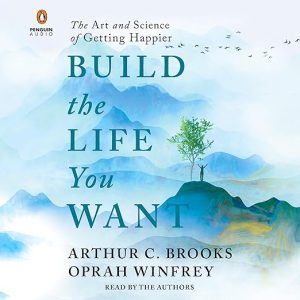
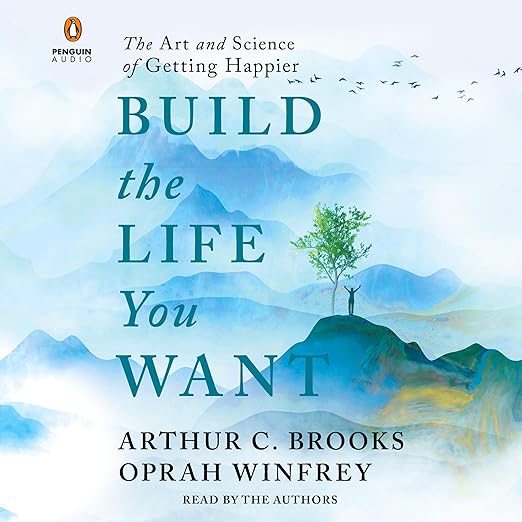
Arthur C. Brooks and Oprah Winfrey open Build the Life You Want with a claim that reframes the entire self-help genre: happiness is a skill you build, not a destination you eventually reach if circumstances finally cooperate. This audiobook, an instant number one New York Times bestseller, pairs Brooks' behavioral science research with Winfrey's decades of interviewing people about what actually sustains them, and the combination is less about motivational energy than about a genuinely practical toolkit. Brooks narrates the audiobook himself, and only Brooks is credited as narrator here, which is worth knowing upfront if you were hoping to hear Winfrey's own voice guiding you through it.
The book's structure centers on four pillars, family, friendship, work, and faith, and Brooks and Winfrey build their advice around what they call emotional self-management: specific, research-backed practices for regulating how you respond to circumstances rather than waiting for circumstances themselves to improve. Reviewer Madeline calls it 'an empowering guide to cultivating happiness and fulfillment in a world filled with challenges,' and that framing captures the book's core pitch accurately: this isn't about eliminating hardship, it's about building the internal capacity to meet it differently. That distinction, skill-building versus circumstance-waiting, repeats throughout the book as its central organizing idea, returning in slightly different language across all four pillars.
Brooks narrates with the measured, academic warmth that has become his signature register across his other audio work, unhurried and precise without tipping into a lecture tone. Reviewer Valerie Love specifically praises how 'Oprah's comments and wisdom' are interspersed with Arthur's research-driven approach and 'quotes from masters throughout the ages,' which suggests the audiobook preserves Winfrey's voice as material within the text even though Brooks alone reads it aloud.
Naming faith as one of only four core pillars, alongside family, friendship, and work, is a more distinctive choice than it might first appear, since a lot of mainstream secular self-help avoids the subject entirely or folds it into vaguer language about purpose or meaning. Brooks and Winfrey treat it as a genuine load-bearing category on equal footing with the other three, which broadens who the book speaks to directly but also means listeners hoping for a purely secular happiness framework will hit a section that assumes spiritual practice, of some kind, matters to durable well-being.
Family and friendship get treated as genuinely distinct pillars rather than folded together under a vague 'relationships' heading, a deliberate choice that reflects real behavioral-science findings about how differently those two bonds function: family ties tend to be involuntary and enduring, friendships voluntary and more fragile, requiring active maintenance most adults quietly let slide. Separating them gives the book room to address a genuinely common complaint, adult friendship atrophy, that a single combined 'relationships' pillar would likely have glossed over.
Why It Works in Audio
The strongest case for listening rather than reading is Brooks' own delivery of dense behavioral-science material. He has a genuine gift for making research findings feel usable rather than academic, and hearing the four-pillars framework explained in the voice of the person who helped develop it adds a credibility a hired narrator simply couldn't replicate. Reviewer Amazon Customer calls the book 'uplifting,' adding that it's a 'good reminder of how we should all act and build communities in support of each other,' which speaks to how practically the ideas land rather than staying abstract.
At just under 6 hours, this is a notably efficient listen for a book carrying this much cultural weight and bestseller attention. Reviewer Valerie Love calls it 'profound and common sensical at the same time,' comparing its wisdom to what 'grandma would mete it out,' but grounded in Brooks' actual behavioral science rather than folk wisdom alone, a combination that keeps the material feeling earned rather than simply comforting.
This book also sits inside a larger project rather than standing alone in Brooks' catalog; he has spent recent years applying behavioral science specifically to questions of happiness and life satisfaction across several connected books, and Build the Life You Want functions as the most accessible, broadly co-authored entry point into that ongoing body of work. Listeners who find this one useful have a real next step available rather than having exhausted Brooks' thinking on the subject in one sitting.
Winfrey's involvement carries its own kind of credibility signal separate from Brooks' academic credentials. Her long career curating book club selections and drawing out guests' hardest personal stories gives her a practiced sense for which advice actually survives contact with an ordinary listener's real circumstances, and reviewers consistently credit the blend of her testimony-driven instincts with Brooks' research rigor as the reason the book avoids feeling like either a dry academic text or a purely anecdotal inspirational one.
What to Watch For in Build the Life You Want
The single biggest thing to know before pressing play is that this is Brooks' voice throughout, not a true dual-narrated conversation between him and Winfrey. Listeners picturing an intimate back-and-forth exchange between the two co-authors should adjust that expectation; Winfrey's contributions come through as material Brooks reads and references rather than as her own recorded voice, which changes the listening experience more than the book's marketing necessarily signals upfront.
Given the compact runtime, the book moves efficiently through its four pillars rather than dwelling extensively on any single one, which works well for a listener wanting a clear framework but may leave someone hoping for deep, chapter-length treatment of just one pillar, say, faith or work specifically, wanting a follow-up read on that narrower subject afterward.
Debuting at number one on the New York Times bestseller list signals something concrete beyond quality alone: it means the book found an unusually wide audience fast, cutting across whatever separate readerships Brooks and Winfrey each bring individually. That kind of crossover reception matters for a listener wondering whether the material skews toward one audience's taste or the other's, since a bestseller of this scale generally requires appealing broadly rather than narrowly to either camp.
Who Will Get the Most From It
Anyone already following Brooks' happiness research through his Atlantic column or earlier books, along with Winfrey's broader audience, is the obvious fit here, and the compact runtime makes this an easy entry point for listeners newer to research-backed self-help who want something more rigorous than pure motivational content but don't want a multi-week commitment to get there.
Listeners specifically hoping to hear Oprah Winfrey's own voice narrating her portion of the book should know that this audio edition credits only Arthur C. Brooks as narrator, so temper that particular expectation even if her name on the cover is part of what drew you to the title.
Does Oprah Winfrey narrate any part of this audiobook?
No. Only Arthur C. Brooks is credited as narrator on this audio edition, so Winfrey's contributions come through as material he reads and references rather than her own recorded voice.
How long is the Build the Life You Want audiobook?
Just under 6 hours, a notably compact runtime for a book with this much bestseller attention, which makes it an efficient listen rather than a sprawling one.
Is this audiobook based on real research or mostly personal anecdotes?
Both, but research-grounded. Brooks brings behavioral science findings throughout, while Winfrey's material adds real-world testimony, and reviewers specifically praise the blend rather than either half alone.