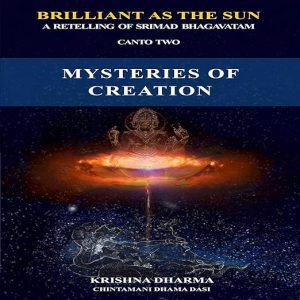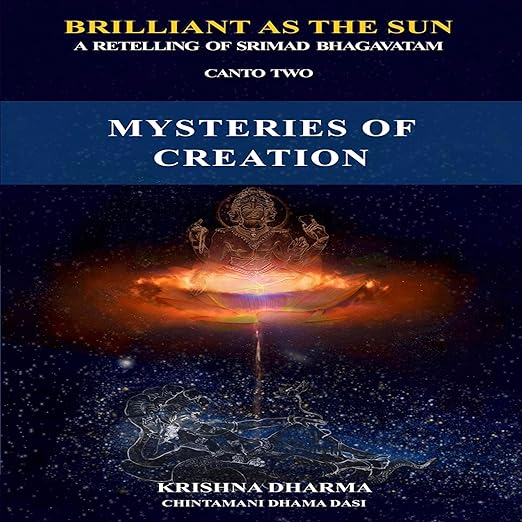
- Read by: Krishna Dharma self-narrates with the gravity and intimacy the sacred text demands, his voice steady and reverent throughout.
- At its heart: Vedic cosmology, the path beyond suffering, the nature of the Supreme Person
- Vibe: Contemplative and luminous, like sitting at the feet of a sage
- Short version: A genuinely accessible entry into the second canto of Srimad Bhagavatam for listeners willing to sit with ancient wisdom.
Srimad Bhagavatam opens in the shadow of death: King Parikit, cursed to die within seven days, sits on the banks of the Ganges and asks one of the most urgent questions a human being can ask. What is the highest duty? How does a person conquer suffering? The sage Shukadeva Goswami answers without hesitation, and everything that follows in this second canto flows from that single exchange. Listening to this audiobook on a quiet morning, I found the framing almost unbearably poignant. Seven days. The countdown is a gift, forcing a clarity most of us never find. Krishna Dharma's translation brings this material into English with a warmth and directness that distinguishes it from more academic renderings. This is not a scholarly apparatus. It is scripture presented as living instruction, shaped for contemporary listeners who may come to the Srimad Bhagavatam without any prior grounding in Vedic tradition.
The Verdict, Briefly
The second canto carries a particular weight within the full Bhagavatam cycle. Where the first canto establishes the frame narrative, the second turns toward cosmology and the mechanics of existence: how Brahma, greatest of the gods, received the knowledge of creation from the Supreme Person and then effected it. Krishna Dharma renders this material with precision but never loses the devotional thread. The description of how the all-powerful Supreme manifests the elements from his spiritual body, then enters them as an expansion of himself, is the kind of passage that rewards repeated listening. The cosmological framework is intricate, but the underlying message, that the universe is saturated with divine presence, never becomes abstract.
One reviewer described this as a path toward freedom from material desires, and that reading is consistent with the text's own claims. Srimad Bhagavatam presents birth, old age, disease, and death as the fundamental problems of human life, and the second canto positions mystic yoga, meditation, and understanding of the Supreme Person as the response. Listeners who arrive with an open mind will find this framework coherent and, at times, profound. Listeners who need empirical validation at every step may find some passages challenging, though the text's own invitation is to approach with openness rather than skepticism.
Why Brilliant as the Sun Works as an Audiobook
The audiobook form is genuinely well-suited to this material. Vedic scripture has always been transmitted orally, and hearing the Bhagavatam spoken aloud recovers something that the printed page inevitably flattens. Krishna Dharma's voice carries the text with a naturalness that reading silently cannot replicate. His pacing gives weight to the major passages, particularly the dialogue between Narada and Brahma on the process of creation, without turning the performance into a recitation.
The text also moves with more narrative momentum than listeners unfamiliar with Hindu scripture might expect. The frame story, Parikit dying while listening to Shukadeva, gives the whole enterprise urgency. Descriptions of the yogic process and the eight mystic perfections are dense, but Dharma's translation keeps them within reach. For anyone already engaged with Bhagavad Gita or the Ramayana as audiobooks, the Bhagavatam represents a natural and rewarding expansion of that listening practice. At just over four hours, this second canto is substantive without being overwhelming. And for listeners entirely new to the tradition, the text's own accessibility philosophy, presenting profound cosmological knowledge in a simplified and dramatic style, means this is a genuine entry point rather than an advanced course.
Points to Consider
The passage on mystic yoga and the eight perfections deserves focused listening. Shukadeva's delineation of man's highest duty arrives early and efficiently, but the deeper material on meditation, on the form of the Supreme Person as an object of contemplation, builds across the canto. Let it accumulate. The cosmological sections that describe Brahma receiving knowledge directly from the Supreme are particularly striking and benefit from being heard rather than rushed.
The absence of citation for specific ancient source texts is not a problem in the same way it would be for an academic text, since the Bhagavatam itself is a canonical primary source. Listeners who want deeper scholarly context will need to supplement with secondary reading, but for the purposes of this audiobook, the text stands on its own authority. One reviewer also noted that its descriptions of universal origins will fascinate those interested in cosmology and astronomy, presenting as they do the intricate scientific understanding of the enlightened sages of ancient India. Coming to those passages with curiosity about the parallel and divergence from contemporary physics makes the listening richer.
Should You Listen to Brilliant as the Sun?
This audiobook will resonate most strongly with listeners already drawn to Hindu philosophy, Vaishnavism, or the broader tradition of Vedic cosmology. It is also worth the attention of anyone interested in ancient answers to perennial questions: why does suffering exist, what is the nature of consciousness, what persists beyond the body. Listeners who found value in Bhagavad Gita as It Is or other works in the Vaishnava tradition will find this a natural companion.
Listeners who require secular frameworks or who find devotional scripture alienating may struggle with passages that presuppose the reality of the Supreme Person and the validity of mystic experience. This is not a failing of the text; it is the nature of sacred literature. Come with curiosity rather than resistance, and the canto rewards that approach considerably. The frame narrative alone, a man given seven days to understand everything that matters, is worth the time of any thoughtful listener regardless of tradition.
Does the audiobook work as a standalone, or do I need to have heard the first canto of Srimad Bhagavatam first?
It works as a standalone introduction to the second canto. Krishna Dharma's translation provides enough context that prior familiarity is not required. Starting here is a reasonable entry point for curious listeners.
Is the audiobook narrated in a way that makes complex Vedic cosmology accessible to general listeners?
Yes. Krishna Dharma self-narrates with clarity and warmth. The cosmological passages on creation and the nature of Brahma are dense, but his pacing and the simplicity of the translation keep them within reach for attentive listeners without specialist background.
At just over four hours, does this audiobook feel comprehensive, or does it leave major questions unaddressed?
Four hours covers the second canto thoroughly and includes the key dialogues on creation, yoga, and meditation. It is a complete rendering of this canto rather than a survey. Listeners wanting more will find additional cantos available separately.