Before You Press Play
- Narrator: Krishna Dharma self-narrates with quiet authority, his fluency in the Sanskrit source tradition giving his delivery an ease and reverence that a hired narrator approaching the material cold could not match.
- Subjects: Creation cosmology, liberation from material suffering, the nature of the Supreme and its relationship to the individual soul
- Tone: Meditative and luminous
- Bottom line: For listeners drawn to Vedic cosmology and Hindu philosophy, this four-hour retelling of the second canto offers genuine depth in an accessible format that honors both the text and the listener.
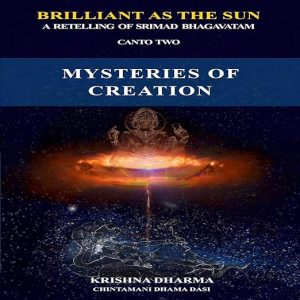
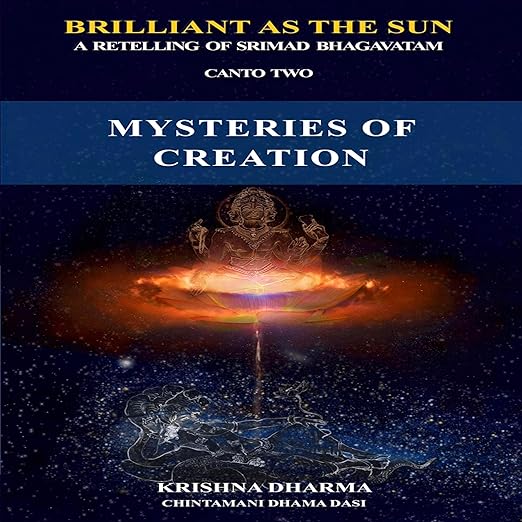
Krishna Dharma's audiobook retelling of the second canto of Srimad Bhagavatam is a genuinely rare thing in the religious audio space: a serious sacred text rendered accessible without being flattened. Brilliant as the Sun: A Retelling of Srimad Bhagavatam earns its perfect rating from reviewers not because it shies away from the text's philosophical density, but because Dharma brings sufficient care and skill to the translation and dramatic retelling that the density becomes navigable rather than impenetrable. This is the kind of sacred text engagement that rewards returning to: the four-hour runtime does not exhaust the material, it introduces it in a form designed to generate further inquiry.
The second canto of the Bhagavatam opens with one of the most dramatically charged scenarios in Vedic literature. King Pariksit has been cursed to die in seven days. Confronted with mortality in its most concentrated and unavoidable form, he asks the great sage Shukadeva Goswami the most urgent question available to him: what is the highest duty of a human being, and how can suffering and death be transcended? The answers Shukadeva provides unfold over the remainder of the canto, moving through the path of mystic yoga and meditation before arriving at the breathtaking cosmological sequence in which Narada questions Lord Brahma about the process of creation. Dharma describes this as a simplified and dramatic rendering, and the phrasing is precisely accurate. He does not strip the philosophy to make it palatable: the discussions of how the all-powerful Supreme Person manifests the elements from a spiritual body, enters them as an expansion of himself, and produces the template for creation that Brahma then effects are present in their full complexity. What he strips is the opaqueness, replacing it with narrative momentum and clear prose that respects the listener's intelligence while removing unnecessary barriers to comprehension.
The Best Parts of Brilliant as the Sun: A Retelling of Srimad Bhagavatam
At four hours and seven minutes, this audiobook functions as an ideal entry point into the Bhagavatam for listeners who have been curious about the text but intimidated by scholarly translations loaded with untranslated Sanskrit and extensive footnotes. The audio format suits this material particularly well for a specific historical reason: the Bhagavatam was originally transmitted orally, recited by sages to assembled listeners, and hearing it spoken aloud by someone with Dharma's fluency in the tradition restores something of that original context and purpose. One reviewer described the narration as brilliantly done and easy to follow, which captures the achievement: Dharma makes a cosmological text about the origins of the universe and the nature of liberation feel immediate rather than remote. The questions the Bhagavatam addresses, why the universe exists, how humans came to be within it, why suffering persists despite an omnipotent Supreme, and how liberation from repeated birth and death is possible, are not antiquarian concerns. They are live questions for any serious person in any era. The Bhagavatam's answers are more precise and more philosophically developed than most Western listeners will expect, and Dharma's retelling lets those answers arrive with the force they deserve.
Before You Commit to Brilliant as the Sun: A Retelling of Srimad Bhagavatam
Listeners approaching this without any prior exposure to Vaishnava philosophy or Sanskrit terminology should give themselves permission to hear the text more than once. The cosmological sections, particularly the passages describing Brahma's act of creation and the structure of the universal form of the Supreme Person, are dense with technical vocabulary that Dharma explains within the text but that requires active attention to follow on first hearing. The four-hour runtime covers only the second canto: this is not a complete retelling of the entire Srimad Bhagavatam, which spans twelve cantos and addresses an enormous range of theological and cosmological subjects. Listeners should approach it as a single chapter of a much larger philosophical text rather than a complete document in itself. The epistemological framework the Bhagavatam operates within, treating the testimony of liberated sages as a valid and superior source of knowledge about cosmological and spiritual realities, is genuinely different from modern scientific or analytical philosophical frameworks. Listeners who can hold that difference consciously without immediately dismissing it will get significantly more from the material than those who require the framework to match their existing assumptions before engaging with the content.
Should You Listen to Brilliant as the Sun: A Retelling of Srimad Bhagavatam?
Practitioners of bhakti yoga, Vaishnavism, or any tradition within the broader Hindu sampradaya will find this retelling both accessible and reverentially handled, and will likely want to extend the listening with the remaining cantos. Listeners with an interest in Vedic cosmology, including the intricate descriptions of universal structure and origin that Dharma notes will fascinate those interested in cosmology and astronomy, will find substantive content that goes well beyond what most introductory texts on Hindu philosophy offer. Anyone working through the fundamental questions of suffering, mortality, and liberation in their own life, regardless of religious or philosophical background, will encounter here one of the most developed and systematically argued answers those questions have received in any tradition. Skip this one if you are looking for academic analysis, historical-critical scholarship, or comparative religion framing: Dharma's approach is devotional and rooted in the living tradition, not secular or comparative. The audiobook rewards listeners who approach it with genuine openness rather than the evaluative distance that academic engagement tends to require.