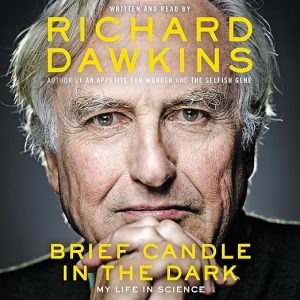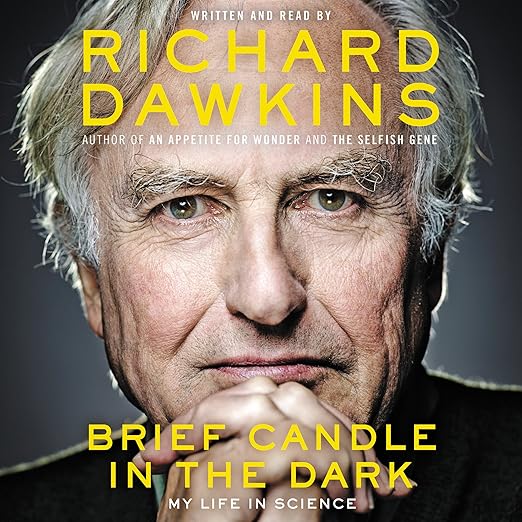
I spent several evenings across two weeks with Brief Candle in the Dark, fitting it around other books in the way you might schedule a long correspondence with a friend whose letters always arrive longer than you expected. Richard Dawkins is not a writer whose memoirs demand sprint-reading; they invite a more leisurely kind of attention, the kind where you find yourself less interested in what comes next than in turning a particular passage over to examine it from another angle. That is both the book's pleasure and, for some readers, its limitation. It is a memoir written by a man who has thought deeply about his own intellectual life and is not inclined toward false modesty about what he found there.
Brief Candle in the Dark is the second volume of Dawkins's autobiography, following An Appetite for Wonder, which covered his early life and the writing of The Selfish Gene. This installment takes up from that departure point and moves through the subsequent books, the intellectual throughline from The Extended Phenotype through The Blind Watchmaker and onward, before arriving at what for many readers is the moment of most interest: the circumstances that led to The God Delusion, the book that transformed Dawkins from evolutionary biologist and public intellectual into one of the defining figures of the New Atheist movement.
Structuring a Memoir Around His Published Works
The organizational logic of Brief Candle in the Dark is biographical but also bibliographic. Dawkins structures the memoir around the succession of his published works, using each book as an occasion to recall the intellectual and personal conditions of its composition. This approach is more interesting than it might sound, because it reveals the degree to which Dawkins's books are not isolated contributions but a continuing conversation with himself, each one emerging from questions raised by the previous, each one reaching further into the implications of the evolutionary framework that has organized his thinking for his entire career.
The chapter material on The Selfish Gene's aftermath is among the most valuable in the book for readers interested in how scientific ideas move through popular culture. Dawkins traces the ways in which the concept of the selfish gene was misunderstood, weaponized, and occasionally enriched by its passage through non-specialist readers and commentators, and his reflections on the responsibility of a scientist who has written for a general audience carry real weight. The discussion of the meme concept, introduced in The Selfish Gene and subsequently developed a cultural life of its own that Dawkins observes with a mixture of pride and slight bemusement, is particularly engaging.
The Iraq War Years That Led to God Delusion
For many listeners, the chapters leading up to and surrounding The God Delusion are the book's primary reason for existence, and they do not disappoint. Dawkins is candid about the role of political events, the Iraq War, what he describes as George Bush's lurch toward theocracy, in shifting his attention from evolutionary biology to the explicit confrontation with religious belief that The God Delusion represents. The account of the New Atheists as a loosely aligned coalition, Dawkins, Christopher Hitchens, Sam Harris, Daniel Dennett, is drawn with evident affection and specificity. His portraits of Hitchens in particular are among the book's most vivid pages.
The reviewer who describes yearning for 'more of his humorous yet scathing criticisms of religion' after a long memoir that is more anecdotal than polemical is capturing something real about the book's tonal register. Brief Candle in the Dark is not The God Delusion. It is a memoir, and memoirs run on reminiscence and personality rather than argument. Listeners who approach it expecting sustained intellectual combat with religion will find instead a more reflective and personal mode, which is appropriate for the genre even if occasionally frustrating for readers who came for the polemics.
Dawkins Narrates Like an Oxford Dinner Guest
Dawkins narrating his own memoir is the only version that makes proper sense, and for most of the thirteen-plus hours it is a pleasure. His voice carries authority and a particular dry wit that suits the anecdotal material well. He reads as someone who is genuinely enjoying the act of recollection, and that enjoyment is contagious in the better sections. At full stretch, the performance has the quality of a very long and very good Oxford dinner conversation, erudite, funny, slightly self-referential, confident that the stories being told are worth telling.
The phrase 'admiration fatigue' that one reviewer uses to describe the experience of the book's less-disciplined passages is honest and worth addressing. Dawkins does not pretend to an ordinary life or a modest reputation, and the memoir's relationship to his own significance is unambiguous. For readers who share his intellectual commitments and find his confidence earned, this will not be an obstacle. For readers who come to the memoir more neutrally, some sections will feel less like candid reflection and more like an extended exercise in self-documentation. Both readings of the same passages are available, and which you access depends largely on what you bring to the book.
Essential for Readers Already Invested in Dawkins
Brief Candle in the Dark is essential listening for committed Dawkins readers and for anyone with a serious interest in how The God Delusion was conceived and what its publication meant for the public discourse around religion and science in the mid-2000s. It is rewarding for readers interested in the sociology of intellectual celebrity, how a scientific reputation translates into broader cultural influence, and at what cost. It is less rewarding for general memoir readers who have no particular prior investment in Dawkins or evolutionary biology, for whom the extended self-reflection will likely feel insufficiently grounded in the universal. Those coming to it primarily as a document of the New Atheism period will find it authoritative if occasionally more self-congratulatory than strictly necessary. The ideas that organized a career are here, clearly articulated, and often illuminating, and that, across fourteen hours of a life richly spent in intellectual engagement, is considerable.
Good to Know
How much of the audiobook is devoted to The God Delusion and the New Atheism, versus the earlier scientific work?
The book covers the full arc of Dawkins's intellectual career, with the New Atheism chapters forming the later portion. Listeners who come specifically for the God Delusion backstory and the portraits of Hitchens, Harris, and Dennett will find those chapters richly detailed but will need to move through substantial earlier material to reach them.
Is this an appropriate listen for someone who is not already a Dawkins reader?
It is possible but limited. The memoir's pleasures are largely bibliographic, Dawkins using each book as an occasion for reflection, which presupposes some familiarity with the works being discussed. New readers curious about Dawkins would do better to start with The Selfish Gene or The God Delusion before returning to the memoir for context.