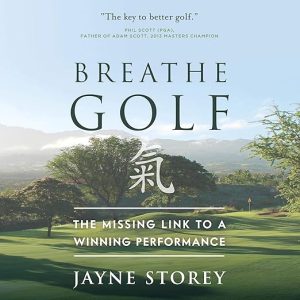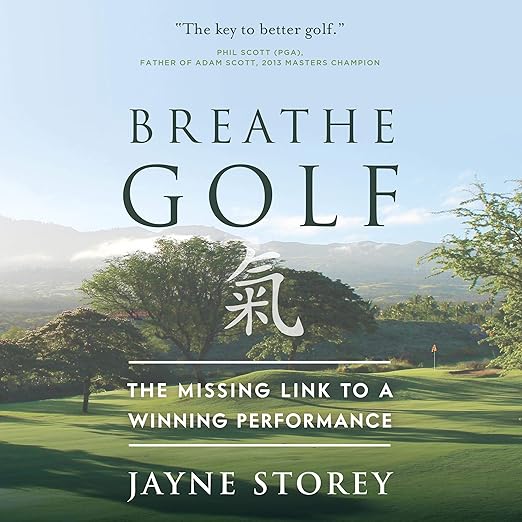
Golf instruction rarely arrives from a teacher of Eastern philosophy, and that mismatch is the first thing to understand about this four-and-a-half-hour audiobook. Jayne Storey comes to the game from a lifetime of meditation and Tai Chi plus eighteen years of research into the perfect golf shot, and the resulting book is not about the swing at all. It is about the breath immediately before it. The claim is that the quiet mind and the effortless shot are the same phenomenon approached from different sides, and that most players lose strokes to mental interference long before technique becomes the limiting factor.
Structure follows the claim closely. The recording works through reducing mental interference, reaching what the copy calls the zone, strengthening the mind-body connection, uniting the mental game with technique, managing anxiety, preparing for competition and performing under pressure, and it supports all of that with real student case studies and more than fifty drills. That is a large amount of practical scaffolding for a book this short, and the ordering is sensible: diagnosis first, competition last. It is also labeled as the first entry in a Performance Practice series, though no companion volume appears anywhere on the listing.
Effortless is the word the book stakes itself on, and it needs unpacking because it sounds like marketing and is not being used that way. What Storey means by it is a shot produced without the layer of conscious management most amateurs add under pressure, and eighteen years of research into a single motion is a narrow enough brief to take seriously. The competition framing is unusually explicit for a book that spends its time on breathing: the stated aims run all the way to mastering anxiety and winning tournaments, not to enjoying the walk. This is performance material with a contemplative method, which is a rarer combination than either half suggests.
Evidence from the reviews is more concrete than most sports-psychology titles manage. One five-star listener reports outright that a hole-in-one followed from the technique, and supplies the context that makes the claim worth reading: a player of sixty-seven with a handicap of ten, mechanically solid, who had already been studying breath control and wanted something simple that worked. That is the profile the book is written for, and it recurs across the pool. This is not a book that promises transformation to a beginner, and its readers do not report receiving one.
Why Breathe GOLF Works as an Audiobook
Sincerity is what the most detailed notice keeps returning to. It opens on "the sincerity with which this book is written", says it "comes from the heart of someone who genuinely wants to share" the method, and quotes Storey's own framing of the breath as "the missing link to a winning performance". Then it makes the sharp observation that nobody can sell you breath, only the reasons to pay attention to it. That is precisely the book's commercial problem and its intellectual appeal in one line: the raw material is free, universal and already in your possession, and what is being taught is attention rather than a product.
Storey reads her own text, and for this subject the decision is close to structural. Breathing instruction delivered in print requires you to read a paragraph, put the book down and then try to reconstruct a rhythm from memory; delivered aloud, the timing is simply given to you, and you can follow it in the moment. One five-star listener describes exactly this pattern, having found the author's teaching on video first and then moved to the recording, which suggests the audio functions as practice material rather than as reading matter. Four and a half hours is also short enough to replay a section before a round without much friction.
Case studies do more work than the drill count suggests. A five-star listener who has filled the three years since retiring with golf books and videos describes never having connected an existing meditation practice to the course until this one, which is the exact gap the student examples are built to close. That listener played as a child, set the game aside until retirement and came back to it, and the resulting profile, technically capable and mentally stuck, recurs through the pool. Hearing another player's account of the same impasse read aloud lands differently from reading it, mostly because the format removes the temptation to skip ahead to the instruction.
Weak Spots in Breathe GOLF
Fifty-plus drills are the format's weak point, and the copy accidentally names the problem when it promises a manual you will refer to again and again. Reference is what linear audio does worst. Locating one specific exercise inside a four-and-a-half-hour file, six weeks after you first heard it, means scrubbing through chapters with no index, and the same returning player quoted above, stuck on a plateau and losing shots to driver and putter, is exactly the listener who will want to go back to a single drill. Plan to take notes, or plan to own both formats.
Who is actually reporting back is worth noticing. Three of the five written comments supply a handicap or an age, and the numbers describe committed players rather than newcomers: handicaps of ten and fifteen, ages of sixty-seven and sixty-eight, decades of play behind them. Two of them also arrived with a practice already in place, breath control in one case and tai chi, yoga and meditation in another. That is a self-selected group, and it means the visible evidence tells you how the method lands for experienced players with a settled swing, and almost nothing about how it lands for anybody else. Behind them sit 293 ratings and a 4.6 average.
The Right Listener for Breathe GOLF
Experienced golfers whose mechanics are sound and whose scores collapse under pressure are the target, and the reviews suggest the book reaches them. Competitive amateurs, club players in local tournaments and anyone already meditating who has never connected that practice to the course will find the bridge built for them. One four-star listener describes the breathing becoming a habitual part of a one-shot routine, which is the realistic best case: not a revelation, a routine.
Beginners should wait. A player still learning where the ball goes has technique problems that no amount of breath work will address, and this book explicitly positions itself as the layer above technique rather than a replacement for it. Anyone wanting swing mechanics, equipment advice or course strategy has come to the wrong book. And anyone whose learning style demands a printed exercise to work through should buy the book instead, because the drills are the part of this the format handles least well.
In Brief
- Narrator: Jayne Storey reads her own breathing instruction, which turns a printed exercise into something you can follow in real time.
- Subjects: Breath control, pre-shot routine, meditation and Tai Chi, performance anxiety, the mental game.
- Tone: Calm, patient, unexpectedly technical.
- Bottom line: Genuinely useful for experienced players stuck on the mental side, close to useless for anyone still fixing a swing.
Before You Listen
Is the Breathe GOLF audiobook useful for a high-handicap beginner?
Not really. The method sits above technique rather than replacing it, and the reviewers who report results describe settled swings and years of play, with handicaps of ten and fifteen. A beginner is still losing strokes to mechanics, which breathing work cannot fix.
Can you follow the drills while listening?
Partly. Breathing sequences come across well when spoken, because the timing arrives ready-made instead of being rebuilt from a printed paragraph. Retrieving a single named drill later is the awkward part, since scrubbing through chapters is no substitute for an index. Take notes.
Does the author narrate this audiobook herself?
Yes. Jayne Storey reads her own instruction, which matters more here than usual: breath work is timing, and hearing the person who developed the method set that timing removes a translation step. The instruction arrives at the pace its author intended rather than one a reader improvises.
How much Tai Chi or meditation background do you need?
None going in, though listeners who already sit or practice report the quickest connection. The contemplative training behind the method stays in the background, since everything is presented as golf instruction, and reviewers arriving with no such history describe picking up the pre-shot routine easily.