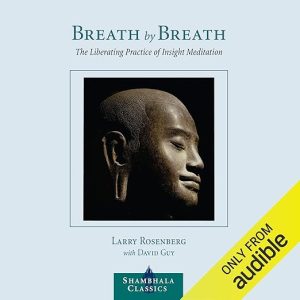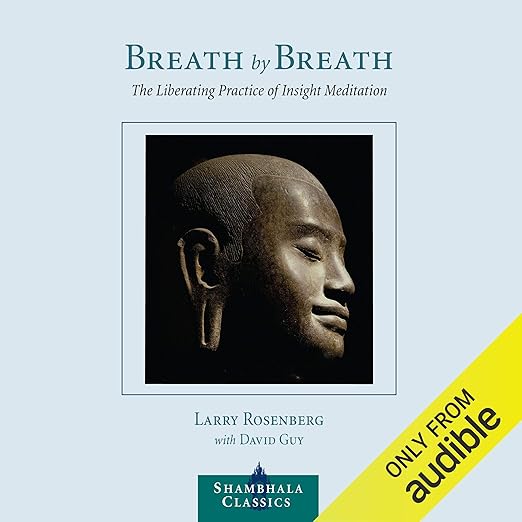
I came to Breath By Breath after several years of inconsistent meditation practice, the kind where you know enough to know you are doing it wrong but not enough to course-correct. I had read the popular mindfulness books, worked through a few apps, attended one retreat where I spent most of the time wondering whether I was doing the sitting correctly. What Rosenberg's book gave me, and what I could not have anticipated from the synopsis alone, was a sense of the practice's depth without any accompanying sense of demand. He is not asking you to achieve anything. He is describing a way of paying attention, chapter by chapter, and letting the description do the work.
The Anapanasati Sutra is the Buddha's specific teaching on cultivating awareness through the breath. Rosenberg works through its sixteen contemplations across the book, beginning with the most basic, simply knowing when you are breathing in and out, and moving gradually toward the later contemplations on impermanence and liberation. He is at pains throughout to insist that this is not an academic exercise and that the contemplations are instructions to be practiced, not understood intellectually. A reviewer who described themselves as a thirty-year-plus practitioner noted that the book's authority comes from direct experience rather than scholarly distance, and that is exactly right.
Ballerini's Pace Favors Meditation Time Over Commute Time
Edoardo Ballerini is an interesting choice for this material and a good one. His voice has a natural quality of attentiveness, a sense that he is present in the reading rather than simply delivering the text. For a book about cultivating presence, that quality is not incidental. His pacing is slightly slower than the average narrative nonfiction narration, which creates the feeling of reading in meditation time rather than commute time. That is either a feature or a frustration depending on what you are looking for, but for this subject matter I think it is a feature.
The book situates itself explicitly in the Vipassana tradition, the insight meditation lineage that includes teachers like S.N. Goenka and Mahasi Sayadaw, and Rosenberg is connected to that lineage through his teaching at the Cambridge Insight Meditation Center. He acknowledges his debts throughout, which gives the book a sense of being part of a living tradition rather than a personal invention. One reviewer helpfully positioned it in a sequence following Jon Kabat-Zinn's Wherever You Go, There You Are and Henepola Gunaratana's Mindfulness in Plain English, describing Breath By Breath as the more advanced next step for readers who have worked through those titles.
Bigger Than Stress Reduction, Leavened by Humor
What distinguishes Rosenberg from the more popular mindfulness literature is his refusal to separate technique from understanding. He is not giving you a ten-minute breathing exercise to reduce stress. He is explaining what the breath awareness practice is for, what it reveals, and what it is pointing toward, namely the direct experience of impermanence and the liberation that follows from meeting that experience without resistance. That is a much larger project than stress reduction, and Rosenberg holds its scale without making it feel inaccessible.
The humor that several reviewers mention is real and necessary. Rosenberg writes with warmth and occasional self-deprecation, and he is skilled at the specific kind of teaching humor that punctures the tendency toward meditative solemnity without undercutting the seriousness of the practice. A thirty-year practitioner called his "wisdom and humor" one of the book's distinctive qualities. At seven hours and thirty-three minutes, the audiobook is long enough to take the subject seriously and short enough to feel complete.
Sixteen Accumulating Contemplations, Without a Story Arc
This is not a book with a conventional narrative arc. The contemplations build on each other, but the movement is less dramatic than the typical nonfiction structure of problem-solution-transformation. Listeners who need a story, even a conceptual one with a clear beginning, middle, and end, may find the accumulative structure slightly disorienting. The book reads best if you slow down and sit with each section before moving to the next, which works against the usual audiobook habit of continuous play.
Rosenberg is writing from within a Buddhist framework, but several reviewers explicitly noted that Buddhist belief is not a prerequisite for benefiting from the practice. The first reviewer, who described themselves as not Buddhist, found the concepts fully accessible. The teachings on impermanence, on the arising and passing of experience, and on the nature of suffering are framed in the sutra's terms but translate readily into secular psychological language. Listeners from other religious traditions have also found the practice compatible with their existing frameworks.
Teaching Liberation Instead of Simple Relaxation
People who have tried mindfulness apps or basic meditation instruction and want to understand what the practice is actually about at a deeper level will find Rosenberg's book the clearest available explanation. Experienced meditators who have practiced for years but feel their understanding of the underlying framework is incomplete will find substantial new ground here. Those entirely new to meditation who want to understand the practice before beginning will find the sixteen contemplations a more thorough introduction than most beginner resources. Listeners looking for quick stress-reduction techniques without any philosophical context should look elsewhere, as Rosenberg is teaching liberation rather than relaxation.
The Audible Studios production quality matches the material well. Unlike some dharma-talk recordings that retain the ambient sound and informal delivery of an actual retreat setting, this is a clean studio recording that presents Rosenberg's teaching in its most accessible form. For a practice that Rosenberg insists must be experienced rather than merely understood, the audio format turns out to be well-suited, since the listening itself can be a form of the attentiveness the book is teaching.
In Brief
- Performance: Edoardo Ballerini brings a quietly compelling presence to Rosenberg's measured prose, his pacing naturally aligned with the breath-awareness the book is teaching.
- What it covers: The Anapanasati Sutra as living practice, insight meditation as liberation, the relationship between stillness and insight
- Feel: Calm and unhurried, inviting rather than instructional
- Our call: One of the most accessible and practically grounded introductions to insight meditation available in audio, suited to beginners and experienced practitioners equally.
Questions Listeners Ask
Is Breath By Breath suitable for complete beginners to meditation, or does it assume existing practice?
Multiple reviewers confirm it works for both. One described it as excellent for beginners and advanced practitioners alike. Rosenberg begins with the most basic contemplation, simply knowing you are breathing, and builds from there. No prior meditation experience is required, though the book also offers substantial depth for experienced practitioners who want to understand the practice's broader framework.
Does the book require Buddhist belief, or is it accessible across religious backgrounds?
It does not require Buddhist belief. Rosenberg is working from within the Vipassana tradition, but he teaches the practice rather than the religion. Several reviewers who are not Buddhist found the contemplations fully accessible. Reviewers from other faith traditions have also found the material compatible with their existing frameworks.
How does Edoardo Ballerini's narration suit the meditative subject matter?
Ballerini's pacing is naturally slower than the average narrative nonfiction narration, and his delivery has a quality of attentiveness that aligns well with a book about cultivating presence. For a subject matter that is asking the reader to slow down and pay attention, this pacing feels like a feature rather than a limitation. Listeners who prefer faster narration speeds may want to use the playback speed controls.
Where does this fit relative to other well-known mindfulness books like Jon Kabat-Zinn's work?
One experienced reviewer placed it in a specific reading sequence: Kabat-Zinn's Wherever You Go, There You Are for initial inspiration, Henepola Gunaratana's Mindfulness in Plain English for practical instruction, and Breath By Breath as the deeper next step for understanding the traditional framework behind both. It works independently, but that sequence reflects how the books build on each other.