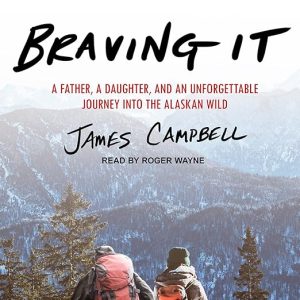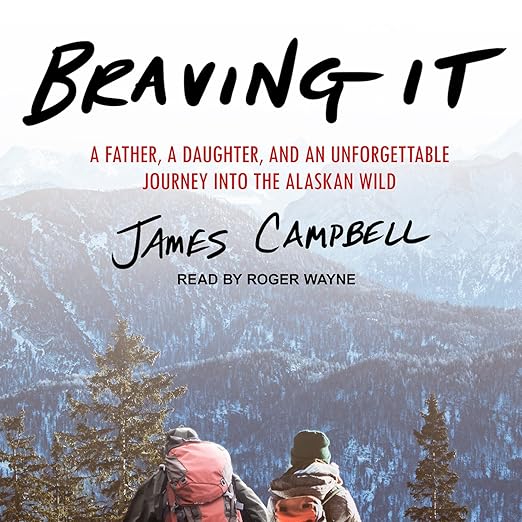
I was thinking about my own father when I started Braving It, which may be why it hit me harder than I expected. James Campbell's account of taking his fifteen-year-old daughter Aidan to Alaska's Arctic National Wildlife Refuge, three times over the course of her sixteenth year, is constructed as an adventure memoir, and it delivers everything that genre promises: extreme weather, bears, traplines, sub-zero temperatures, and the particular silence of a place with almost no human presence. But what it is really about is something more ordinary and more profound: the last window before a child becomes an adult, and a father's instinct to fill that window with something that will last.
Campbell is not a reckless man. He hesitated, he tells us, about inviting Aidan into a situation that would involve clouds of mosquitoes, the threat of grizzlies, bathing in an ice-cold river, and hours of grueling labor peeling and hauling logs. His cousin Heimo Korth, who has lived in the Arctic interior for decades, is not a tourist guide. He is someone who has built his life in genuine isolation, and the Campbells are entering that life as working participants, not observers. That distinction matters. Aidan is not on an adventure vacation. She is doing real labor in a real place with real consequences for failure.
The Review
The structure of Braving It is built around three distinct Alaska visits during Aidan's fifteenth year, each more demanding than the last. The first summer trip involves cabin construction alongside Heimo and his wife. The second, a winter return, involves working the traplines and hunting for caribou and moose in windchills of fifty below zero. The third and most ambitious trip, intended as Aidan's rite of passage before she leaves home, takes father and daughter into even more remote terrain.
Reviewer Wayne A. Smith noted that the first two trips involve joining Heimo on his homestead along the Coleen River, and that the structure works both as a father-daughter relationship book and as a genuine immersion in what life above the Arctic Circle actually requires. That dual function is what distinguishes Braving It from both pure adventure writing and pure family memoir. Campbell is not choosing between the external and internal stories. He is demonstrating that they are the same story told at different scales.
The Best Parts of Braving It
Campbell is a skilled writer, but Aidan is the book's moral engine. He is watching his daughter encounter a world that has no interest in accommodating her comfort or inexperience, and he is watching her respond to that encounter in ways that surprise him. Reviewer Dalgal46, preparing for an Alaska trip with grandchildren, described being very impressed at the challenges they met and how they met them together, observing that their lives depended on each other and how they handled themselves.
That mutual dependence is what the Arctic tests. In ordinary life, a father can protect a fifteen-year-old from most immediate physical risk. In the Arctic, protection requires the other person's active participation. Aidan cannot be sheltered. She has to become capable. Campbell's account of watching that happen, the mosquitoes, the physical labor, the eventual competence with the traplines, is moving in the way that witnessing actual growth is moving, which is different from the sentiment that can be manufactured around a narrative of growth.
The Caveats
Narrator Roger Wayne brings a quality of controlled restraint to the material that is well-matched to Campbell's prose style. Like Tasker in Everest the Cruel Way, Campbell tends to describe the external environment with precision and let the emotional content emerge from the accumulation of detail rather than from explicit emotional declaration. Wayne honors that approach. He does not editorialize. He reads the descriptions of the Arctic landscape, the working rhythms of the traplines, the particular silence of winter in the ANWR, with the kind of even investment that allows the place to exist in the listener's imagination.
Reviewer Bruce Peterson, who has done flat and whitewater canoeing and felt the author made him feel he was right along with them, was describing something the narration reinforces. Wayne's pacing creates space for the environment to register, which is essential for a book about a place that most of its readers will never visit. At nine hours and fifty-seven minutes, the audiobook is long enough to build genuine atmospheric investment without overstaying its welcome.
The Right Listener for Braving It
Braving It is genuinely cross-genre in its appeal. Adventure readers will get the Alaska wilderness content they are looking for. Readers interested in family memoir and the parent-child relationship during adolescence will find something specific and honest here. Reviewer M. Hubbard, who is a father of daughters, described Campbell as having set the bar too high for the rest of us, which is both a joke and a real tribute to how clearly Campbell documents what this experience meant for his relationship with Aidan.
Reviewer PaulWI connected with the book through a love of nature and what he called fernweh, the longing for distant places, and found inspiration in it even without a direct Alaska connection. That quality of vicarious transport is one of the things the audio format handles particularly well here. Wayne's narration places you in the landscape alongside the Campbells in a way that complements rather than replaces the visual imagination the book requires.
Those looking for a fast-paced survival narrative will need to adjust their expectations. This is not a story about escaping catastrophe. It is a story about enduring difficulty with someone you love, and understanding, over three seasons, what that endurance builds. If you come to it in that spirit, it will stay with you.
Questions Listeners Ask
Is Braving It a sequel to another James Campbell book, or does it stand alone?
It stands alone as a memoir, though Campbell's cousin Heimo Korth, who plays a central role in the Alaska sequences, is also the subject of Campbell's earlier book Heimo's Arctic Refuge (published as The Final Frontiersman in some editions). Reviewer Bruce Peterson read Braving It as an immediate sequel to that book and found the context enriching. Prior knowledge of Heimo is not required, but it deepens the portrait of the life Aidan is entering.
Does Roger Wayne's narration capture both the harshness of the Arctic setting and the warmth of the father-daughter relationship?
Yes, and maintaining both registers without tipping toward either pole is the narration's defining achievement. Wayne's delivery is measured enough to let the landscape breathe while sustaining the emotional through-line. He does not sentimentalize the family scenes or flatten the environmental descriptions. The balance holds across the nearly ten-hour runtime.