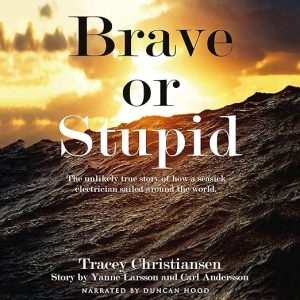
The Brave or Stupid audiobook begins with a handshake. Not a metaphorical one - a literal, old-fashioned handshake between two Swedish men who have just casually suggested sailing around the world over wine with a best friend and have now, somehow, committed to it. The setup sounds like the premise of a comedy, and Tracey Christiansen's narrative of Yanne Larsson's three-year circumnavigation is genuinely funny in places, but the handshake is not a gimmick. It is the structural and moral center of a book about what happens when ordinary people take their commitments seriously enough to see them through long after the evidence strongly suggests they should stop.
Yanne Larsson is a middle-aged electrician from Helsingborg, Sweden, with no particular passion for sailing, no obvious adventurer's identity, and no money. His friend Carl Andersson is similarly equipped. The idea comes not from a desire to find themselves or to prove something to the world but from a casual conversation that neither man was willing to walk back once the handshake made it real. The five years between handshake and departure - spent buying a boat, learning to sail, and saving money - are compressed in the telling, but they establish the important point that this was not a sudden impulsive act but a slow accumulation of preparation by people for whom nothing in this enterprise came easily.
First, the Big Picture
The three-year voyage begins in 2002 when Larsson and Andersson leave Helsingborg, and it covers storms, tropical diseases, dramatic setbacks, love, and the kind of encounters with strangers that only happen when you are visibly a long way from anywhere safe. One reviewer who described the book as one of my all-time favorites among sailing books, placing it alongside the old classics and the current crop of serious cruising accounts, noted that the combination of adventure set-pieces and genuine human warmth is what distinguishes it. Another noted that despite expecting something more technically focused on sailing, they could not stop reading even when the book turned out to be primarily about the people and places rather than the mechanics of the voyage. Duncan Hood's narration gives equal weight to the adventure passages and the quieter moments, which is the right call - the book's emotional depth comes from the friendship and from the internal changes the two men undergo, not only from the incidents.
Christiansen writes with what one reviewer called a great sense of humor plus an even greater ability to convey the emotional stakes clearly. That combination is harder to achieve than it sounds. The comedy in Brave or Stupid does not undercut the genuine difficulty of what Larsson and Andersson experience; it is the natural register of two people who are in over their heads and know it and keep going anyway. Hood understands this distinction and plays it accordingly - the funny passages are funny because the situation is absurd, not because the storyteller is performing absurdity.
What Makes Brave or Stupid Worth Hearing
At eighteen hours and fifty minutes, this is a substantial listening investment. That runtime is proportional to the journey it covers - three years and a circumnavigation deserve more than a condensed summary. The variety of settings, from the South Atlantic to the Caribbean to the Pacific to the Indian Ocean, provides genuine momentum across the full length. The relationship between Yanne and Carl, which begins as the premise of the adventure and ends as its subject, deepens throughout in the way that long shared experience deepens relationships in real life rather than in the way narrative convenience would demand.
Listeners who discovered this book by chance, as at least one reviewer described, and were enthusiastic enough to immediately seek out more from the same author, reflect something about the particular quality of quiet adventure writing that does not announce itself. Brave or Stupid was not written by a celebrity or a professional adventurer; it was written by someone who did something and found a way to describe it honestly. That honesty is what the audiobook ultimately delivers, across all eighteen hours of it.
The Caveats
Listeners expecting technical sailing content - detailed accounts of sail handling, navigation decision-making, equipment choices under pressure - will find the book lighter in that department than some circumnavigation accounts. One reviewer noted the book is more a travel account of places visited and people met than a sailing manual, and that assessment is accurate and important to know before beginning. The narrative structure follows the chronology of the journey without significant retrospective reflection, which means some sections are more incident-dense than others. The comedy-adventure tone Christiansen establishes early is consistent enough that the emotional deepening in the latter sections lands with more force for being somewhat unexpected.
Who Should Pick Up Brave or Stupid
Sailing and adventure listeners who have worked through the familiar circumnavigation accounts and want something with more humor and less celebrity will find this a rewarding discovery. Listeners drawn to deep-friendship travel narratives - the specific quality of a relationship built through shared difficulty over sustained time - will find the Yanne-Carl dynamic one of the more honest portraits of that kind of bond in the adventure genre. The book is clear about its own audience, naming armchair travelers who always wonder what if as the people it is written for, and that self-description is accurate. Listeners who prefer adventure memoirs with high production-value heroes and unlimited resources should note that the limitations here are precisely the point of the whole enterprise.
- Narration: Duncan Hood handles the blend of dry comedy and genuine vulnerability in Yanne Larsson's story with a light touch - he does not push the humor but lets it surface naturally from Christiansen's writing.
- Themes: The binding power of a handshake, transformation through sustained difficulty, deep friendship tested over three years at sea
- Mood: Warm and adventure-driven, with a dry Scandinavian humor underlying the bigger emotional moments
- Verdict: An eighteen-hour sailing memoir that earns its runtime through genuine incident and honest character work - the handshake premise is not a metaphor but the literal load-bearing structure of the whole story.