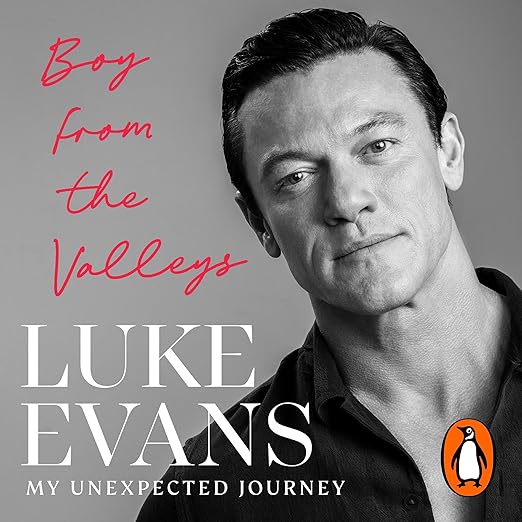
Luke Evans spent his childhood mornings dressed in a suit and tie, knocking on doors in the Rhymney Valley to spread his family's Jehovah's Witness faith, while other kids his age were home watching Going Live on television, and that contrast opens this audiobook's account of a childhood built around religious duty and quiet difference. Evans narrates his own memoir, tracing the distance between that mining-village upbringing and a career that eventually landed him in The Hobbit, Beauty and the Beast, Fast and Furious, and Dracula Untold, by way of London's Soho scene and West End stages.
Mutual Respect Across Genuinely Different Paths
The pivotal turn comes at seventeen, when Evans left both his family home and his religion to move to London, a decision the synopsis frames as bold precisely because it meant walking away from faith and family structure at once, not just relocating for opportunity. Soho's theater scene is where he found the specific outlets, singing, acting, performing, that his upbringing had never made room for, and the memoir treats that discovery less as a triumphant reveal and more as the slow, ongoing process it evidently was.
From there the book moves through his West End breakthroughs in Miss Saigon, Avenue Q, and Rent before tracking the Hollywood turn that most listeners will already associate with his name. What keeps the later, more famous chapters from reading as a standard celebrity-memoir victory lap is Evans's stated focus on the relationship he's rebuilt with his family, describing mutual respect across genuinely different paths rather than a clean reconciliation narrative, which tracks with how reviewers describe the book's tone as honest rather than tidy.
A Comic Villain and a Tragic Monster
The specific roles named in the synopsis span an unusually wide range for one career: Gaston in Beauty and the Beast is a preening comic villain, Dracula in Dracula Untold is a tragic, sympathetic monster, and the ensemble work in the Fast and Furious franchise is pure action-blockbuster machinery. That range gets referenced in the book mostly in passing rather than through extended behind-the-scenes detail, which keeps the memoir's focus where Evans clearly wants it: on the personal journey rather than a career retrospective of individual productions.
The book's three-part shape, Welsh childhood, London reinvention, Hollywood career, gives it a clean forward momentum that a lot of memoirs organized around theme rather than chronology lack, and that straightforward structure makes it an easier audiobook to follow without notes than a more fragmented, essay-style memoir would be.
The title itself, Boy from the Valleys, plainly signals where Evans wants the emotional center of gravity to sit; even with a Hollywood career spanning major franchises, he chose to name the book after the place he left rather than the industry he found, a small but telling framing choice that the memoir's actual balance of attention backs up.
An Honor to Hear Luke Narrating His Life
Self-narration matters enormously for a memoir built this specifically around voice and performance history; Evans spent years training as a stage and screen performer before ever writing this book, and that background shows in how the narration handles both the comic and the genuinely difficult material without the flattening effect a hired narrator reading someone else's life story can sometimes produce.
Reviewer Diane Quigley captures that range directly, describing the listening experience as bringing "laughter, tears and smiles" and calling it "an honor to hear Luke narrating his life," a reaction that specifically credits the audio format rather than just the content, which is exactly the kind of endorsement that matters for a self-narrated memoir. Richard Harrison's review adds a different, more personal dimension, describing the particular difficulty of recognizing one's sexual orientation while part of a religious group that, as he puts it, does not consider gay individuals part of its faith community.
Published by Penguin in 2024, the memoir arrives at a point in Evans's career where he has enough distance from both the religious upbringing and the early struggling-actor years to reflect on them with real perspective rather than raw immediacy, which suits the reflective, measured tone reviewers describe rather than something closer to an in-the-moment confessional.
Book Buff Found the Ending Unsatisfying
Not every review is uncomplicated praise. Book Buff, while calling the book "engaging, humorous, and very honest," landed on four stars specifically because the ending felt unsatisfying, noting Evans was "raised very religious" and suggesting the memoir doesn't fully resolve that thread by its close. That's a fair thing to flag going in: listeners expecting a complete, bow-tied reckoning with the Jehovah's Witness upbringing specifically may come away wanting more closure than the book, by at least one careful reader's account, actually delivers.
At nine hours and fifty minutes, the book has real room to cover childhood, faith, sexuality, and an unusually varied entertainment career without feeling rushed, but that same breadth means no single thread, the religious upbringing, the coming-out process, the Hollywood career, gets the sustained, chapter-length depth a memoir focused on just one of those subjects might offer instead.
A Recognizable Subgenre, Told the Welsh Way
Memoirs built around leaving a high-control religious community while also navigating a hidden sexual identity have become a genuinely recognizable subgenre within celebrity autobiography more broadly, and listeners who have read several entries in that space will recognize familiar beats here: the childhood door-to-door proselytizing, the moment of rupture, the search for chosen family elsewhere. Evans's specifically Welsh, working-class framing is what keeps the familiar arc from feeling like a retread of a story told many times before.
Listeners specifically interested in detailed West End theater history, the actual behind-the-scenes mechanics of landing and building a career in shows like Miss Saigon and Rent, may find that material covered more briefly than the eventual film career, since the book's proportional attention favors the emotional throughline over a comprehensive theatrical-career record.
Belonging and Self-Acceptance Beyond Just Wales
Anyone going in purely for Hollywood set-visit stories and blockbuster-franchise anecdotes should recalibrate expectations; the book spends real, deliberate time on the Welsh, working-class, religious childhood before it ever gets near a film set, and that earlier material is clearly the emotional core rather than a brief preamble to the famous part.
Listeners who've walked away from a demanding religious upbringing themselves, regardless of whether sexuality was part of that story, will likely find Evans's account of leaving at seventeen resonates beyond the specifics of Jehovah's Witness theology. Fans curious about Welsh working-class culture specifically, a background genuinely underrepresented in celebrity memoir generally, get a fuller, more grounded picture here than the eventual Hollywood chapters alone would suggest.
General memoir readers without a specific personal connection to Wales, Jehovah's Witnesses, or the entertainment industry should still find the book accessible, since Evans writes toward universal questions of belonging and self-acceptance rather than assuming specialized outside knowledge of any of those specific worlds.
The Short Version
- Performance: Luke Evans's stage and screen training carries directly into his self-narration, handling both the memoir's comic beats and its harder material without a hired narrator's flattening distance.
- What it covers: Leaving a high-control religion, coming to terms with sexuality, Welsh working-class roots meeting Hollywood
- Feel: Candid, warm, unresolved in places
- Our call: A genuinely personal self-narrated memoir that earns its emotional core, even if the ending leaves a few threads less resolved than some listeners will want.
Does Luke Evans narrate this audiobook himself?
Yes, and his stage and screen performance background comes through clearly in how he handles both the memoir's lighter and more difficult sections.
How much of this audiobook focuses on Luke Evans's Hollywood career versus his childhood?
The book spends substantial, deliberate time on his Welsh, Jehovah's Witness upbringing and his move to London before reaching the film career most listeners will recognize him for.
Does this audiobook address Luke Evans's sexuality and his religious upbringing directly?
Yes, it's a central thread, tracing the tension between his Jehovah's Witness childhood and coming to terms with being gay, though one reviewer notes the resolution feels less complete than the rest of the story.
How long is the Boy from the Valleys audiobook?
It runs nine hours and fifty minutes, long enough to give the childhood, coming-out, and career chapters each real room without feeling rushed.