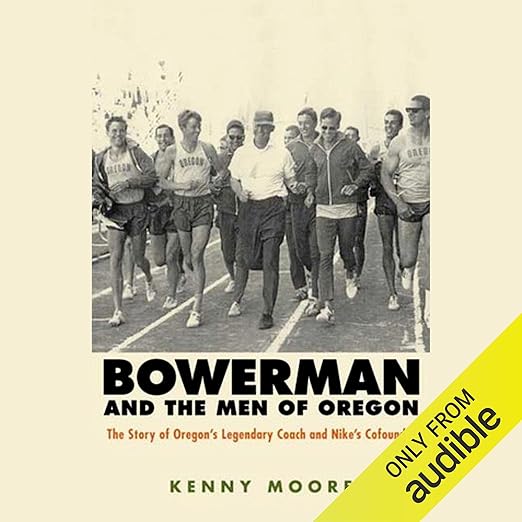
- Read by: Paul Cirzan handles the scope of a 20-hour biography with steady competence, authoritative without being flat, and sensitive to the book's emotional moments.
- At its heart: Coaching philosophy, the origins of Nike, athletic legacy and sacrifice
- Vibe: Epic and reverential, but grounded in specific human detail
- Short version: One of the best sports biographies available on audio, essential for runners and anyone interested in how a single person reshapes a culture.
I started Bowerman and the Men of Oregon on a long drive through a grey November morning and finished it over the course of a week, listening in stretches of forty minutes or an hour during commutes and walks. Twenty hours is a serious commitment for any audiobook, and I want to say plainly: this one earns every minute. Kenny Moore has written something that functions simultaneously as sports biography, institutional history, and a meditation on what it means to build people rather than win races, and Paul Cirzan's narration holds the weight of all three throughout.
Bill Bowerman is best known today as a co-founder of Nike, and that association tends to reduce him to a business story. Moore, who ran for Bowerman at the University of Oregon and competed in two Olympic marathons, insists on the fuller picture, and the picture is remarkable. Over 24 years as Oregon's track coach, Bowerman won four national team titles and his athletes set thirteen world records. He also invented the waffle sole, legend has it using a household waffle iron, that helped establish Nike's early identity, and he coached the US team at the 1972 Munich Olympics, which meant being present for one of the darkest events in sports history. Moore had full cooperation from the Bowerman family and Nike, plus years of recorded interviews, and the depth of that access shows on every page.
How Bowerman and the Men of Oregon Holds Up
What makes this biography exceptional rather than merely thorough is Moore's proximity to his subject. He is not a journalist reconstructing a life from the outside; he is a former athlete writing about a coach who shaped him, which gives the narrative an intimacy that straight biography rarely achieves. He is also honest about Bowerman's contradictions, his demanding standards, his occasional ruthlessness, his private generosities and his public abrasions. One reviewer described the book as painting Bowerman "across a canvas as broad as the Western skyline," which is accurate: it reaches back to Bowerman's ancestors' settlement in Oregon, moves through his fatherless upbringing, his WWII service in a ski battalion, and eventually to his decades coaching athletes including the stormy, supremely talented Steve Prefontaine.
Prefontaine's presence in the book is electric. Moore writes about him with the knowledge of someone who ran against him and beside him, and the passages about Pre, his talent, his ego, his refusal to run tactically when running hard was available as an option, are among the most vivid in the audiobook. Cirzan handles these sections with the emotional restraint they require, never overplaying what Moore has already written with enough feeling.
The running world has produced a remarkable body of literature in the past two decades, from memoir to training manual to cultural history, and Bowerman and the Men of Oregon sits near the top of that canon. For listeners who came to running through Born to Run or through Nike's own carefully managed mythology, this book offers something more complicated and more truthful: a portrait of a man who was genuinely transformative and genuinely difficult, whose legacy includes both the shoe that changed an industry and the training philosophy that changed how the world thought about jogging as a health practice.
The audiobook's length is justified. At twenty hours and seventeen minutes, Moore has room to develop the supporting cast, the Oregon athletes who formed the core of what Bowerman was building, in ways that shorter treatments cannot afford. The result is a book about many men, not just one, and that breadth makes the coaching philosophy concrete rather than abstract: you watch it work on specific people in specific races over specific seasons, and by the end you understand what Bowerman was doing not because Moore explains it in the abstract but because you have seen it in action across twenty years.
Weak Spots in Bowerman and the Men of Oregon
The book's structure is chronological and comprehensive, which means some sections, particularly those covering Bowerman's early life and his military service, move at a slower pace before the track and field years take over. Listeners primarily interested in the running and Nike material may find the first few hours require patience. That patience is rewarded, but it is worth flagging for listeners who prefer a faster entry into their subject.
The Munich Olympics section, covering the terrorist attack that killed eleven Israeli athletes and coaches, is handled with gravity and care. Moore does not rush past it, and Cirzan's narration in these passages is notably subdued, appropriately so. It is not a comfortable section to listen to, but it is an essential one for understanding Bowerman's experience of sport at its highest level.
The Right Listener for Bowerman and the Men of Oregon
Runners of any level will find this essential, it is the book behind Nike's origin story and behind modern American distance running culture. Sports biography listeners who appreciate depth and insider access rather than quick narrative will find Moore an ideal guide. For anyone interested in coaching philosophy, organizational culture, or how a single individual can reshape a practice across generations, this is one of the richest examples in the genre. The only listeners who should approach with caution are those genuinely put off by long-form biography at the twenty-hour mark.
Before You Listen
How much of this book covers the founding of Nike versus Bowerman's coaching career?
The coaching career is the primary subject. Nike's origins, including the development of the waffle sole, are covered in meaningful detail, but Moore consistently frames them within Bowerman's larger identity as a coach and innovator in human performance. Listeners hoping for a business history of Nike will want to supplement with Phil Knight's Shoe Dog.
Is Steve Prefontaine a major figure in the book?
Yes. Prefontaine ran for Bowerman at Oregon and is one of the book's most vivid presences. Moore knew Pre personally as both a rival and a teammate, and writes about him with an intimacy and specificity that most Pre biographies lack. His sections are among the audiobook's most compelling.
Does the narration hold up over twenty hours, or does it feel fatiguing?
Paul Cirzan maintains consistent quality throughout. He adapts well to the book's different modes, the family history, the race narratives, the darker Munich passages, without overcorrecting into theatrics. Twenty hours is a long listen by any measure, but Cirzan does not make it feel longer than it is.
Do I need to know much about track and field to follow the athletic sections?
No. Moore writes for a broad audience and explains the tactical and technical elements of track competition clearly without slowing the narrative for experts. Readers who know the sport will get more out of certain passages, but no prior knowledge is required.