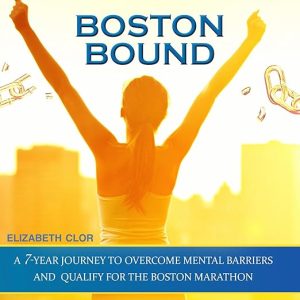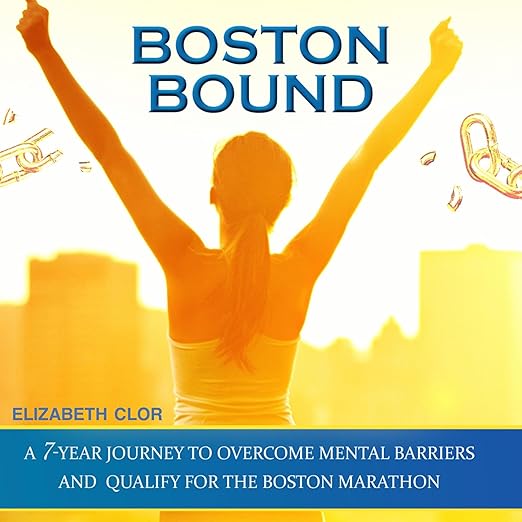
Qualifying for the Boston Marathon takes a specific, punishing number, and Elizabeth Clor spent seven years chasing hers before she figured out the real obstacle wasn't her legs. What do you do when your training log shows steady gains year after year and your own head still won't let you cross the finish line at the pace you need? This audiobook, narrated by Clor herself, is her account of that seven-year stretch, where physical progress kept colliding with a spiral of perfectionism and anxiety, and the specific mental overhaul she eventually built to break the pattern.
Clor is not a coach or a sponsored athlete, and Boston Bound never pretends otherwise. One reviewer, amber, praised the book for being written by 'someone like all of us, not an elite athlete or coach', and that distinction shapes every chapter. Patrick Durand made a similar point, noting that 'most running books are written by Olympians and Professional Athletes' and that 'much is lost for us mere mortals with regular day jobs' when that's the only perspective on offer. Clor's story runs the opposite direction: a recreational runner with a day job, a qualifying standard, and a brain that sabotaged years of physical readiness.
The self-narration is the audiobook's strongest structural choice. Clor is describing her own anxiety spirals and perfectionist loops from the inside, and a professional narrator reading someone else's diagnosis of their own mind would lose exactly the texture that makes this book work. At six hours and twenty-five minutes, the pacing stays tight, with no padding out the seven-year arc into unnecessary training-log detail; the runtime tracks the psychological throughline Clor is actually interested in, not a mile-by-mile recap of every race.
Perfectionism and anxiety get named together in the synopsis, but they aren't quite the same obstacle, and part of what makes Clor's account useful is watching her tease them apart. Perfectionism kept raising the bar on what counted as an acceptable training block; anxiety then attached itself to the fear of falling short of that constantly-rising bar. Naming the two forces separately, rather than treating 'mental roadblocks' as one undifferentiated fog, is part of what gives the eventual framework enough precision to actually be useful.
Highlights
The premise is narrower and more useful than a typical running memoir: this is a book about the specific mechanics of self-sabotage, not a general inspirational arc. Clor identifies perfectionism and anxiety as the actual bottleneck standing between her physical readiness and her qualifying time, and she walks through the concrete steps she took to overhaul her mindset rather than just narrating the emotional highs and lows of race day. That structure gives the audiobook a genuine framework a listener can extract and apply, not just a story to feel good about.
It also reaches past the running audience by design. The book's closing pitch is explicitly aimed at 'anyone seeking to realize their full potential, physically or otherwise,' and the tools Clor describes for identifying and removing mental roadblocks are built to generalize. A listener who has never run a competitive mile but recognizes their own version of a goal repeatedly undercut by their own head will find plenty to work with here, which is a wider net than the marathon framing on the cover might suggest.
The seven-year timeline itself is a structural choice worth noting. Most running memoirs compress into a single training cycle building toward one race-day climax; Boston Bound instead spans years of a qualifying attempt that kept falling apart for reasons that had nothing to do with fitness. That longer arc gives Clor room to show the same self-sabotaging pattern recurring across multiple attempts before she finally identifies it, which makes the eventual mindset shift land as earned rather than a tidy last-chapter epiphany bolted onto a single race narrative.
What to Watch For in Boston Bound
RunningMommy's four-star review is worth taking seriously precisely because it's the most critical voice in the mix. She called Boston Bound 'a good, quick and inspiring read' and said she 'could relate to a lot of it since I know the ups and downs of racing', but also admitted that 'as a fellow runner, I was a bit annoyed by some of the woe is me, woe is me rambling.' She specifically flagged a recurring thread about Clor's sensitivity to heat and sun as a sore spot. That's a useful counterweight to the five-star praise elsewhere: the same self-focused psychological detail that makes the book valuable as a case study can also read as repetitive if a listener isn't there for the introspection.
None of the three reviews attached to this listing comment on Clor's narration specifically, only on the content and the writing, so no independent read on delivery, pacing, or vocal energy exists beyond the text itself. Polished, broadcast-trained narration is not what's on offer here; this is an author reading her own book, with everything that implies about warmth and unevenness both. And with 358 ratings behind a 4.4 average, this has a real, established track record, even if the qualifying-time specificity of the subject keeps the audience naturally narrower than general sports memoirs.
This is a personal memoir told in the first person, not a clinical or academic treatment of sport psychology, and listeners should calibrate expectations accordingly. Clor is describing what worked for her specific mind and her specific goal, drawing on lived experience rather than citing research studies or working from a licensed therapist's framework. That gives the material real diagnostic value as a mirror for a listener's own patterns, but it's worth knowing going in that the 'specific tools and a useful framework' the synopsis promises come from personal trial and error rather than a formal, credentialed methodology.
Is This One for You?
A single hard goal that has quietly turned into an obsession, marathon or otherwise, is the real prerequisite for recognizing the shape of this story fast. Recreational runners chasing a qualifying time, a personal record, or any other number that has started to feel more like an enemy than a target are the most direct fit, especially listeners who've made real physical progress and still can't figure out why the result won't come. The framework Clor builds around identifying and dismantling mental roadblocks also travels well outside running, into any pursuit where anxiety and perfectionism have quietly become the actual opponent.
Elite training theory, splits analysis, or race-day science this is not, and listeners hoping for a coach's technical breakdown of marathon qualifying should look elsewhere. This is psychological memoir first, running memoir second, built around one runner's seven-year fight with her own mind rather than a training methodology. The self-narration means the performance will land differently than a studio-trained voice actor's would, for better or worse, and RunningMommy's flagged frustration with some of the more repetitive self-pity passages is worth keeping in mind before pressing play.
- Voice: Elizabeth Clor narrates her own account; none of the attached reviews assess her delivery specifically, but the first-person authenticity carries real weight.
- Big ideas: Perfectionism and anxiety, marathon qualifying, mindset overhaul
- Atmosphere: Introspective and determined
- Worth it?: An honest, specific psychological case study for anyone whose own mind is the real obstacle to a goal, not a training-plan book.