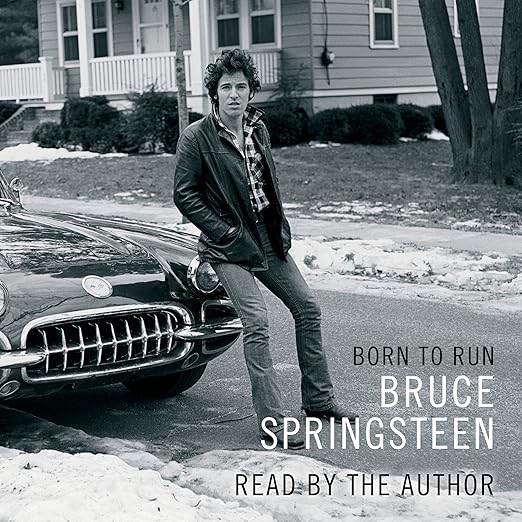
Bruce Springsteen privately devoted himself to writing his autobiography in the years following his 2009 Super Bowl halftime performance. The result - Born to Run, the memoir - arrived in 2016 and immediately earned praise that reached for concert metaphors because no other framing adequately described it. NPR called it the 508-page equivalent to one of Springsteen and the E Street Band's famous four-hour concerts: nothing left onstage, diehard fans and first-timers alike departing sated and somehow already aching for more. This audiobook brings that writing to a new register, narrated by Damien Witecka across just over eleven hours. The central question for any artist memoir in audio is whether the prose can carry the weight that the live performance carried across decades. For Born to Run, the answer is yes, and the authorial voice behind the prose is the primary reason.
What separates Born to Run from the overcrowded genre of rock star memoir is the same quality that separates Springsteen's best lyrics from most rock songwriting: the prose is constructed with intention and craft. He is not dictating anecdotes into a tape recorder for someone else to shape and sequence. He is writing, with the lyricism and structural care of someone who has spent five decades thinking precisely about what language can do under creative and personal pressure. The account of growing up Catholic in Freehold, New Jersey - the specific texture of working-class poverty and inherited religion and creative hunger that eventually produced the songs - is the memoir's most revelatory section and the part that rewards careful listening most richly. One reviewer describes the memoir as answering questions about how rock music was created more broadly, which is accurate: Springsteen uses his own particular story as a lens on the American musical moment he inhabited and helped define. The songs are presented not as products of talent or ambition but as necessities - things that had to be made because the psychological alternative was worse. That framing gives the memoir a seriousness that most artist autobiographies cannot achieve because most artists are not this honest about the relationship between their creative work and their interior life.
The Ed Sullivan Moment That Started It All
The memoir covers territory that even dedicated fans may not have encountered in other sources: the personal struggles that shaped the best-known albums, including the depression that Springsteen discusses with notable candor for a performer of his stature and public image. The early years as a bar band king in Asbury Park, before the E Street Band solidified into the group that would produce the classic albums, are rendered with the specificity of someone who has carried those years carefully rather than letting them blur into myth. The moment he identifies as the Big Bang of his musical imagination - seeing Elvis Presley appear on The Ed Sullivan Show - is described with the kind of precision that makes a formative experience legible to a reader who was nowhere near it. Witecka narrates with appropriate gravity and warmth, treating Springsteen's prose as literary material rather than celebrity product. Rolling Stone described the memoir as utterly unique and endlessly exhilarating, and that description holds in the audio format as firmly as it does on the page. Entertainment Weekly's assessment - a reminder that the one thing you cannot run away from is yourself - is the most economical summary of the book's emotional argument.
A Skeptic's Review Ends Up Calling It Brilliant
The candor Springsteen brings to his personal struggles - his clinical depression, the complicated and unresolved relationship with his father that surfaces in multiple forms across the memoir, the tensions within the band at various points across decades of working together - is disarming in the precise sense: you do not anticipate it, and it makes the memoir more valuable than a retrospective assembly of career highlights could be. One reviewer begins by confessing they were never the biggest Springsteen fan and ends by describing the book as brilliant, honest, and heartfelt. That trajectory from skepticism to genuine engagement is the most useful kind of reader response data for a memoir like this: it tells you the book works for people who come without prior devotion, not just for those who already know every word of Darkness on the Edge of Town. Listeners who are familiar with the catalog - Thunder Road, Badlands, The River, Born in the USA, The Rising, Nebraska - will find the memoir enriching in ways that are harder to access from outside those recordings. The sections on specific albums become richer when you can hear the music in memory while reading about its origins. But the human story is legible without them, and the audiobook makes that clear.
Timed to the Anniversary, Carried by Witecka
This audiobook rewards Springsteen fans most directly, but it is built to travel well beyond that readership. For anyone interested in how American working-class identity and popular music intersected across the latter half of the twentieth century, or in the sustained question of how a performer maintains creative honesty across five decades without either repeating himself or disappearing into irrelevance, the memoir is substantive enough to stand on those questions alone. Skip it if you want a conventional rock biography built around discography chronology and industry anecdote; this is interior, literary, and focused on meaning rather than career statistics. The fifty-year anniversary of the Born to Run album and the companion film Deliver Me from Nowhere make this an especially timely listen for anyone who wants the story behind the songs.
In Brief
- Voice: Damien Witecka narrates Springsteen's memoir with a delivery that respects the lyrical weight of the prose - this is a book written by a man who thinks in songs, and the narration honors that rhythm without trying to perform Springsteen himself.
- Big ideas: Working-class Catholic identity and artistic escape, the creation of rock mythology, depression and creative drive as forces that cannot be separated from each other
- Atmosphere: Candid and expansive, with the rhythm of a long concert where the between-song stories matter as much as the music itself
- Worth it?: Born to Run is a memoir by a performer who gave four decades of everything to his songs and his audience, and this audiobook carries that generosity with it.
Do you need to be a Springsteen fan to get something meaningful from this audiobook?
The memoir is written in a way that is accessible to readers without deep prior familiarity with the catalog. At least one reviewer describes coming to it with minimal fandom and finding it genuinely moving. Deeper familiarity with the music adds dimension to the sections about specific albums and their origins, but the core narrative - growing up working-class Catholic in New Jersey, building a band, reckoning with depression and family history - reads as human experience rather than music industry insider material.
How does listening to this audiobook compare to reading the print memoir?
The prose is literary and constructed in a way that rewards the audio format specifically - Springsteen writes with the rhythms of a songwriter, and those rhythms carry when spoken. Damien Witecka's narration treats the material with appropriate gravity, making the eleven-hour runtime feel like a sustained piece of work rather than an assembly of assembled anecdotes.
Is this audiobook appropriate for listeners primarily interested in the craft of songwriting rather than Springsteen's biography?
Yes. Several reviewers who came to the memoir specifically to understand the creative process behind the music found the book answered broader questions about songwriting, band dynamics, and the relationship between personal experience and artistic output. The sections on how specific albums were conceived and recorded are detailed enough to be instructive about creative process in ways that extend beyond Springsteen's biography.