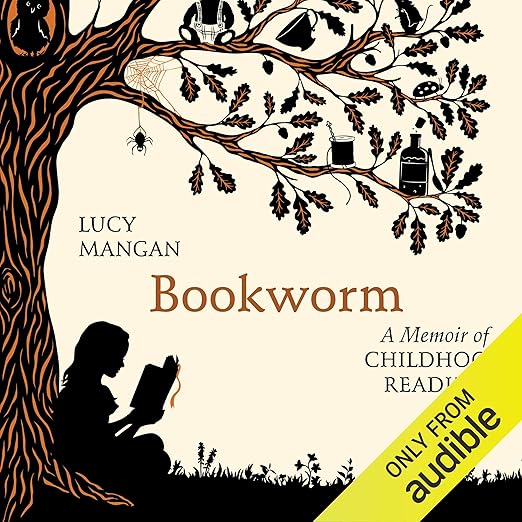
At a Glance
- Narrator: Lucy Mangan narrates her own memoir, and the self-narration is essential - her voice carries the specific register of someone who grew up reading compulsively and has retained the intellectual habits of that childhood.
- Subjects: Childhood reading as self-formation, British literary heritage, the private life of a compulsive reader
- Tone: Warm and discursive, with sharp comic asides and occasional genuine tenderness
- Bottom line: Mangan's memoir of childhood reading is for the specific reader who treats their own reading history as autobiography - it rewards the kind of listener who will spend a week pulling old books off shelves after finishing.
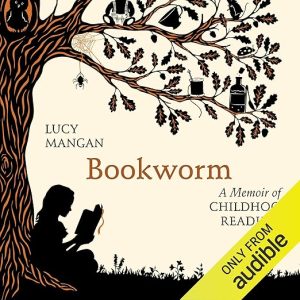
Lucy Mangan grew up inside books, and that fact is not a metaphor in the Bookworm audiobook - it is a description of a childhood spent in near-constant reading, with the physical world arranged around that primary activity as though in orbit. Mangan narrates her own memoir across seven hours and 27 minutes, and the decision to have her read it herself is the format's major asset: her voice carries the specific rhythms of someone who spent her formative years in the company of sentences, and those rhythms are audible in how she reads as much as in what she writes.
The memoir covers Mangan's childhood reading from roughly the first books she remembers through adolescence, organized not strictly by age but by the books themselves. Narnia and Wonderland, Kirrin Island and the Railway Children, Charlotte's Web and Judy Blume's work: Mangan moves through a childhood spent primarily inside books, using each title as an occasion to think about what it does, what it gave her, and what it says about the period that produced it. The result is part literary criticism, part personal memoir, and part argument about why childhood reading shapes the adult mind in ways that are distinct from all other reading that follows.
She Loved Blyton While Knowing the Politics
Mangan's critical intelligence is the book's engine. She does not simply describe what she loved; she explains why, and the explanations are specific enough to be genuinely interesting even when the specific books are ones you have not read. Her treatment of Enid Blyton handles the genuine pleasure and the retroactively uncomfortable politics of those books with the kind of intellectual honesty that a nostalgic memoir could easily avoid. She loved Kirrin Island; she also knows what Blyton's politics were and what the books exclude. Holding both of those things simultaneously is the kind of reading she is modeling throughout.
One reviewer noted reading many of the same books Mangan did when young but also loving others she did not, specifically mentioning Dickens and Tolkien, and described the effect as partly recognition and partly productive disagreement. That dynamic is one of the best things this kind of memoir can produce: the reader's own list runs alongside Mangan's, sometimes converging and sometimes diverging, and the divergences are as interesting as the agreements. Another reviewer called it a pleasant and funny stroll through childhood reading with some acute observations, a description that is accurate but slightly undersells the sharpness of those observations.
The Wombles and Milly-Molly-Mandy Test American Ears
The memoir is British in ways that affect the listening experience. The specific books Mangan prioritizes, including the Wombles, Milly-Molly-Mandy, and E. Nesbit's Railway Children, are more central to British childhood reading than American. American listeners will find some sections more reference-heavy than others. This is a feature rather than a bug for readers interested in British children's literary culture, but it is worth knowing in advance.
Mangan's Narration Feels Live, Not Reported
Mangan narrating her own memoir is not simply an author reading her text. Her delivery has the specific quality of someone who is revisiting these books in real time. The pleasure is live rather than reported, and she finds the comedy in her childhood self's reading habits without condescending to that child. She handles the more personally revealing passages about what books gave her that real life did not with a directness that a professional narrator would have been more likely to soften.
The audio format has a particular advantage here: Mangan's critical voice in conversation is well-known to British radio listeners, and her reading has the quality of intelligent, opinionated conversation rather than formal narration. The sections where she argues for the lasting importance of specific books, or where she resurrects a forgotten title that deserves reexamination, have the energy of someone talking you into reading something rather than writing an academic case for it. That quality is persuasive in ways that print alone might not be.
The Forgotten Treasures Mangan Wants You to Read
The book's argument that childhood reading shapes adult identity in specific and traceable ways is made through accumulation rather than stated as a thesis. Mangan does not argue programmatically; she demonstrates. This means the book rewards the kind of reader willing to follow a discursive structure through multiple digressions before the cumulative point arrives. Listeners who want a book with a clear argumentative spine should know that this memoir proceeds more like an extended conversation than a structured case, and that the payoff is cumulative rather than delivered in a single passage.
The forgotten treasures Mangan identifies for the next generation of bookworms are a genuine feature of the book. She makes a specific case for several books that have dropped out of the children's literature canon, and for readers who enjoy being recommended something obscure by someone with credible taste, these sections are particularly valuable. The recommendations are grounded in specific accounts of what the books actually do rather than nostalgic generalities.
Revisiting a Childhood Book, Finding It More Layered
This audiobook is for adult readers who remember their own childhood reading as formative - who can trace specific adult sensibilities back to specific books encountered young. It works equally well for people who grew up in Britain with the exact books Mangan discusses and for people whose own childhoods featured a different list, because the underlying argument about reading and identity is not parochial. Anyone who has had the experience of returning to a childhood book as an adult and finding it more layered than they remembered will find Mangan's treatment of that experience precise and illuminating. Listeners looking for memoir driven by narrative plot rather than reflection and digression should look elsewhere.
Before You Listen
Is this audiobook primarily about British children's literature, or does it apply to readers with different reading backgrounds?
The specific books Mangan covers lean heavily British - the Blyton series, E. Nesbit, Milly-Molly-Mandy, the Wombles - alongside more universal titles like Charlotte's Web and Judy Blume. American readers will find some sections more reference-dense than others, but the underlying argument about how childhood reading shapes adult identity applies regardless of which specific books you grew up with.
Does Lucy Mangan's self-narration add to the audiobook experience or would a professional narrator have served better?
Mangan narrating her own memoir is a significant asset here. Her voice carries the intellectual habits she describes in the text. A professional narrator would have produced a technically clean recording; Mangan produces something more personal and, in the context of this particular memoir, more appropriate to the material.