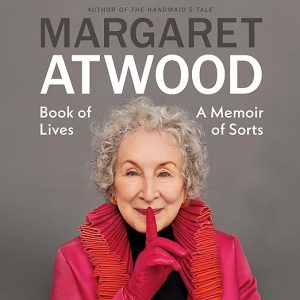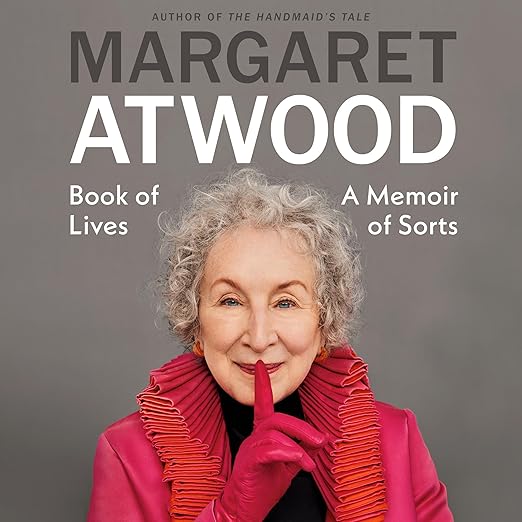
An entomologist father and dietician mother raised Margaret Atwood largely in the forests of northern Quebec, and that unconventional, nomadic childhood is where Book of Lives begins its account of one of the most influential literary careers of the past century. This audiobook runs 25 hours and 35 minutes, and Atwood narrates her own memoir, tracing a line from an isolated eighth birthday she calls forlorn through The Edible Woman, Cat's Eye, her Berlin years writing The Handmaid's Tale, and her decades with the writer Graeme Gibson.
Every Writer Is at Least Two Beings
The book's organizing idea is stated early and directly: 'Every writer is at least two beings: the one who lives, and the one who writes,' Atwood writes, adding that 'though everything written must have passed through their minds, or mind, they are not the same.' Book of Lives is built around tracing exactly that gap, linking specific life events to the books they eventually became, the 'cruel year' behind Cat's Eye, the Orwellian atmosphere of 1980s Berlin behind The Handmaid's Tale, rather than presenting a standard chronological biography.
The scope is genuinely wide for a single memoir: bohemian literary gatherings, major political turning points Atwood lived through, and, true to her own sensibility, a cast of real people who sound like they wandered out of one of her novels. That scope demands real runtime, but it covers a career that spans from the early 1970s literary scene through the cultural phenomenon her dystopian fiction became decades later.
Atwood's own words carry real weight throughout, and the synopsis offers a preview of that voice directly: describing her eighth birthday spent in isolation in the Quebec wilderness, she writes, 'It sounds forlorn. It was forlorn. It gets more forlorn.' That triple repetition, deadpan and exact, is recognizably the same sensibility that runs through her fiction, applied here to her own remembered childhood rather than an invented character.
It Sounds Forlorn, It Was Forlorn
The memoir's structure, linking specific books to the life events that produced them, means this works almost as a secret companion volume to Atwood's own bibliography; listeners who go back afterward to reread Cat's Eye or The Handmaid's Tale with this context in hand are likely to notice details they missed the first time, since Atwood is explicit here about which real experiences fed which fictional scenes.
Even the book's title carries a small argument in it: not a life but Lives, plural, gesturing back to that opening idea of the writer as at least two beings occupying one body across decades.
Atwood's stature as one of the most lauded and influential cultural figures of her generation is treated here less as a fact to be celebrated than as a specific, traceable outcome of decades of unglamorous daily writing work, which keeps the memoir grounded in process rather than settling into simple celebration of a famous name.
A Great Read Whether or Not You're an Atwood Reader
Atwood narrating her own memoir is close to essential rather than a nice-to-have. This is a writer with decades of public readings and a famously precise sense of rhythm in her own prose, and hearing her deliver lines about her own life carries an authority and specific dry humor that a hired narrator, however skilled, would be reconstructing secondhand rather than simply performing as felt experience.
Reader BARBARA LONG put it plainly: 'It's a great read whether or not you're an Atwood reader,' crediting Atwood's 'talent for distilling her experiences and setting them as wholly relevant to anyone.' That crossover appeal, reaching listeners well outside Atwood's core literary-fiction readership, is echoed across multiple reviews of this memoir specifically, evidence that the book earns a broader audience than a standard literary memoir might expect.
Discovering the Edible Woman in the Early 1970s
At 4.5 stars from 689 ratings, this has drawn a substantial and consistent listener base, a meaningful data point for a 25-hour literary memoir that asks real time commitment of its audience. That combination of high volume and high average rating suggests the book is reaching well past a narrow literary-fiction readership into Atwood's broader cultural audience.
Reader Boomerbroadcast traced a genuine decades-long relationship with Atwood's work back to discovering The Edible Woman shortly after its original publication in the early 1970s, describing recognizable Toronto locations and experiences that made the novel feel immediately personal. That kind of long-term reader loyalty, spanning Atwood's entire career from early realist fiction through dystopian speculative work, says something about the consistency of voice this memoir now traces back to its origins.
A Downloadable PDF the Audio Alone Misses
Reader Elfinstone offered the most useful caveat: despite having 'jumped ship' when Atwood moved into dystopian fiction, a genre they don't typically enjoy, they still found this memoir 'lively and entertaining,' while noting honestly that 'sometimes it bogs down and is confusing.' That's a fair summary of the tradeoff in a book this expansive; not every chapter moves at the same pace, and listeners without deep familiarity with Atwood's full bibliography may lose the thread occasionally.
This audiobook edition includes a downloadable PDF of images and drawings from the original book, material that audio-only listeners will simply miss. If visual material, family photographs, sketches, is part of why you want this memoir specifically, grab that PDF alongside the audio rather than skipping it.
Readers coming from other recent literary memoirs, worth comparing this to how contemporaries like Joan Didion or Patti Smith have handled the same challenge of turning a working writer's interior life into readable memoir, will find Atwood's approach less confessional and more archival, more interested in tracing cause and effect between lived event and eventual book than in raw emotional disclosure for its own sake.
Twenty-five hours is a genuinely major listening commitment, longer than most conventional memoirs; consider breaking it into sections organized around the different eras of Atwood's career rather than attempting long continuous sessions, since the book's episodic, book-by-book structure lends itself naturally to that kind of pacing.
Skip It for the Visual PDF Instead
Recommended for Atwood readers of any era, whether your entry point was The Edible Woman in the 1970s or The Testaments decades later, and for literary memoir fans generally interested in how a working writer's actual life fed her fiction. It's also a strong pick for anyone drawn to the writing life itself as a subject, independent of Atwood's specific fame.
It's also worth a listen for anyone interested in Graeme Gibson specifically, since Atwood's decades with him get real space here beyond a passing biographical mention; listeners who know him only as Atwood's partner will come away with a fuller sense of that relationship's actual shape.
Skip it if 25-plus hours of literary reminiscence isn't the commitment you want right now, or if you'd rather engage with the visual PDF material as your primary way into the book, in which case the print or ebook edition may serve you better than audio alone.
Does Margaret Atwood narrate the Book of Lives audiobook herself?
Yes, and it's one of the strongest reasons to choose the audiobook over print. Hearing Atwood deliver lines about her own life, in her own rhythm and dry humor, carries an authority a hired narrator couldn't fully replicate.
Do I need to have read The Handmaid's Tale before listening to Book of Lives?
No. While the memoir traces how The Handmaid's Tale and other novels came to be written, reviewers note it works whether or not you're already an Atwood reader.
Does the Book of Lives audiobook cover Margaret Atwood's relationship with Graeme Gibson?
Yes, her decades-long relationship with the writer Graeme Gibson is a significant thread throughout the memoir, alongside the political and literary milestones of her career.
Is the Book of Lives audiobook worth it if I haven't read Atwood's dystopian fiction?
Reviewer feedback suggests yes. One listener who specifically avoids dystopian fiction still found the memoir lively and engaging, crediting Atwood's ability to make her personal experience feel relevant beyond her most famous genre.