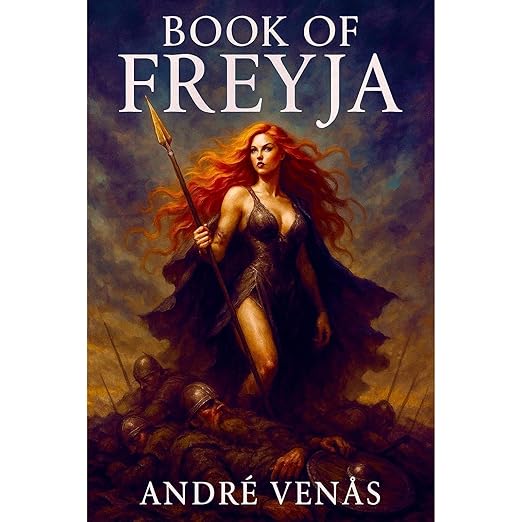
Book of Freyja announces its intentions with architectural precision. Andrè Venås opens at the golden doorway of Folkvangar, Freyja's hall in Norse cosmology, and the choice is deliberate: this is not a book that approaches the goddess from the comfortable distance of academic mythology. It positions itself at the threshold and asks the reader to cross. The question Venås is really asking across these five and a half hours is whether reclamation is possible, whether you can write about a divine figure through myth, ritual, and poetry simultaneously, and whether that mixture produces something stronger than any single mode alone. The answer the audiobook arrives at is yes, with qualifications that honest listeners should know before they begin.
Is Book of Freyja Worth Your Time?
The book's ambition is real and its execution is largely successful, with qualifications worth knowing upfront. Venås writes Freyja in her full complexity: the lover and the warrior, the teacher of seidr and the weeper of amber tears for her lost husband Od, the sovereign who cannot be diminished into any single archetypal role. The Brisingamen narrative, the Aesir-Vanir war chapters, and the Loki trial retellings are handled with genuine care, restoring the raw dimensionality that popular retellings often flatten into simplified moral lessons. Reviewer Azmarul, who approaches the book from a practitioner's perspective, notes that the author takes some liberties with mythological details and offers some good UPG, Unverified Personal Gnosis, information, opening new aspects of the goddess even for readers already deep in Norse studies.
Reviewer Lauren Wilkinson came to the book looking for an introduction to Freyja and found it reference-worthy enough to add to her permanent collection. Reviewer CJ, who identifies as someone who struggles to retain information from reading, calls it an easy entry, which speaks to Venås's skill in making esoteric Norse material accessible without stripping it of depth. That accessibility sits alongside genuine sophistication in the devotional chapters, where Venås's rituals, prayers, and invocations are written for people who intend to use them rather than merely observe them from a scholarly remove. The sections on seidr practice are the book's most original contribution; Venås moves beyond myth retelling into the practitioner's relationship with the craft Freyja is said to have taught the Aesir.
The grammatical inconsistencies that Azmarul flags in the print version are a fair criticism. In audio, some of these surface as slightly rough transitions between sections, places where the prose shifts register in ways that feel unpolished. They are not severe enough to undermine the experience, but they are present and honestly worth knowing about before you commit to the runtime.
The Best Parts of Book of Freyja
The choice to receive this material as audio rather than print has a specific logic. The ritual invocations and prayers that Venås includes are meant to be spoken, not silently absorbed on a page. Hearing them, even through Virtual Voice narration, activates a different mode of reception than reading them. The same applies to the poetry woven through the mythological retellings; the cadence of verse, even when delivered by synthetic narration, carries more of its intended rhythm in audio than in silent reading.
That said, Virtual Voice is the book's primary limitation as an audio experience. The devotional register that Venås is working in, the incantatory quality of certain passages, the intimacy of the prayers addressed directly to Freyja, requires a human voice that can inhabit the tone rather than merely reproduce it. A self-narrated version by Venås, or a narrator familiar with the devotional tradition, would have served the material significantly better. Listeners who find the synthetic narration distracting may want to read the print version for the ritual content specifically, using the audio for the narrative and mythological chapters where the limitation is less consequential.
Before You Commit to Book of Freyja
The book is explicit that it is written for women who refuse to shrink and for anyone drawn to the old gods who dwell in the shimmering spaces between beauty and power. This framing is thematic rather than exclusionary; male readers and non-binary practitioners who engage with Norse polytheism and the sacred feminine as a concept will find the material applicable across that boundary. The emphasis on sovereignty, on Freyja as a model of power that refuses submission, is the book's organizing moral argument, and it is sustained across the mythological, devotional, and meditative sections with consistency.
Listeners coming from an academic Norse studies background should know that Venås is writing as a practitioner first. The book's relationship to scholarly sources is present but not foregrounded; primary engagement is with living tradition rather than peer-reviewed literature. For scholars, this is context, not a flaw. For practitioners, it is the point. The tapestry of lore, poetry, and meditative insight that Venås describes in the synopsis is accurately characterized; these modes genuinely coexist rather than being listed as marketing categories.
Should You Listen to Book of Freyja?
Practitioners within Norse polytheism, Asatru, or related pagan traditions who want a devotional companion that takes Freyja's full mythological range seriously will find this audiobook a useful addition to their practice. Readers who are curious about Norse mythology from a spiritual rather than purely historical angle, and who are drawn to the archetype of sovereign feminine power, will find the book accessible and emotionally engaged. Those looking for academic rigor or a skeptical outside perspective on Norse religion should approach with adjusted expectations. The Virtual Voice narration is a practical limitation worth noting, but the material itself is coherent, deeply felt, and written with evident knowledge of the tradition it honors. At five and a half hours, the commitment is manageable even for listeners who may want to revisit particular sections in the future.