The Short Version
- Read by: David Drummond takes on prose that shifts between lyrical description and a guide's plainspoken storytelling, a real register challenge across the runtime.
- At its heart: displacement from a lifelong craft, mentorship across generations, the cost of tourism on a fragile fishery
- Vibe: Reflective and literary, closer to elegy than adventure writing
- Short version: A quietly powerful character study for readers of literary nonfiction, not a technical fishing guide, at its best when compared to A River Runs Through It.
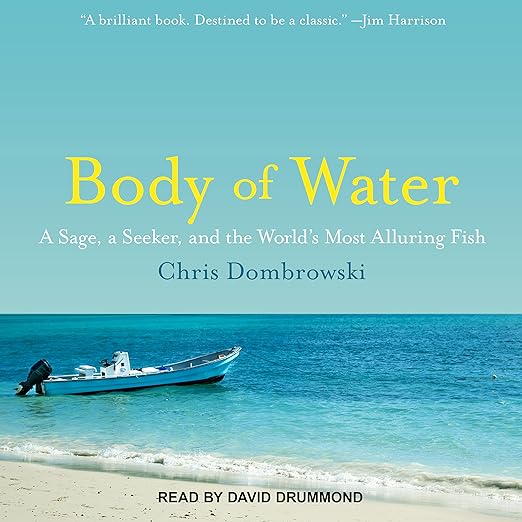
Two children, one of them still in utero, an income hovering near zero, and two competing passions that rarely pay well at once: that was Chris Dombrowski's situation when a single unexpected email changed his year. This audiobook opens with that email, an all-expenses-covered invitation to the Bahamas that Dombrowski, a poet and fly-fishing writer by trade, could not afford to refuse. What follows over six hours and seventeen minutes is less a fishing memoir than a portrait of David Pinder, a legendary Bahamian bonefishing guide whose accuracy and patience Dombrowski describes as virtuosic, built from a career spent reading a fish's next move before the fish itself decides on it.
By the time the two men meet, Pinder has already been pushed out of the tourism industry he helped build, watching cataracts cloud his vision after a lifetime spent staring at open water, and collecting only a small severance after forty years of guiding. That is the book's real emotional core: an industry that used Pinder's expertise to attract the very tourists who then degraded the fishery, and a writer who arrives just in time to hear the stories before that specific kind of hard-won, place-based wisdom disappears along with the guide who carries it. Dombrowski finds, in his own account, a profound integrity in Pinder's life that the fishing itself is really only a vehicle for.
Bonefish themselves are worth understanding as a species to appreciate what makes Pinder's expertise so specific: they are prized among anglers precisely because they are notoriously difficult to catch, moving in skittish schools across shallow tropical flats where a single wrong footstep or shadow can send an entire group scattering. That difficulty is what turns a guide like Pinder into something closer to a translator between angler and fish, reading water conditions, wind, and animal behavior in ways that take decades to develop. Dombrowski's own line describing this, that Pinder knows what the fish think before they think it, is not casual flattery but a precise description of a genuinely rare, cultivated skill.
David Drummond narrates a book written by a working poet, which sets a specific bar: Dombrowski's prose leans lyrical in its descriptive passages and turns plainer, more direct when Pinder himself is speaking or being quoted. A narrator handling this kind of material needs to shift registers convincingly between those two modes without flattening either one, letting the poetic sections breathe while keeping Pinder's own voice, and the real Bahamian setting his stories are rooted in, grounded and specific rather than generically atmospheric. No review comments on narration directly, but the pairing of a poet's prose with an audio format built for close listening is a natural fit worth noting.
A Reader's Search for Something to Fill the Gap
One reviewer titles their glowing response 'A modern River Runs Through It', invoking Norman Maclean's classic directly, and the body of that same review backs the comparison up: the reviewer writes about stumbling to explain why they love fly fishing, landing on the idea that 'it's about so much more than catching fish,' and finding that same insight at the center of Dombrowski's book. That is a serious literary comparison to invite, and Body of Water largely earns it, not by copying Maclean's structure but by sharing his conviction that a fishing story is really a vehicle for something else entirely, family, mortality, inherited skill, dignity in labor.
A second reviewer invokes a different real touchstone: Harry Middleton's The Earth Is Enough, describing that book as a personal masterpiece almost impossible to follow up, and going hunting through their own shelves of fly-fishing books for something that could fill the resulting gap. That reviewer calls the search itself telling: 'The gap was too wide to fill.' That makes it a meaningful endorsement that Body of Water gets named specifically as a book capable of standing in that company, even if not quite closing the gap outright. A third, shorter review simply calls the book 'realistic and easy to read', a more modest but still genuine vote of confidence.
Drummond Gives a Title Double Duty as Place and Person
This is not a technical how-to guide, and listeners hoping for detailed casting instruction or gear breakdowns should recalibrate expectations before starting. The fly-fishing content here is almost entirely in service of character and place: Pinder's decades of accumulated knowledge, the specific mechanics of bonefishing in Bahamian flats, and the slow erosion of an industry that no longer has room for the guides who built its reputation in the first place. Listeners will come away understanding a great deal about what makes bonefishing distinctive as a discipline, but almost none of it in a form directly usable on their own next trip out.
The pacing itself is genuinely literary rather than a brisk narrative-nonfiction clip, which suits its subject but means listeners looking for fast-moving adventure writing may find some sections more contemplative than they expect. The emotional weight of Pinder's displacement from an industry he helped create sits alongside, rather than beneath, the more purely descriptive fishing writing, and a listener has to be willing to sit with both registers, elegy and instruction, running through the same relatively short runtime.
The book's own title carries a quiet double meaning worth noticing: Body of Water reads first as a description of the Bahamian flats themselves, but by the end it also reads as a description of Pinder, a life shaped almost entirely by decades spent reading one specific body of water more closely than anyone else around him. That kind of title doing double duty is a small craft choice, but it signals the kind of close attention Dombrowski, as a poet, brings to language even in a work of nonfiction prose, and it rewards a listener paying similarly close attention across the full six hours.
Real Shared DNA With a Fly-Fishing Classic
Anyone who loved A River Runs Through It, or who has any genuine relationship to fly fishing as more than a hobby, will find the most to love here, and the comparison two separate reviewers draw to that book and to The Earth Is Enough is not empty flattery; it reflects real shared DNA in what these books are actually trying to do. Poetry readers curious about nonfiction prose from a working poet will also find plenty here, since Dombrowski's descriptive writing carries the same attention to language that defines his poetry.
Readers with no interest in fishing at all, and no patience for a slower, more reflective nonfiction pace, should look elsewhere, since the book never really pretends to be anything other than what it is: a meditation on craft, displacement, and inherited knowledge, wrapped around a specific guide's specific life rather than a broad survey of the sport. Readers wanting fast plotting or a conventional adventure-travel arc are likely to find the pacing here too patient for what they came for.