
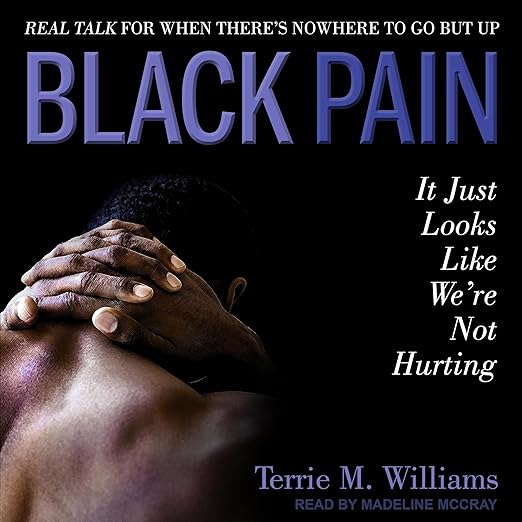
- Performance: Madeline McCray keeps a grounded, steady delivery across both the confessional and practical chapters, never tipping into melodrama.
- What it covers: Hidden depression, the cost of performing composure, healing within Black community and family.
- Feel: Raw and confessional, turning practical and hopeful in the second half.
- Our call: A genuinely powerful listen, especially for anyone who has hidden real pain behind visible success.
Public relations clients like Eddie Murphy filled Terrie Williams's calendar for three decades, and not one of them ever saw what was happening underneath the success. This audiobook opens from that gap between public performance and private collapse, and it doesn't waste time getting there: within the first chapter, Williams describes waking in terror and eating through nights she couldn't explain, then finally collapsing without knowing why. What she eventually names is depression, and what follows is part memoir, part diagnosis of a pattern she came to see everywhere in the Black community once she stopped hiding her own.
Williams spent thirty years building a game face so convincing that even she seems startled, in retrospect, by how long she kept it up. That's the real subject here, more than depression as a clinical category: the specific cost of performing composure for a living while falling apart privately, and the specific reasons that performance gets rewarded in Black communities where showing vulnerability has often been treated as a luxury nobody could afford.
One reviewer, writing under the name never gonna get it, calls it 'a Must have for all people, not just people of color,' while noting the book reads as female-centered at first since Williams is telling her own story, though men, in that reviewer's words, 'Plow through' the early chapters and find plenty that applies to them too. A second reviewer, posting as Works great, writes that the book offers real stories showing that, in her words, 'Black People are not exempt from pain and the mental stresses we endure, just to Be.'
Williams's specific career context matters too: running public relations for entertainment and legal clients meant her job was literally managing other people's public image while her own fell apart in private, a specific irony the book returns to more than once. That professional backdrop, high-visibility crisis management by day and a hidden personal crisis by night, gives the memoir a specificity that a more general account of struggling with depression wouldn't carry.
McCray Stays Grounded Through Both Halves
The audiobook earns its highest praise for making abstract statistics feel personal, which is exactly what a subject like depression in the Black community needs to avoid feeling like a lecture. A third reviewer, math diva, writes that the book was 'so powerful, that when sharing a few passages with my husband, it became clear that each of us had to have our own copy,' and describes it as the pick for her book club that month. That kind of reaction, a book so compelling it demands its own copy rather than a shared one, says something about how personally the material lands.
Structurally, Williams moves between her own history running a high-profile PR firm and a wider argument about how emotional pain gets rerouted into crime, addiction, workaholism, and eating disorders when it has nowhere honest to go. The back half turns practical, laying out paths toward relief through faith, therapy, diet, exercise, building a real support network, and cutting off people who drain rather than sustain you. Narrator Madeline McCray keeps the delivery grounded through both halves, never tipping into false cheer during the practical chapters or melodrama during the confessional ones.
The audio format suits confessional memoir particularly well here, since hearing Williams's own account of a panic attack or a binge-eating episode carries a different emotional register than reading the same paragraph silently on a page. McCray's narration choices, when to slow down, when to let a sentence sit before moving on, do real work shaping how the heavier passages land, even though none of the three attached reviews discuss her performance directly.
Depth Over Breadth, One Woman's Specific Collapse
Williams is candid about this being, structurally, a book she needed to write from inside a specific experience, and one reviewer flags that the opening stretch reads as 'very female centered as the author is a women and so that perspective is prominent.' That's worth knowing going in if you're a male listener; the same reviewer insists the payoff is there once you push past it, but the entry point isn't neutral, and Williams doesn't pretend otherwise.
At nearly fifteen hours, this also isn't a quick listen, and the subject matter, workaholism, addiction, eating disorders, self-harm through overwork, doesn't let up much once it gets going. None of the three reviews attached to this listing spend much time on McCray's narration specifically, which makes it hard to say for certain how her performance compares to reading the book in print, though nothing in the reactions suggests the audio format gets in the way of the material landing.
One more thing worth knowing: Black Pain was written specifically around Williams's own PR career and the entertainment and legal industries she worked in, so listeners expecting a broader sociological survey of depression across different professions or income levels will find the lens narrower and more personal than that framing might suggest. The strength of the book is depth over breadth, one woman's specific collapse and recovery rather than a comprehensive study.
For Anyone Who Wore a Game Face Too Long
Anyone carrying the specific exhaustion of performing fine in public while falling apart in private will likely recognize themselves somewhere in these fourteen-plus hours, and that recognition is the book's real value, more than any single piece of practical advice. It fits especially well for people in the Black community for whom Williams's framing of emotional pain as a community-wide, culturally reinforced silence will land with immediate specificity, but her larger argument, that depression dressed up as busyness or anger or overeating still needs to be named as depression, travels well beyond that audience too.
One thing worth flagging directly, since even a five-star reviewer raised it, is that the opening chapters center Williams's own experience as a woman before the argument widens out; men looking for a book that speaks to them from page one may need patience they don't expect to need. A purely clinical, research-driven approach to depression isn't what this delivers, so anyone looking for that framing should look elsewhere. The book club angle one reviewer mentions also points to a real secondary use case: this works as well for guided group discussion as it does for solitary listening, maybe better, given how much of the content practically invites being talked through with someone else afterward. For everyone else, especially anyone who has ever kept a game face on longer than was healthy, the nearly fifteen hours earn their length.
Does the audiobook offer specific paths to healing, or is it mostly diagnosis of the problem?
Both. Williams spends real time on practical paths toward relief, including faith, therapy, diet, exercise, building a support network, and cutting off toxic relationships, after establishing the scope of the problem.
How explicit does Terrie Williams get about her own collapse and depression in the narration?
Very. The opening material describes her waking in terror and eating through nights she couldn't explain before her eventual collapse, and that personal candor sets the tone for the rest of the book.
Is this audiobook better suited to individual listening or a group discussion format?
It works well either way. One reviewer made it her book club's pick for the month, and the mix of memoir and practical guidance gives a group plenty to discuss beyond just personal reaction.







