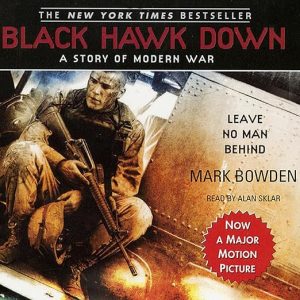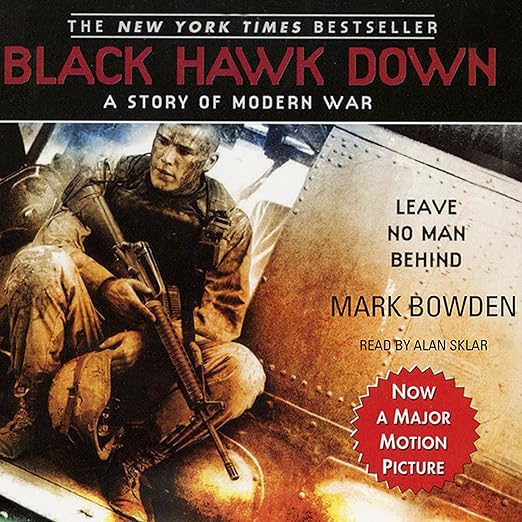
Ninety-nine American soldiers went into Mogadishu expecting an hour-long raid and instead spent a night fighting for their lives. How does a mission that precise, meant to take about sixty minutes, spiral into the most intense American firefight since Vietnam? That is the question Mark Bowden spends all fifteen hours of this audiobook answering. Black Hawk Down reconstructs the October 1993 raid meant to capture two lieutenants of a renegade Somali warlord, a mission Task Force Ranger expected to complete quickly and instead fought through until the following morning, and Bowden builds the account from both American and Somali sources: extensive interviews, classified combat video, and radio transcripts most journalists never get access to.
Alan Sklar's Untested Read of a Chaotic Night
Alan Sklar is not a narrator I have heard before, so his casting here is a fresh assessment rather than a confirmed track record, but the demands of this specific book are worth naming plainly: fifteen hours of dense combat chronology, dozens of named soldiers on both the American and Somali sides, and radio-transcript material that has to stay comprehensible even as the narrative jumps between multiple simultaneous firefights happening in different parts of the city. A narrator without real command of pacing could easily let that complexity blur into noise.
What comes through in reviewer accounts is that Bowden's own reporting does most of the heavy lifting, and a narrator's job is mostly to stay out of its way. Alan Winters calls the book 'a nonfiction account with all of the qualities of a fiction thriller,' crediting Bowden's immersion in 'detailed research' for that effect, and that kind of tension-through-accuracy, rather than tension manufactured through vocal performance, is exactly what this audiobook needs from its narrator: clarity and steady pacing over dramatic flourish, letting the source material's own intensity carry the listener.
Bowden's broader body of work backs up the confidence reviewers place in his research; he is also the author of Killing Pablo, his account of the manhunt for Pablo Escobar, and that same appetite for embedding deep inside classified or hard-to-access military and intelligence operations runs through both books. Listeners who found this kind of ground-level, multi-source reconstruction compelling here have a natural next listen already waiting in his other work.
Black Hawk Down did not start as a book at all; Bowden originally reported and wrote the story as a serialized newspaper series for the Philadelphia Inquirer, published in installments before it was expanded into the full book. That origin shows in the pacing, a reporter's instinct for hooking readers chapter by chapter carries over cleanly into an audiobook format built around discrete, listenable segments, each one capable of standing somewhat on its own while still building toward the full night's chronology. Listeners familiar with long-form serialized journalism will recognize the structural instincts underneath the finished book.
Both Sides of Mogadishu Earn This Its Reputation
This audiobook earns its reputation as one of the defining accounts of modern combat journalism because Bowden refuses to tell only the American side. Stone Dog's review frames the book as 'the quintessential story of combat in the post Cold War era,' specifically noting how a mission that began as humanitarian intervention became 'a disastrous attempt at nation building.' That double perspective, tactical ground truth and geopolitical context, is what separates this from a straightforward battle narrative; Bowden is as interested in why the mission happened as in how it went wrong.
Barron Laycock's review adds a useful credential to weigh: he writes as someone 'formally involved with the support of military operations,' and still calls the book 'interesting, disturbing, and captivating,' specifically recommending it to 'every American interested in how contemporary foreign policy often injects our armed forces into hostile and violent political situations.' That kind of endorsement, from a reader positioned to catch inaccuracies or oversimplification, carries real weight for a book built on this much interview-based reconstruction of a single chaotic night.
The book's influence extends well past its own sales figures; the Battle of Mogadishu became a genuine turning point in how the US calibrated the political risk of humanitarian military intervention for years afterward, with the casualties suffered that night cited repeatedly in later debates over whether and how to commit ground forces abroad. Bowden's reporting is part of why the event holds that outsized place in foreign policy memory rather than fading into a footnote alongside other 1990s peacekeeping missions.
Fifteen Hours of Names, Casualties and Chaos
The scale of named characters is real and worth preparing for. Ninety-nine soldiers plus the Somali fighters and civilians Bowden interviewed add up to a large cast moving through simultaneous, overlapping combat, and even with clear narration, listeners unfamiliar with military unit structure and radio terminology may need to focus harder than usual to track who is where during the book's most chaotic sequences. This is not a casual background listen; the density rewards close attention.
At over 15 hours, this is also a genuinely heavy emotional undertaking, not just a long one. Eighteen American deaths and casualty figures on the Somali side that run into the hundreds killed and over a thousand wounded are not abstracted into statistics; Bowden's reporting stays close to individual human cost throughout, a real strength of the book but one that means listeners should be prepared for a demanding, sometimes brutal listening experience rather than a detached historical survey.
Listeners who know the story primarily through Ridley Scott's 2001 film should expect a meaningfully different experience, not just a longer one. The film compresses and streamlines for a two-hour runtime and a clear cast of characters; Bowden's book keeps far more of the Somali perspective, the political backstory, and the after-action complexity intact, which is exactly why it remains the more complete account despite being the less widely seen version of the story.
Fuller Than the Film, Harder to Sit Through
This audiobook is essential listening for anyone interested in modern military history, the ethics and mechanics of humanitarian intervention, or the specific tactical and political lessons the US military drew from Mogadishu that shaped later engagements. It also rewards listeners who appreciated the 2001 film adaptation but want the fuller, more balanced, more deeply reported version; Bowden's book has range and context the film's runtime never could include.
Skip it if graphic combat detail and sustained casualty description are difficult content for you personally, since Bowden does not soften the human cost on either side. Listeners looking for a shorter, more introductory overview of the Battle of Mogadishu, rather than a comprehensive 15-hour reconstruction, may also find a documentary or a shorter historical summary a better starting point before committing to Bowden's full account.