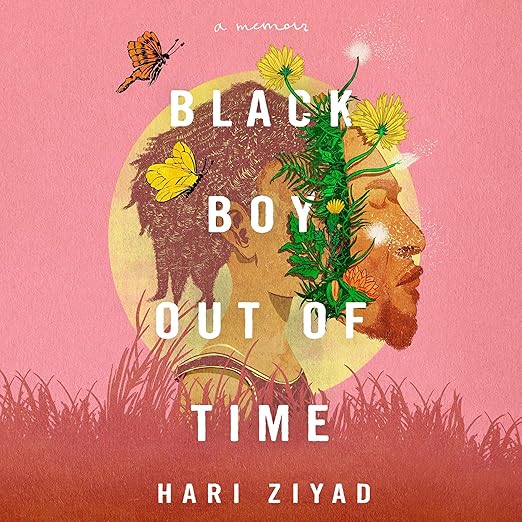
Nineteen children in one blended family, two religious traditions under a single roof, and a childhood spent Black and queer in Cleveland, Ohio. Hari Ziyad's memoir starts from that arithmetic and spends nine hours and twenty-one minutes of audiobook working out what it did to a person. The book is not laid out as a life story told forward. It is a reframing, which is the description's own word, of a coming-of-age narrative other people had already written on Ziyad's behalf, and the argument running underneath is that Black children are handed a very small set of available stories and then held to them for the rest of their lives. Brilliance Audio released the recording in March 2021, with Desean Terry credited to read.
Tenderness and Rage Aimed at the Same Child
Hari Ziyad writes with an unusual double motion, looking back at a child with real tenderness and at the systems built around that child with what the description calls justified rage, and neither register cancels the other out. Sustaining that across a full book is difficult, and it is the main reason this memoir keeps its footing where others in the category lose theirs. One response arrives having read widely in Black writing from Senegal, Haiti, Martinique and beyond, expects a personal biography, and finds something else entirely: a current and unsparing perspective that the wider diaspora, by that reader's account, has been missing. The mismatch that response describes is real, and it is also the point of the book.
Trust is the word the description keeps returning to: trust built, broken and repaired across generations. That is the actual subject here, more than gender or race taken separately, and it explains the structure better than the memoir label does. Ziyad moves between a childhood in Cleveland and the work of finding a self in New York City, and the movement reads as argument rather than as sequence, with each return to the past testing something claimed about the present. If you want a life delivered in order, this is not it. If you want to watch somebody take apart the terms they were handed before they could object to them, the shape makes immediate sense from the first hour.
Terry's Reading Answers a Dedication to the Dead
Desean Terry is the voice you will hear, and the assignment carries a specific difficulty inside it. This is a first-person memoir whose author the description refers to in the plural throughout, and whose dedication names an audience rather than a reader: the outcast, the unheard, the unborn, and the dead. A book that speaks toward the dead needs a reading capable of holding direct address without tipping it into performance, and that is a narrow line to walk. Nine hours and twenty-one minutes is long enough that any strain in the balance will surface. It is also long enough that a reading which finds the line becomes the actual reason to take this one in audio rather than on the page.
Brilliance Audio published it, and one credited reader carries the whole thing, with no cast and no author narration listed anywhere. That last absence deserves a thought on a memoir. When a writer reads their own account, a listener gets the person; when somebody else does, a listener gets an interpretation, and interpretation is not automatically the weaker of the two. A trained voice will carry a long stretch of dense, argumentative prose more reliably than most authors manage, and this book is dense and argumentative in a way that punishes flat delivery. What gets given up is the particular weight of hearing a person say their own hardest sentences in their own time.
Reviews From Before This Recording Existed
All but one of the written responses on this page predate the release date printed on it. The listing says March 1, 2021. Almost every response beneath it carries a February date from that same year, with a lone entry arriving after the release. That gap tells you something concrete: the column here is not testimony about this recording. It is testimony about the text, gathered before the audio existed at all. Nothing in it is dishonest and nothing in it is useless. It simply answers a different question from the one a buyer of an audiobook is asking, and the page stacks the two together as though they were interchangeable.
Readers should also know what the column warns about, because the publisher copy does not. One response describes a book that forces you to think critically about important and triggering material, calls the writing extremely open and personal, and states plainly that the story is emotional and sometimes hard to take. That is the most practically useful sentence anywhere on this page, and it arrived from a reader rather than from a marketing department. The description talks about tenderness, rage and the necessary disruption of social norms; it never mentions that some of the childhood material is difficult. A warning supplied by a reader is still a warning, and on a memoir this direct it is worth taking at face value before you start.
Ideas Over Incident, Openings Instead of Resolutions
Give it the hours if you want a memoir that argues. This suits listeners who read for ideas as much as for incident, and who are comfortable with a book that keeps interrupting its own story to ask what the story is for and who it was built to serve. It suits anyone interested in how race and gender get taught to a child well before the child has words for either. And it suits people who came to Ziyad through the journalism and want the longer form. One response captures the honest middle ground exactly, describing a book it consistently respected without ever quite embracing, which is a legitimate outcome here rather than a failure on either side.
Choose a different memoir if you want a life delivered in order, with the childhood settled before the adulthood starts, because this book refuses that arrangement on principle and announces the refusal early. Equally, if you want the warmth without the argument, the tenderness here is genuine and never once detached from the critique surrounding it. And if a memoir has to resolve for you, be warned that this one finishes by opening outward, toward the future and toward people not yet born, rather than by closing anything down. Cleveland is where it starts and New York is where it goes, and the distance between the two gets measured in what a person has to surrender in order to be recognized.
Common Questions
Whose story is Black Boy Out of Time?
Hari Ziyad's, told as a memoir rather than as reportage. The description places the childhood in Cleveland, Ohio, inside a blended family of nineteen children, and the adult material in New York City. The recording came from Brilliance Audio on March 1, 2021.
How long is the Black Boy Out of Time audiobook?
Nine hours and twenty-one minutes. That is an ordinary memoir length, but the prose is dense and the structure moves between periods instead of running forward, so it asks more attention than most books of that size. Spreading it across a week of commutes works better than attempting it in two sittings.
Is the Black Boy Out of Time audiobook a novel or a memoir?
A memoir, and the description is specific about it, calling the book a reframing of the author's own coming-of-age story. The confusion is understandable, because the writing moves between periods and takes long argumentative detours that read closer to essay than to narrative. It is filed under LGBTQ+ studies.
Who narrates the Black Boy Out of Time audiobook?
Desean Terry, credited alone. No author narration is listed, and no cast or second voice appears in the credits, so the whole memoir arrives through one hired reader. The publisher is Brilliance Audio, and no second credit of any kind appears in the production details.