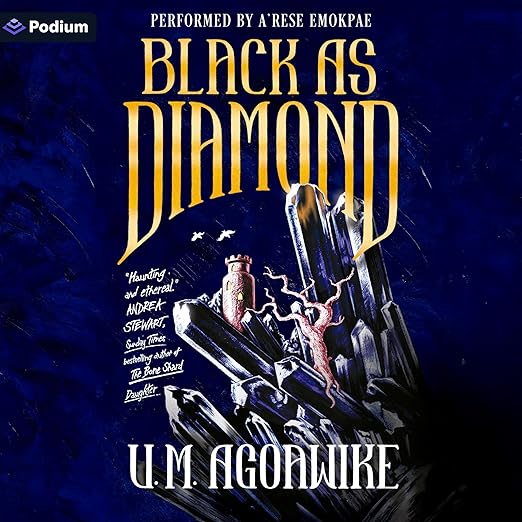
Asaru carries a curse that could wipe out everyone he was born to defend, and this audiobook spends fifteen hours and thirty-nine minutes refusing to make that easy. U. M. Agoawike's debut reached Podium Audio in March 2026 filed under Literature & Fiction, a shelf that undersells it badly. What waits inside is secondary-world fantasy with its own species, its own long grievance and its own vocabulary, and the vocabulary turns out to be the thing that decides whether a listener stays.
Pauline's 3.75 Stars Flag a Language Barrier
Pauline's four-star entry does the rare and useful thing of showing its arithmetic: 3.75 stars, rounded up. What follows is the most candid account of the experience anyone has posted. The plot is compelling and rich, the quest and found-family material land differently from most, the prose fits the story and paints a vivid picture. And still, Pauline kept feeling like an outsider who did not quite speak the language of the world being described. That sentence is the whole review, and it counts double in audio, where a listener cannot glance back two pages to check what a keyel is.
Asaru's Curse Binds Him to a Reluctant Healer
Agoawike builds everything on a bind. Asaru, a winged warrior of the eresh keyel, goes into the human realm to find out what happened to his brother's squadron and picks up a fatal curse instead. Wren, a former healer with a bad habit around dangerous magic, ends up spell-bound to him after Asaru commits what the description calls a terrible crime. Two people who would never choose each other can no longer separate, and their only lead is the Chronicler, keeper of the history of Asaru's people.
My own reaction sits close to Pauline's. When this book moves, it is genuinely eerie, and the destination it points toward, human civilization broken and reassembled into something else entirely, is an enormous swing for a first novel. When it stops moving, it teaches, and the teaching arrives without a glossary.
Eresh Keyel Culture Rests on an Old War
Jamie E Flood's five-star response is the one to read before buying. It praises the scale of the worldbuilding, the queer identity questions the book keeps returning to, the found-family bond that forms under pressure, and a balance of dark and haunting material against warmth and comradery. That entry also names the quality the publisher copy will not: an eerie register that never quite lifts, carried by prose it calls lyrical without the story slowing down.
Such a combination justifies a long file. Plenty of secondary-world fantasy is grim. Very little of it manages grim and warm at once, and fewer books still find warmth between two characters who were forced together by a spell rather than choosing each other. Agoawike also does something structural with the eresh keyel, a winged people organized entirely around fighting the remnants of an enemy that died long ago. A whole culture built on a war that ended before anyone living was born is a strong engine, and the description promises the Chronicler will explain how that culture was assembled.
Queer identity is not decoration here either. Agoawike sets out identity, history and power as the three subjects, then places them inside a society crushed by what a few people did generations back. That is a thesis, and a debut willing to carry one earns its length. It also explains why the pace behaves the way it does: a novel arguing that the present is shaped by a buried past has to bury the past first, which costs hours before it pays anything back.
A'rese Emokpae Carries Four Viewpoints Alone
Kaitlyn's three-star is the warning label. It arrived expecting old-school eighties epic fantasy from a new novelist and found the book hard to stay interested in. Her specific complaint matters more than the grade: four characters each get a viewpoint, which muddies the early hours, and those four paths take a long time to converge, so for a stretch a listener follows separate stories with very little context binding them together.
A'rese Emokpae is the single credited voice for all of that. One reader handling four viewpoints is ordinary practice and no problem in itself, but it does mean performance is the only thing separating Asaru's chapters from Wren's, at exactly the point where the plot is not yet helping. Add invented nouns arriving at speed and no page to pause on, and the opening hours ask considerably more of a listener than the closing ten.
One practical note before you commit. The description warns of mature content, then sends the buyer to the author's website for the full list of content warnings without linking it. Anyone who chooses books by content flag has to go hunting elsewhere before pressing play, which is a failure of the listing rather than of the novel. The shelving is loose in the same direction: a Literature & Fiction tag on a book with winged warriors, freelance killers and an ending that breaks the world tells a browser almost nothing useful.
Fantasy Fans Willing to Stay Lost Awhile
Choose this if you want fantasy built from the ground up and you are content to be lost for a while. Anyone who enjoys the slow reveal of a strange society, who wants queer characters whose identity is load-bearing rather than incidental, and who likes a bound-against-their-will pairing will find a great deal to hold. The found-family thread earns its place, and the eerie register is unusual enough on its own to justify the entry cost. Commuters and multitaskers should think about their listening conditions rather than their taste, because this is a book that punishes the half-hour spent half-listening more than most.
Impatient listeners get punished here too. If you need four strands braided inside the first hour, if you want fantasy vocabulary glossed as it arrives, or if you tend to drift when a book withholds context deliberately, this is the wrong long file to commit to. Anyone sensitive to dark material should settle the warning list first, since the description declines to settle it for you. Eighties-style epic fantasy exactly as it used to be made is not quite what arrives either: the shape is recognizable, the delivery altogether stranger and colder.
Key Details
- Narrator: A'rese Emokpae is the single credited voice for a story that rotates four viewpoints, which puts the early separation of characters entirely on the reading.
- Subjects: Queer identity, found family, inherited history, a curse-bond between reluctant allies.
- Tone: Eerie and cold-lit, with unexpected warmth breaking through.
- Bottom line: A large, strange debut that rewards patience and punishes divided attention.
Questions Listeners Ask
How long is the Black as Diamond audiobook, and is it part of a series?
Podium Audio lists it at fifteen hours and thirty-nine minutes. No series name or volume number appears in any field on the record, and the description presents the story as a self-contained debut, so nothing on the listing suggests a prior volume is needed before starting this one.
Does the audiobook work if you rarely read secondary-world fantasy?
It asks more than most. Agoawike invents a species, a vanished enemy and a working vocabulary, and delivers all of it inside the story rather than in a glossary. Listeners who enjoy assembling a world from context will be fine; anyone who prefers explanation up front should expect a demanding first stretch.
Where do I find the content warnings for Black as Diamond?
The description flags mature content and states that a complete list of content warnings lives on the author's website, without providing a link. Buyers who screen by content flag will need to search for the author's site separately, since the product page itself carries only that single general warning.
Who reads the Black as Diamond audiobook, and who released it?
A'rese Emokpae is the only name in the narrator field, and Podium Audio published the recording on March 3, 2026. The credits name no second reader and no full cast, so one voice carries the four rotating viewpoints across the entire running time.