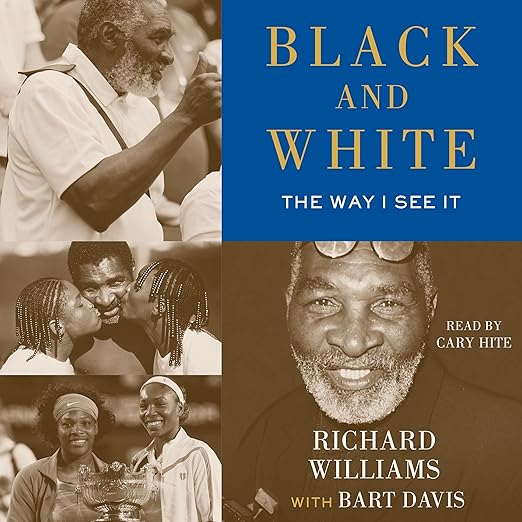
At a Glance
- Narrator: Cary Hite voices Richard Williams' memoir with the texture of someone who understands the difference between a man performing resilience and a man reporting it; the delivery is grounded and direct, appropriate for a narrator whose credibility depends on not overselling.
- Subjects: Self-made determination and fatherhood, racial adversity and strategic defiance, the complexity of a public figure misread by media
- Tone: Unflinching and proud, occasionally raw but never self-pitying
- Bottom line: A memoir that reframes a story most people think they already know, narrated with the plainness the subject deserves.
Richard Williams wrote Black and White before Will Smith would portray him in King Richard, before the Academy Award, before most of the world had formed a settled opinion about who he is and what he did. The audiobook, narrated by Cary Hite across 8 hours and 26 minutes, is Williams' own account of a life that the media coverage of Venus and Serena's careers had consistently misrepresented: a man described as eccentric, controlling, or dangerous who saw himself, and who Serena herself describes in quoted passages, as a protective and deeply devoted father operating from a coherent philosophy about what his daughters would need to survive and succeed in an industry that was not built for them.
The Kirkus Reviews description quoted in the book's own marketing, "upfront and unapologetic," is accurate in both directions. Williams is upfront about the poverty of his Shreveport, Louisiana upbringing in the 1940s, about the racial violence he witnessed and survived, and about the specific calculation behind how he chose to raise his daughters in Compton before moving them to Florida for serious tennis development. He is unapologetic about that calculation: the plan to create world-class tennis champions before his daughters were born, the decision to coach them himself without formal tennis training, and the confrontational relationship with an industry that wanted to control a narrative he refused to surrender. The memoir doesn't make these choices into simple heroism; it presents them as a man's considered decisions under specific historical and personal circumstances, and it asks readers to engage with those decisions on their actual terms rather than on the terms the media narrative provided.
Cary Hite's narration is well-matched to the material. Williams' voice in the text is plain, direct, and occasionally blunt in ways that could tip into harshness in the wrong reading. Hite keeps the delivery grounded, finding the dignity in Williams' matter-of-fact account of violence, loss, and triumph without smoothing the edges that make the story credible. The reviewers who describe being stopped mid-chapter by what this man has experienced in his lifetime are responding to something real in the text that Hite preserves in the audio treatment rather than dramatizing into something more conventionally moving.
Reviewer DShiDon's observation that whatever you think you know about Richard Williams is incorrect is the book's central argument made in a single sentence. The media version of Williams, the unreliable eccentric who got lucky with genetically gifted daughters and a grandiose plan that somehow worked, is the target the memoir is written against. The counter-argument, delivered across 8 hours, is that the eccentricity and the luck are both misreadings of someone operating from a coherent philosophy under exceptional pressure, surrounded by forces that had strong incentives to diminish what he was actually doing.
Why It Works in Audio
The memoir does something specific that the film adaptation, excellent as it was in many respects, could not do: it gives Williams' interiority rather than a constructed dramatic version of events shaped by script and performance. The scenes in King Richard are written for cinema; the passages in Black and White are written, however imperfectly, from inside a life that cinema was interpreting from the outside. Williams' account of what it meant to parent Venus and Serena through the USTA system, through the racism of professional tennis as an institution, and through the media pressure that intensified as his daughters' careers became unmistakably historic, has a granularity that performance and script can approximate but not replicate.
The Shreveport origins section is the most powerful part of the audiobook. Williams describes the racial violence of his Louisiana upbringing with a specificity and composure that is more affecting than dramatization would typically be. Hite navigates this material with the restraint it requires, trusting the facts to carry their own weight rather than performing emotion that would come between the listener and what Williams is describing. This is the part of the book that establishes why the rest of it, the tennis strategy and the media battles and the championship victories, means what it means.
Weak Spots in Black and White
The memoir is Richard Williams' own account, and that first-person authority comes with the limitations inherent to autobiography. This is not an objective biography cross-referenced against multiple sources; it is a self-portrait by a man with strong views about how his story has been told and a determined interest in correcting that record. Williams has strong opinions about the people and institutions he encountered, and he does not hold those opinions quietly or balance them with counterargument. Readers who want the version of events that has been checked against outside perspectives should supplement the memoir with reported journalism. What the book provides that journalism cannot is the internal experience: what it felt like from inside, what the motivations were as Williams understood them, what he was trying to build and why.
The tennis chapters, following Venus and Serena's development through junior and professional competition, are detailed in ways that will be more immediately immersive for tennis followers than for general sports memoir readers. Williams is specific about training decisions, match contexts, and tournament politics in ways that reward some baseline tennis knowledge, though the narrative momentum carries listeners through even when the sport-specific detail is dense.
Recommended For
Anyone who watched King Richard and wants the source version of the story rather than the adapted dramatic interpretation will find this audiobook essential context. Sports memoir listeners interested in the intersection of race, ambition, and family legacy will find the material rich and specific enough to reward the full 8-hour investment. Listeners who know Venus and Serena Williams primarily as cultural figures rather than tennis fans will still find Williams' account compelling, because the book is ultimately more about fatherhood, survival, and racial navigation in America than it is about tennis strategy. Skip it if you want the journalistic, multi-source biography rather than the first-person account, or if Williams' conviction about his own choices is more likely to frustrate than to engage you as a listener.