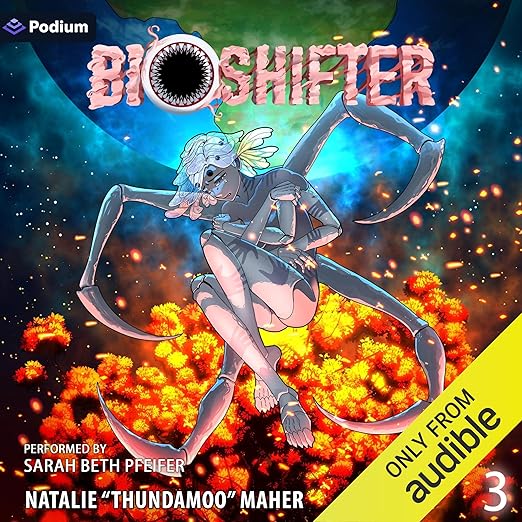
Trilogy endings are where most series lose their nerve, and the Bioshifter: Volume 3 audiobook spends twenty-three hours and twenty-four minutes refusing to. Hannah begins this one euphoric, having finally shown people who she actually is, teaching Earth about magic and taking what the description calls a pleasant vacation in a city built by robots. Nothing about that lasts, and the book knows it before you do.
The Review
Manumit, the city of the Crafted, is where the finale starts assembling its questions. Why did the Crafted go to war in the first place, and why did they stop so abruptly? What do you do about government agents parked outside your house? And how does one person prevent an apocalypse that an entire sect, the Disciples of Unification, is convinced she will personally cause? The scale escalates without the tone abandoning what made the series work, which is the trick most third volumes fail at when they decide the ending has to be solemn.
Characters are the engine, and a June 2024 five-star identifies that correctly: fantasy and magic are the bread and butter, but the meal is the cast, specifically Hannah and the friends who keep showing up for her. That response also tracks her development across the trilogy in both physical and mental terms, which is the accurate frame for a series whose transformations are never only bodily.
Self-revelation in that opening line is doing real work throughout. Hannah spends this volume living openly as herself while the world around her demands she also save it, and the book puts those two pressures in the same twenty-three hours without pretending either one cancels the other. That is a harder balance than most finales attempt, and it explains why the responses on this page describe joy and devastation in the same sentence.
Why Bioshifter: Volume 3 Works as an Audiobook
Sarah Beth Pfeifer holds a very long file and a very wide tonal range. This is a book that moves from comic vacation material to atrocity and back, with robotic characters, a doomsday sect and an ordinary teenager to keep separate, and the transitions arrive without warning by design. A page gives you a scene break to brace against. A recording gives you the next sentence. The Crafted are the specific test: a robotic population with its own history of war and silence has to sound like a people rather than a device, and the book spends real time on why they fought and why they stopped.
Darkness is not incidental here, and a five-star from March 22, 2024 is direct about it: the emotional beats still hit hard without a reread, and this volume goes dark enough that the response had to stop several times to process what had happened. Heartbreaking in the best way, it concludes. Anyone deciding whether to spend a credit here should read that as a content note rather than as enthusiasm.
Scale works in favor of a finale like this one. Twenty-three hours is enough room to answer the trilogy's standing questions about the Crafted war, to run the apocalypse plot properly, and to give the friendships the closing space they earned, which is exactly what a rushed final volume cannot do. Audio also suits a story built on long stretches of ordinary life interrupted by catastrophe, since a listener cannot skip ahead to check whether the calm is about to break.
The Caveats
Names are where this listing gets slippery. The byline reads Thundamoo, and one five-star filed on March 18, 2024 thanks somebody called Natalie for the heartbreak, praising a series it says it loved all three volumes of. The page never explains the relationship between those two names, and it credits only one of them, which matters to any listener trying to find the author's other work.
Dates undercut the star display. This recording was published on October 1, 2024, and four of the five verdicts on the page date from March to June of that year, months before the audio existed. The one that came afterward, in February 2026, describes a book that was physically painful to read and impossible to put down, which is a reading verdict too. The 116 ratings behind the 4.6 average sit on a page where every written response awarded five stars, so whatever pulled the average below five was never written down.
Shelving is the last flag. The listing files a robots-and-apocalypse fantasy finale under an identity category with no genre tags attached at all, which is how a book ends up invisible to the readers most likely to want it. Anyone browsing for fantasy will not find this; anyone browsing the category it sits in may not expect a twenty-three hour magic epic.
Should You Listen to Bioshifter: Volume 3?
Readers who have finished volumes one and two are the only audience that makes sense here. A February 2026 five-star describes not expecting the series to hurt as much as it did and being unable to stop regardless, which is roughly what a finale of this kind demands of a reader. Listeners who want transformation stories written with joy rather than as trauma will find this one unusual and worth the hours.
Grief is the price of admission. The middle stretch is genuinely brutal, several responses warn about it in advance, and anyone in a fragile week should postpone rather than sample. Volume one is where the emotional groundwork gets laid, and arriving here first means meeting the payoff of three books with none of the reasons to care about it.
Common Questions
Does the Bioshifter: Volume 3 audiobook finish the story?
Yes. The description states plainly that this is the third and final book, and the standing questions about the Crafted, the Disciples of Unification and the predicted apocalypse are all addressed here. Expect a conclusion rather than a hook into a fourth volume, and a trilogy that ends where it said it would.
Can you follow the Bioshifter: Volume 3 audiobook without the earlier books?
Not really. The plot assumes the magic system, the political situation and Hannah's history are already familiar, and the emotional payoffs are built on two volumes of setup. Begin at volume one instead, where the world, the stakes and the friendships are established from scratch.