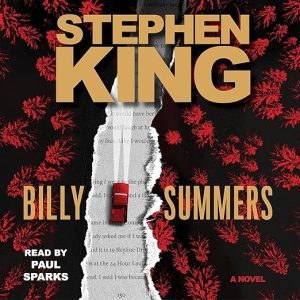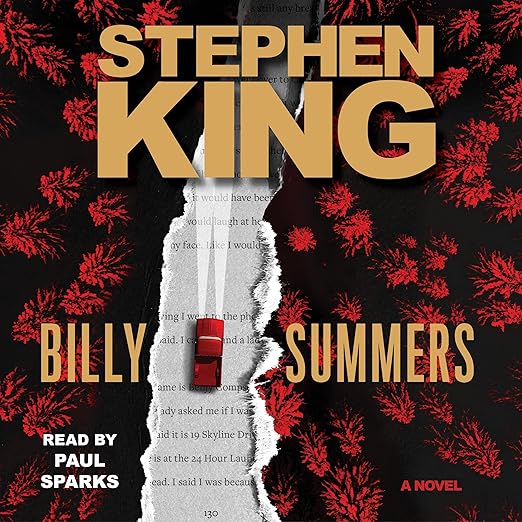
I was halfway through Billy Summers on a Wednesday afternoon when I realized I had made a tactical error. The first half of this novel moves slowly and deliberately, building Billy's character with almost novelistic care for a thriller, and I had planned to use it as background listening. That did not work. Every time I tried to let it recede into ambient noise, something in the prose or in Sparks's performance would pull me back. By the time the novel accelerates in its second half, I had given up trying to do anything else while it played.
Stephen King's 2021 novel is described in the synopsis as a good guy in a bad job, and that compression is accurate but flattening. Billy Summers is a hitman who will only kill genuinely bad people, a decorated Iraq War veteran, a man who uses the cover of being a dim-seeming aspiring novelist to surveil his marks. He is also, by the novel's account, an actual writer. And now he wants out.
How Billy Summers Holds Up
The novel's structure is unusual for King and unusual for the thriller genre. The first half is essentially a character study: Billy establishing his cover in a small Midwestern city, getting to know neighbors, writing the memoir he is using as his legend, and waiting for the conditions of the job to align. The pacing is, as more than one reviewer notes, pretty slow for the first half. One detailed reader described the setup as careful establishment of Billy's past traumas and skillful, observant, clever nature, and that is an accurate description of what King is doing.
What that slow build earns is emotional access. By the time the job goes wrong, as the synopsis promises it will, you are inside Billy's perspective in a way that makes the novel's second half feel genuinely consequential rather than generically urgent. King has spent two hundred pages making you care about this specific man in these specific circumstances, which is why the crisis that erupts there lands the way it does. The revenge narrative in the novel's third act, where Billy pursues the people who set him up while also dealing with the aftermath of a violent crime he witnesses, is powered entirely by what the first half established.
Why Billy Summers Works as an Audiobook
The casting of Paul Sparks here is worth the critical attention. Sparks has a quality in his narration that is difficult to describe precisely: he reads Billy's intelligence as self-concealed rather than absent. When Billy is playing the dim writer for his cover, there is always a slight register underneath the performance that lets you hear what Billy is actually thinking. It is a subtle distinction and Sparks maintains it consistently across nearly seventeen hours.
The sections where Billy actually writes, where he is working on his memoir as part of his cover and the memoir becomes increasingly real to him, are handled with particular care. King is doing something meta here about writing as a way of processing experience and trauma, and Sparks reads those sections without overstating their significance. The memoir-within-a-thriller structure is one of the novel's more ambitious choices, and the narration trusts it to work without annotation.
Weak Spots in Billy Summers
The novel is described in the synopsis as part war story and part love letter to small-town America and the people who live there, and that description deserves unpacking. The town where Billy establishes his cover is drawn with affection rather than condescension. The neighbors he meets, the local rhythms, the way genuine community forms around ordinary proximity, are rendered by King with visible pleasure. Billy comes to value these things in ways he did not expect to value them, and that transformation is what gives the novel its emotional weight beyond its plot mechanics.
One reviewer described it as one of King's best novels and noted that he is still capable of writing good stuff that matches his early work. Another called it meeting Robert Ludlum in unexpected ways. Both descriptions capture something real: this is a King thriller that has more going on under its genre surface than its marketing suggests, and the surface is already good.
Who Should Listen to Billy Summers
King readers who have followed his recent standalone work and wondered whether he still has the patience for genuine character building will find their answer here. Thriller listeners who want their genre fiction to take its protagonist seriously rather than using character as delivery mechanism for plot will find the long first half rewarding rather than slow once they understand what it is building toward.
The sixteen-hour-plus runtime is appropriate for what King is doing. This is not a book that benefits from compression. It earns its length, and Sparks earns the patience it requires of the listener. Those who bounce off the deliberate first half and want something that kicks into gear faster will not find what they are looking for here. Those willing to let King set the tempo will find one of the more genuinely satisfying thrillers he has written in the past decade.
- Voice: Paul Sparks gives Billy Summers a quiet, watchful quality that suits the character's cover persona as a dim writer; the narration is controlled in ways that amplify the novel's slow-build tension.
- Big ideas: The ethics of violence, small-town America as moral counterweight, the writer-as-observer
- Atmosphere: Deliberate and character-driven early, then increasingly urgent
- Worth it?: One of King's strongest standalone novels in years, patient enough to earn its emotional payoff and surprising in its genuine warmth.
Questions Listeners Ask
Does Billy Summers connect to any other Stephen King novels or is it fully standalone?
Billy Summers is a fully standalone novel with no connections to King's shared fictional universes. Listeners can come to it without any prior King knowledge, though familiarity with his voice and style will help calibrate expectations for the pacing.
How explicit is the violence in Billy Summers?
The novel deals with professional killing and includes a violent crime in its second half that has significant consequences for the plot. The treatment is unflinching but not gratuitous. King is more interested in the psychological aftermath of violence than in graphic depiction of it.
Is Paul Sparks's narration effective for the memoir sections Billy writes as part of his cover?
Sparks handles these meta-fictional sections with care, distinguishing them tonally from the novel's main narrative without over-signaling the shift. The memoir material is where King is doing his most ambitious thematic work in the novel, and the narration respects that ambition.
How does Billy Summers compare to King's other recent crime and thriller work like Mr. Mercedes?
Both are King in his crime thriller mode, but Billy Summers is more intimate and character-driven than the Hodges trilogy. The first half of Billy Summers has almost no thriller mechanics; it is a character study. Mr. Mercedes leans into genre plotting from the start. Readers who found the Hodges books satisfying on genre terms may need to adjust expectations for Billy Summers's slower burn.