Before You Press Play
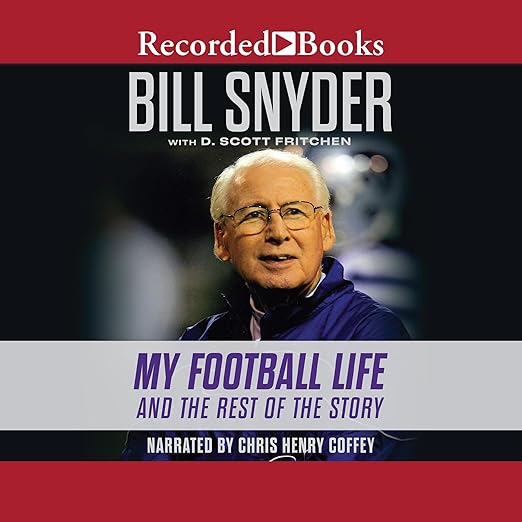
- Narration: Chris Henry Coffey delivers the autobiography with quiet authority, matching the measured, purposeful quality Snyder himself projects throughout the book.
- Themes: Leadership and sacrifice, second chances, the architecture of winning cultures
- Mood: Reflective and determined, with the weight of hard-won perspective
- Verdict: Fans of Kansas State football will find this essential; readers drawn to leadership memoir with genuine complexity will find it unexpectedly rich.
Bill Snyder's story is built on a premise that should not work. In 1988, Kansas State had one of the worst college football programs in the country, a record of losses stretching back decades, and a stadium that symbolized neglect more than ambition. The autobiography that Snyder wrote across more than fifteen hours of this audiobook does not pretend the turnaround was inevitable or easy. That honesty is what separates it from the motivational-speaker genre it might otherwise resemble. Chris Henry Coffey narrates this memoir with the steady, unshowy competence that the material requires. Snyder's voice is not theatrical. He does not deal in sentiment. The prose reflects a man who spent his career communicating through systems, goals, and expectations rather than emotion. Coffey finds that register precisely and holds it across a long runtime without the performance ever feeling flat.
Our Take on Bill Snyder
The emotional center of the book is the Wildcat Goals for Success, the behavioral and philosophical framework Snyder developed and refined over decades. These are not motivational slogans. They are operational commitments, the kind of detailed expectation-setting that most coaches gesture toward but few actually implement with Snyder's consistency. Listeners will find these goals return repeatedly across the memoir, not as repetition but as evidence of a mind that always returns to first principles when disoriented by success or setback.
The account of turning Kansas State from a program that had not won a conference title since 1934 into a number one ranking and six eleven-win seasons in seven years is handled with specificity rather than legend. Snyder gives credit broadly, to coaches, players, staff, and university administration, and is candid about the cost: eighty-hour work weeks, a life organized around football at the expense of nearly everything else. One reviewer described this as an inspiring story of unselfishness. Snyder himself seems to understand that his dedication extracted a price from the people around him, and he does not shy away from that accounting.
The Strengths
The retirement and return arc is the section that elevates this audiobook above standard sports biography. Snyder stepped back, watched the program decline under his successor, and returned to coach again, eventually leading Kansas State to a second Big 12 title. For listeners interested in leadership, this second act is the most interesting material in the book. Coming back after a successor has dismantled what you built requires a particular combination of self-belief and institutional loyalty that Snyder examines honestly. He does not pretend the return was uncomplicated, professionally or personally.
The battle with throat cancer, woven through the final years of his second tenure, is handled with the same directness Snyder brings to everything else. He does not dramatize it. The audiobook's strength throughout is precisely this refusal of drama for its own sake. Snyder competed against enormous odds, rebuilt twice, fought illness, and kept working. The book presents this not as heroism but as character: the accumulated effect of showing up consistently in the right direction over many years. That framing is more persuasive than heroism, and it is what listeners who are not Kansas State fans will take away.
Before You Commit to Bill Snyder
Listen closely to the early chapters on his pre-Kansas State years in St. Joseph, Missouri, and his apprenticeship under other coaches. The formation of his coaching philosophy happens in those years, and the seeds of the Wildcat Goals appear early in raw, uncodified form. The contrast between who he was as a young coach and who he became is instructive and not always flattering to his earlier self. Snyder is candid about his flaws in ways that feel earned rather than performed.
The book also does not shy away from complicated relationships, particularly around family and the sacrifices his schedule required, though it handles them with restraint rather than full disclosure. The portrait that emerges is of a driven, somewhat isolated man who understood football at a very high level and could transmit that understanding to young men, but who sometimes struggled to apply the same care to relationships outside the program. That complexity makes this memoir worth the time even for listeners with no particular attachment to Kansas State or college football.
What makes the audiobook unusual among coaching memoirs is Snyder's treatment of the young men who played for him. He did not simply develop football players. He ran a program explicitly designed to produce functional adults, using the Wildcat Goals as a curriculum for character alongside athletics. Several reviewers noted how much they learned about the Kansas State program's internal culture from the book, not just the scoreboard results. That dimension of the memoir gives it a reach beyond sports biography: it is also a record of what it looked like when a coaching staff took seriously the idea that their job did not end when the player left the facility.
Who Should Listen to Bill Snyder
The core audience is clear: Kansas State supporters, college football fans who know the Wildcats' history, and anyone who followed Snyder's career will find this exhaustive and satisfying. At fifteen-plus hours, it is a genuine deep dive, not a summary. Listeners should arrive with time and patience for the detail.
Beyond the sports audience, this memoir works well for readers interested in organizational turnaround, leadership under adversity, and the question of what sustained excellence actually costs. The Wildcat Goals for Success have been discussed in business and coaching circles beyond football, and hearing Snyder walk through their origin and application in his own context gives them weight that secondary summaries cannot replicate. Skip this if you want a polished celebration; pick it up if you want the full picture of a complicated career, including the parts that complicate the legend.