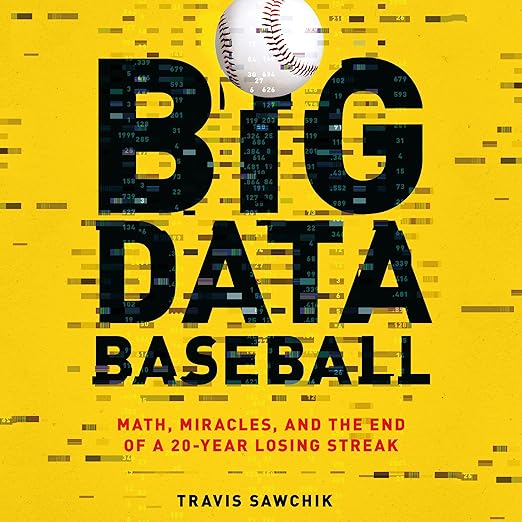
I grew up watching baseball mostly for the theater of it, the way tension builds pitch by pitch, the mid-inning substitutions that either look like genius or madness in retrospect. I came to Big Data Baseball not as a statistics convert but as someone skeptical of the idea that analytics had fully colonized the sport I loved. Travis Sawchik's book didn't entirely dismantle my skepticism, but it made me far more sympathetic to what a well-built analytics program can actually do, and it did so through one of sports writing's more reliable delivery systems: a genuine underdog story.
The Pittsburgh Pirates lost twenty consecutive seasons. Twenty. From 1993 to 2012, the franchise managed the longest losing streak in North American professional sports history. They did it while competing in a league with no salary cap, against teams like the New York Yankees and the Boston Red Sox whose payrolls dwarfed Pittsburgh's total budget. The 2013 season, which Sawchik reconstructs in careful detail, is the story of how a team with no financial advantages found a different kind of edge and what happened when they had the organizational courage to act on it.
Sawchik is a journalist, not an academic, and the book reads like the best kind of sports journalism: deeply reported, driven by human characters as much as ideas, and structured around a narrative that knows where it's going. He introduces readers to the specific analytics tools the Pirates deployed, pitch framing and defensive shifting are the two central ones, and explains not just what they are but why the Pirates were in a position to use them more aggressively than other teams. A small-market club with little to lose is, paradoxically, better positioned to take unconventional statistical approaches than franchises with larger payrolls and more conservative front offices.
The human dimension is what keeps the book from feeling like a stats seminar. Sawchik follows individual players and coaches through their resistance to and eventual acceptance of data-driven instruction. The catching staff learning to frame pitches differently. Infielders repositioning themselves on the fly according to shifting charts. Veteran coaches being asked to trust numbers they didn't generate and couldn't always explain intuitively. The cultural negotiation between whiz-kid analysts and graybeard coaches, as the synopsis describes it, is the book's real subject, and Sawchik handles it with the nuance it deserves. Neither side is made the villain, and neither is made infallible.
Why Big Data Baseball Works as an Audiobook
One reviewer drew the inevitable comparison to Moneyball and correctly noted this isn't quite that. Michael Lewis's book was a broader cultural argument about market inefficiency and the irrationality of traditional scouting. Sawchik's focus is tighter: one team, one season, two specific analytical tools, and the organizational dynamics that allowed those tools to make a difference. That narrower focus is actually a strength. The book doesn't try to be a manifesto for a new kind of baseball. It tries to explain how the Pirates went from ninety-loss seasons to a playoff berth, and it succeeds at that specific task with real elegance.
Peter Larkin's narration fits the material well. He has a natural conversational quality that suits sportswriting, and he handles the technical passages, the explanations of pitch framing metrics, catcher framing scores, defensive positioning percentages, without becoming robotic or losing the narrative momentum that makes the surrounding story engaging. For a book that has to move between locker-room human drama and statistical analysis, that tonal flexibility matters.
Weak Spots in Big Data Baseball
The most genuinely interesting section of the book involves the way the Pirates managed the interface between analytics staff and field personnel. Sawchik makes clear that the data alone wasn't sufficient, what made the difference was the organization's ability to present analytical insights in terms that experienced coaches and players could trust and act on. This is a lesson that extends well beyond baseball, and it's why the book has found readers well outside the sports audience. The challenge of getting expert practitioners to update their intuitions based on systematic evidence is universal.
One reviewer noted that the book has held up well even as baseball analytics has accelerated since publication, and that's an interesting quality. The specific numbers are less important than the organizational narrative, which remains instructive regardless of how the tools evolve.
The Right Listener for Big Data Baseball
This is an easy recommendation for baseball fans, obviously, but also for readers interested in organizational change, evidence-based decision-making, or the sociology of expert communities being asked to change their methods. If you've read Moneyball and want a more focused follow-up case study, Big Data Baseball is a natural next listen. Non-sports readers who've responded to books like The Signal and the Noise or Thinking, Fast and Slow will find Sawchik's ground-level journalism a useful complement to those more theoretical texts.
Skip it if you want deep technical coverage of advanced baseball statistics. The book explains enough to make its narrative work, but it's not a primer on sabermetrics, it's a story about people and institutions, which is what makes it so readable.