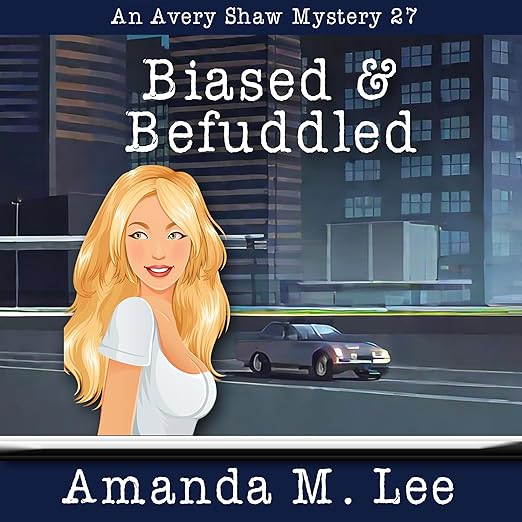
- Performance: Angel Clark is a natural fit for the Avery Shaw series, delivering the character's snark and warmth with a consistency that long-time series listeners will appreciate.
- What it covers: small-town investigative journalism, social media as both tool and threat, political accountability
- Feel: Light and comedic with genuine stakes underneath, breezy without being empty
- Our call: A strong late-series entry that integrates a contemporary social media subplot with a local murder investigation in ways that feel timely without feeling forced.
I tend to approach long-running series in the cozy mystery genre with a specific kind of cautious optimism. By the time a series reaches its twenty-seventh entry, as the Avery Shaw mysteries have with Biased and Befuddled, you know what you are getting: familiar characters in a familiar setting, a new crime to investigate, and a resolution that restores order without unsettling the series' fundamentals. The question at that volume count is not whether the formula works but whether the author is still finding ways to make it feel fresh. Amanda M. Lee is, at least here.
The case at the center of this volume involves Nick Butterfield, a local fixture in Macomb County who is known to almost everyone for riding his bicycle in all weather and making an impression at intersections through a combination of aggressive cycling and explicit hand gestures directed at passing motorists. When Nick turns up dead, Avery initially assumes it was a traffic accident. The deputy on scene lets slip a detail that changes the picture: Nick was shot as well as struck. The question of who would want to kill a homeless man who annoyed people without quite rising to the level of mortal enemy is the mystery's engine, and Lee wrings genuine intrigue from what is, on the surface, an unlikely victim.
Dating App Drama Gives the Book Its Title
The secondary plotline involving the Are We Dating the Same Guy social media pages is what gives this installment its contemporary texture. Avery discovers the page and becomes absorbed in it, which then collides with her investigation when she starts poking at local politicians whose names appear on the social media threads. The convergence of the two storylines is where the book earns its title: Avery's biases about who is worth investigating and her befuddlement about the social media world both get tested as the story develops.
One reviewer flagged that the collision of these two plotlines felt slightly contrived at the moment when the villains' motivations required explanation from Avery herself. That is a fair observation. The narrative mechanics are visible at that juncture in a way they are not for most of the book. But Lee lands the resolution, and the reviewer acknowledged as much, so the slight awkwardness is an acceptable price for an otherwise well-paced installment.
Avery and Eliot Still Feel Like Partners
By volume twenty-seven, a recurring couple either feels utterly convincing as a partnership or has calcified into repetition. Avery and Eliot manage the former here, partly because Lee continues to give each of them distinct things to do. Avery still wants to win, still wants to help people she perceives as needing it, and still generates friction with her editor Tad that several reviewers have found consistently entertaining. Eliot supports her adventures while occasionally dreading the inevitable complications. One reviewer noted specifically appreciating that the characters continue to grow and change as the series goes on, which is the right ambition for a series of this length, and one that many serial writers fail to sustain.
Tad is used well in this volume as a counterpoint to Avery's instincts. The running tension between a journalist and her editor, between the impulse to follow a story and institutional caution about where that story might lead, is one of the series' more quietly interesting dynamics. The political thread in this volume, which connects the social media investigation to local officials and their private behavior, gives that tension new material to work with.
Angel Clark Has Found Avery's Exact Register
Angel Clark narrates the Avery Shaw series with a consistency that rewards listeners who have been with the series across multiple volumes. She has found Avery's register, that particular combination of confident snark and genuine emotional investment in outcomes, and delivers it without the kind of performance choices that would call attention to themselves at the expense of the story. For a nine-hour-and-forty-seven-minute installment of what is now a very long series, that reliability matters. There is something genuinely pleasurable about returning to a voice you know well for a new story, the same quality that makes returning to a long-running podcast host feel different from encountering a new one.
The Macomb County setting is written with enough granularity that it functions as a character in its own right, with its own political texture and social dynamics. Lee writes local in the best sense: the place feels like somewhere, not just a backdrop for a procedural plot.
The humor in this volume is also worth addressing specifically, since cozy mystery humor is a distinct skill that not all writers in the genre possess. Lee has a facility for comic timing that shows up in Avery's internal monologue, in her exchanges with Tad, and in the way the social media investigation keeps producing moments of escalating absurdity as Avery goes deeper into territory she was not expecting. The Are We Dating the Same Guy pages as a narrative device work partly because Lee commits to the comedy of someone deeply competent in her own domain encountering a subculture she knows nothing about, without making Avery seem incompetent in the process. That balance is tricky to maintain, and the book manages it.
Twenty-Seven Volumes In, Veterans Get the Most
Series veterans will find this one of the stronger recent installments, with the social media subplot adding contemporary flavor without displacing the characteristics that have made the series worth following for twenty-seven volumes. New listeners are better served by starting earlier in the series, not because this volume fails to provide context but because the character relationships have accumulated enough history that starting here means missing the foundation of what makes those dynamics work. If you are looking for a cozy mystery series to begin at the beginning, this is a strong argument for starting with book one.